## Heatmap: Heads Importance for Different Tasks
### Overview
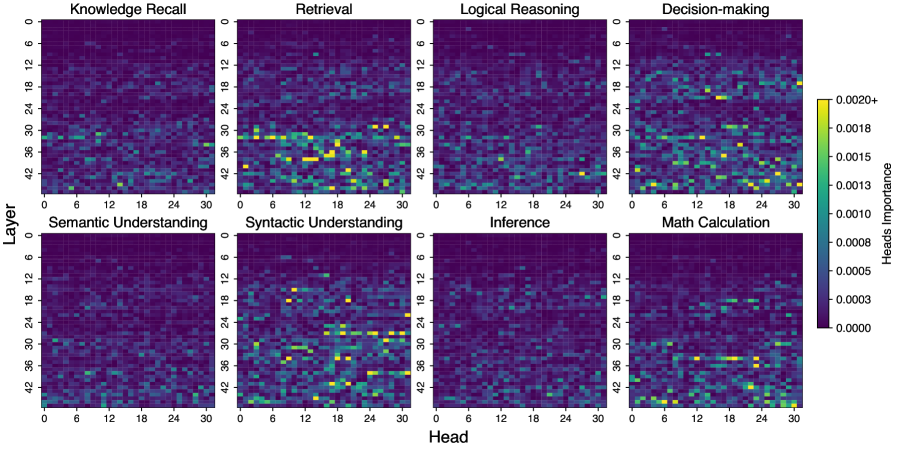
The image presents a series of heatmaps visualizing the importance of different "heads" across various layers for different tasks. Each heatmap represents a specific task, with the x-axis indicating the "Head" and the y-axis indicating the "Layer." The color intensity represents the "Heads Importance," ranging from dark purple (0.0000) to bright yellow (0.0020+).
### Components/Axes
* **X-axis:** "Head" - Ranges from 0 to 30 in increments of 6.
* **Y-axis:** "Layer" - Ranges from 0 to 42 in increments of 6.
* **Heatmaps:** Eight heatmaps, each representing a different task.
* **Color Scale (Heads Importance):** Located on the right side of the image.
* Dark Purple: 0.0000
* Purple: 0.0003
* Blue: 0.0005
* Green: 0.0008
* Light Green: 0.0010
* Yellow-Green: 0.0013
* Yellow: 0.0015
* Bright Yellow: 0.0018
* Very Bright Yellow: 0.0020+
* **Task Labels:**
* Top Row (left to right): Knowledge Recall, Retrieval, Logical Reasoning, Decision-making
* Bottom Row (left to right): Semantic Understanding, Syntactic Understanding, Inference, Math Calculation
### Detailed Analysis
**1. Knowledge Recall:**
* The heatmap is mostly dark purple, indicating low importance across most heads and layers.
* Slightly higher importance (blue to green) is observed in the lower layers (30-42) and some heads (around 12-18).
**2. Retrieval:**
* Higher importance is concentrated in the lower layers (30-42).
* Several heads (around 6-18) in these lower layers show significant importance (yellow).
**3. Logical Reasoning:**
* The heatmap is predominantly dark purple, indicating low importance across most heads and layers.
* A few scattered points of slightly higher importance (blue to green) are visible.
**4. Decision-making:**
* Similar to Logical Reasoning, the heatmap is mostly dark purple.
* A few scattered points of slightly higher importance (blue to green) are visible, particularly around layer 36.
**5. Semantic Understanding:**
* Higher importance is observed in the lower layers (30-42).
* Several heads (around 12-24) in these lower layers show significant importance (yellow).
**6. Syntactic Understanding:**
* Higher importance is concentrated in the lower layers (30-42).
* Several heads (around 6-18) in these lower layers show significant importance (yellow).
**7. Inference:**
* The heatmap is predominantly dark purple, indicating low importance across most heads and layers.
* A few scattered points of slightly higher importance (blue to green) are visible.
**8. Math Calculation:**
* The heatmap is predominantly dark purple, indicating low importance across most heads and layers.
* A few scattered points of slightly higher importance (blue to green) are visible, particularly in the lower layers.
### Key Observations
* Tasks like Retrieval, Semantic Understanding, and Syntactic Understanding show a concentration of high importance in the lower layers (30-42).
* Tasks like Logical Reasoning, Decision-making, Inference, and Math Calculation show generally low importance across all layers and heads.
* Knowledge Recall shows a slightly higher importance in the lower layers compared to Logical Reasoning, Decision-making, Inference, and Math Calculation.
### Interpretation
The heatmaps suggest that for tasks like Retrieval, Semantic Understanding, and Syntactic Understanding, the lower layers of the model are more critical. This could indicate that these tasks rely more on lower-level features or representations learned in the earlier layers. Conversely, tasks like Logical Reasoning, Decision-making, Inference, and Math Calculation may rely on a more distributed set of features across all layers, or potentially on different architectures altogether, resulting in lower importance scores for individual heads. The concentration of importance in specific heads for certain tasks suggests that those heads are specialized in extracting relevant information for those tasks. The data suggests that different tasks rely on different aspects of the model's architecture, with some tasks being more dependent on lower-level features and specific heads than others.