## Diagram: Vector Representations and Relations
### Overview
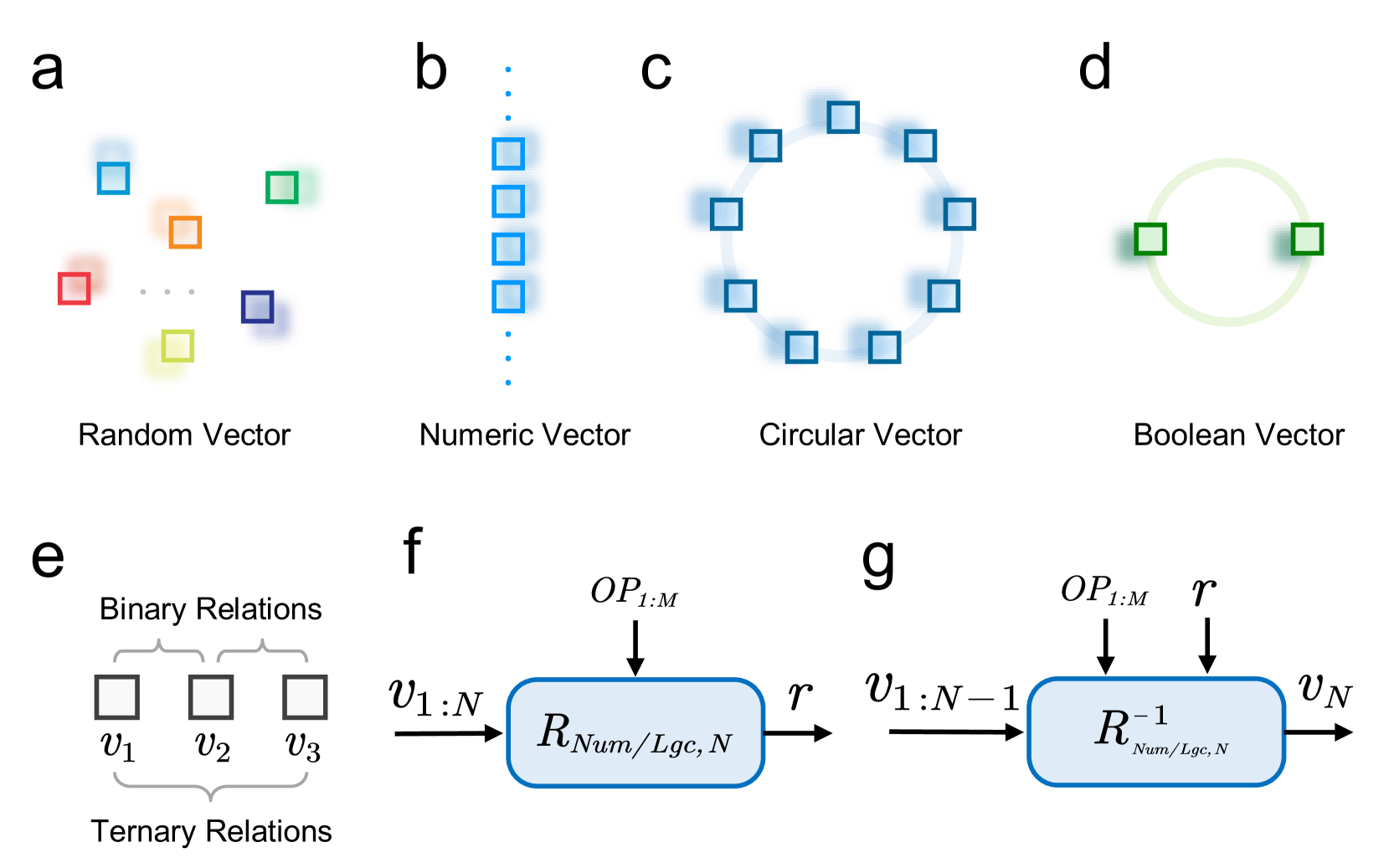
The image presents a series of diagrams illustrating different types of vector representations (random, numeric, circular, boolean) and their relationship to binary and ternary relations. The diagrams are labeled a through g, and utilize simple geometric shapes (squares, circles) to represent vectors and relationships.
### Components/Axes
The image consists of seven distinct diagrams, each with a descriptive label below it:
* **a:** Random Vector
* **b:** Numeric Vector
* **c:** Circular Vector
* **d:** Boolean Vector
* **e:** Binary Relations / Ternary Relations
* **f:** Diagram showing a vector `v1:N` input to a relation `RNum/Lgc,N` and output `r`.
* **g:** Diagram showing a vector `v1:N-1` input to a relation `R-1Num/Lgc,N` and output `r` and `vN`.
Diagrams f and g include mathematical notation:
* `v1:N` represents a vector of size N.
* `RNum/Lgc,N` represents a relation with numerical and logical components, operating on vectors of size N.
* `O1:M` represents an operation.
* `r` represents an output or result.
### Detailed Analysis or Content Details
**a: Random Vector**
This diagram shows approximately 10 square shapes of varying colors (red, orange, blue, purple, green, pink) scattered seemingly randomly across a plane. The shapes are of roughly equal size.
**b: Numeric Vector**
This diagram depicts approximately 10 vertically aligned square shapes. The squares are gray and appear to be evenly spaced. The arrangement suggests an ordered, numeric representation.
**c: Circular Vector**
This diagram shows approximately 12 square shapes arranged in a roughly circular pattern. The squares are light blue and are distributed around a central point.
**d: Boolean Vector**
This diagram shows two green square shapes enclosed within a light gray circle. This suggests a binary or boolean representation, where the shapes inside the circle represent "true" and those outside represent "false".
**e: Binary/Ternary Relations**
This diagram illustrates binary and ternary relations using three square shapes labeled `v1`, `v2`, and `v3`. The squares are connected by lines, representing relationships between them. The label "Binary Relations" is above the squares, and "Ternary Relations" is below.
**f: Relation Diagram 1**
A rectangular box labeled `RNum/Lgc,N` receives an input vector `v1:N` (represented by an arrow pointing into the box). An output `r` is shown as an arrow exiting the box. Above the box is an arrow labeled `O1:M`.
**g: Relation Diagram 2**
A rectangular box labeled `R-1Num/Lgc,N` receives an input vector `v1:N-1` (represented by an arrow pointing into the box). Two outputs are shown as arrows exiting the box: `r` and `vN`. Above the box is an arrow labeled `O1:M`.
### Key Observations
* The diagrams a-d demonstrate different ways to represent vectors, ranging from random distributions to ordered numeric sequences and circular arrangements.
* Diagrams e-g illustrate how these vectors can be used in relational operations.
* The notation in diagrams f and g suggests a mathematical framework for defining and manipulating relations between vectors.
* The diagrams f and g are very similar, with the only difference being the input vector size and the addition of an output `vN` in diagram g.
### Interpretation
The image appears to be a conceptual illustration of how vectors can be used to represent data and how relations can be defined and applied to these vectors. The different vector representations (a-d) suggest that the choice of representation depends on the nature of the data being modeled. The relation diagrams (f-g) demonstrate how these vectors can be processed to produce outputs based on defined rules or operations. The mathematical notation suggests a formal, potentially computational, approach to defining and manipulating these relations. The difference between diagrams f and g could represent a recursive or iterative process, where the output `vN` is fed back into the relation for further processing. The image is likely intended for an audience familiar with basic vector algebra and relational concepts, possibly in the context of machine learning, data analysis, or knowledge representation.