## Diagram: Vector Types and Relational Operations
### Overview
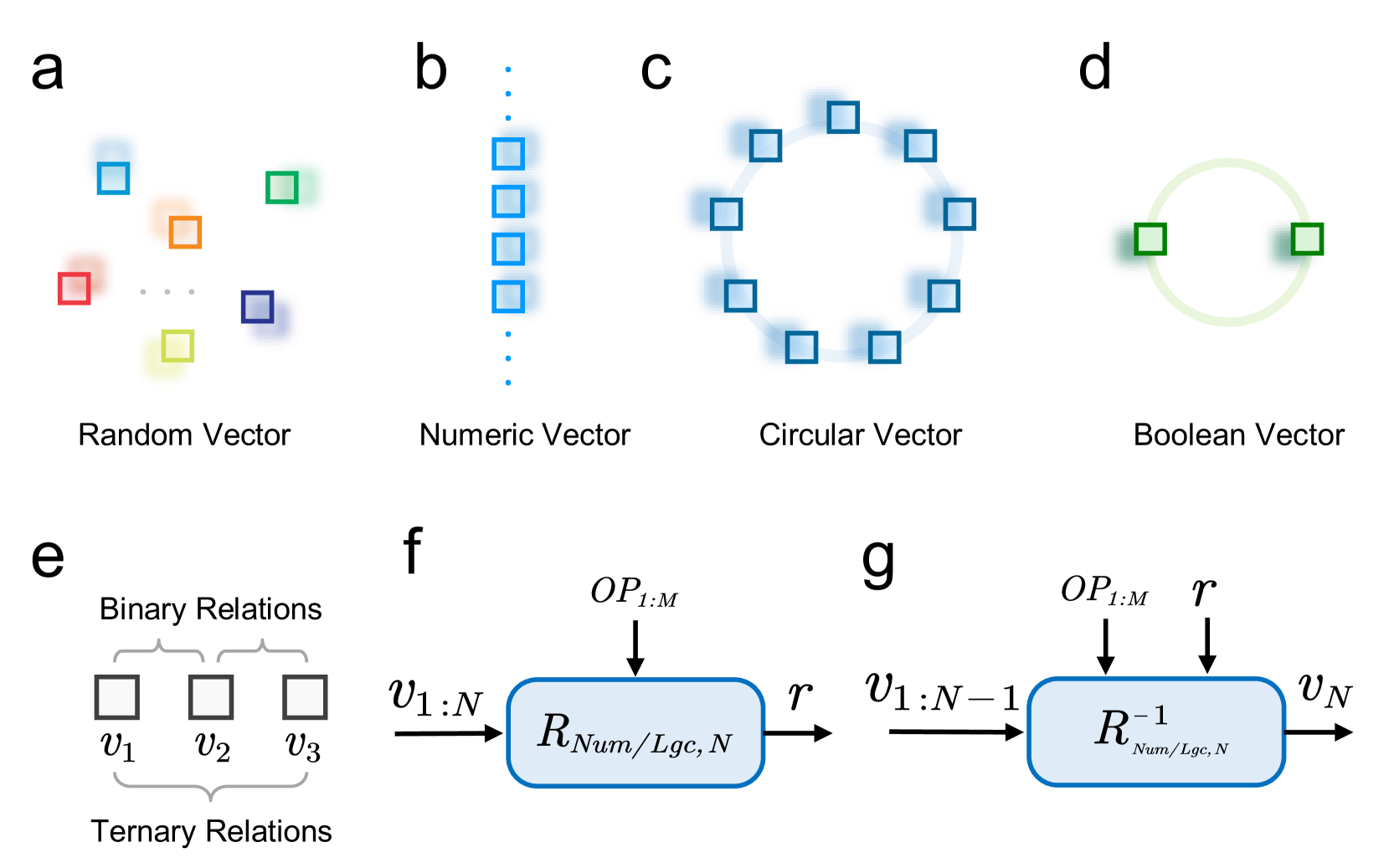
The image presents a technical diagram categorizing four vector types (Random, Numeric, Circular, Boolean) and two relational operation systems (Binary/Ternary Relations and Numerical/Logical Transformations). Visual elements include colored squares, directional arrows, and mathematical notation.
### Components/Axes
**Top Row (Vector Types):**
- **a. Random Vector**: Six colored squares (red, blue, green, orange, yellow, purple) with varying opacity, arranged asymmetrically.
- **b. Numeric Vector**: Six blue squares aligned vertically with three dots above and below.
- **c. Circular Vector**: Eight blue squares arranged in a perfect circle with a faint circular outline.
- **d. Boolean Vector**: Two green squares connected by a light green circular outline.
**Bottom Row (Relational Systems):**
- **e. Binary/Ternary Relations**: Three gray squares labeled *v₁, v₂, v₃* with bidirectional arrows indicating relations.
- **f. Numerical Transformation**:
- Left: *v₁:N* → Middle: *R<sub>Num/Lgc,N</sub>* → Right: *r*
- Arrows labeled *OP₁:M* above input/output.
- **g. Logical Transformation**:
- Left: *v₁:N-1* → Middle: *R⁻¹<sub>Num/Lgc,N</sub>* → Right: *v_N*
- Arrows labeled *OP₁:M* and *r*.
### Detailed Analysis
**Vector Types (a-d):**
- **Random Vector (a)**: Colors distributed without pattern; red (top-left), blue (top-right), green (top-center), orange (center), yellow (bottom-center), purple (bottom-right).
- **Numeric Vector (b)**: Uniform blue squares with implied numerical ordering via vertical alignment.
- **Circular Vector (c)**: Equidistant blue squares forming a closed loop.
- **Boolean Vector (d)**: Symmetrical green squares with connecting outline suggesting logical equivalence.
**Relational Systems (e-g):**
- **Binary/Ternary Relations (e)**:
- *v₁* ↔ *v₂* (bidirectional arrow)
- *v₂* ↔ *v₃* (bidirectional arrow)
- *v₁* ↔ *v₃* (dashed arrow, implied ternary relation).
- **Numerical Transformation (f)**:
- Input: *v₁:N* (vector of length N)
- Process: *R<sub>Num/Lgc,N</sub>* (matrix operation)
- Output: *r* (scalar result).
- **Logical Transformation (g)**:
- Input: *v₁:N-1* (vector of length N-1)
- Process: *R⁻¹<sub>Num/Lgc,N</sub>* (inverse matrix operation)
- Output: *v_N* (single value).
### Key Observations
1. **Vector Symmetry**:
- Circular Vector (c) shows perfect radial symmetry.
- Boolean Vector (d) exhibits bilateral symmetry.
2. **Color Coding**:
- Random Vector (a) uses distinct colors for each element.
- Numeric/Circular Vectors (b,c) use uniform blue.
3. **Arrow Directionality**:
- Binary relations (e) use bidirectional arrows.
- Transformations (f,g) use unidirectional flow.
4. **Mathematical Notation**:
- *R<sub>Num/Lgc,N</sub>* and its inverse *R⁻¹<sub>Num/Lgc,N</sub>* suggest linear algebra operations.
- *OP₁:M* likely denotes a 1-to-M mapping function.
### Interpretation
This diagram illustrates a framework for vector classification and transformation in computational systems:
1. **Vector Representation**:
- Random vectors (a) model unstructured data.
- Numeric (b) and Circular (c) vectors represent ordered/structured data.
- Boolean (d) vectors encode binary states.
2. **Relational Operations**:
- Binary/ternary relations (e) define interactions between vector elements.
- Numerical transformation (f) reduces vectors to scalars via matrix operations.
- Logical transformation (g) reconstructs vectors through inverse operations, implying error correction or data compression.
3. **System Integration**:
- The *OP₁:M* notation suggests these operations handle variable-length inputs/outputs.
- The inverse matrix *R⁻¹* in (g) implies reversibility, critical for lossless transformations.
**Notable Anomalies**:
- The Random Vector (a) lacks a clear pattern, contrasting with the structured Numeric/Circular Vectors.
- The Boolean Vector (d) uses green exclusively, while other vectors use blue or mixed colors.
This framework likely applies to machine learning (vector embeddings) or database systems (relational algebra), emphasizing structured data manipulation through linear transformations.