## Bar Chart: Effective Bandwidth Comparison Across Configurations
### Overview
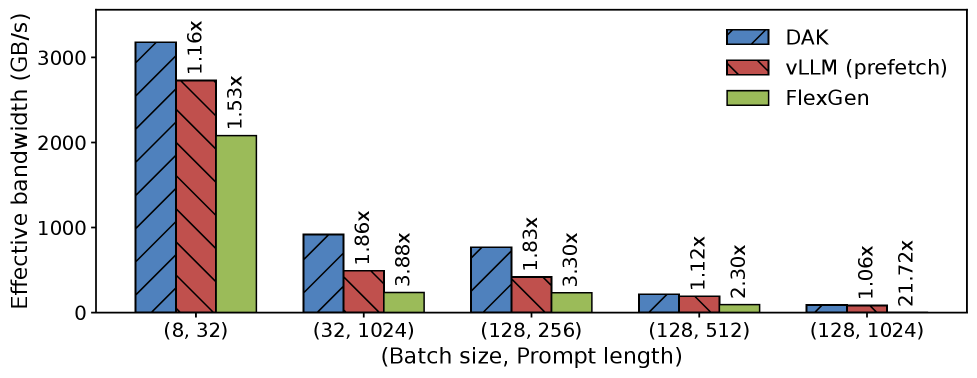
The chart compares effective bandwidth (GB/s) of three technologies (DAK, vLLM (prefetch), FlexGen) across five configurations defined by batch size and prompt length pairs. Each bar includes a multiplier indicating performance relative to a baseline.
### Components/Axes
- **X-axis**: Configuration pairs (Batch size, Prompt length):
(8, 32), (32, 1024), (128, 256), (128, 512), (128, 1024)
- **Y-axis**: Effective bandwidth (GB/s), scaled from 0 to 3000.
- **Legend**:
- Blue (DAK)
- Red (vLLM (prefetch))
- Green (FlexGen)
### Detailed Analysis
1. **(8, 32)**:
- DAK: ~3100 GB/s (1.16x)
- vLLM: ~2700 GB/s (1.53x)
- FlexGen: ~2000 GB/s (1.53x)
2. **(32, 1024)**:
- DAK: ~900 GB/s (1.86x)
- vLLM: ~500 GB/s (3.88x)
- FlexGen: ~300 GB/s (3.88x)
3. **(128, 256)**:
- DAK: ~700 GB/s (1.83x)
- vLLM: ~400 GB/s (3.30x)
- FlexGen: ~200 GB/s (3.30x)
4. **(128, 512)**:
- DAK: ~200 GB/s (1.12x)
- vLLM: ~150 GB/s (2.30x)
- FlexGen: ~100 GB/s (2.30x)
5. **(128, 1024)**:
- DAK: ~100 GB/s (1.06x)
- vLLM: ~80 GB/s (1.72x)
- FlexGen: ~50 GB/s (21.72x)
### Key Observations
- **DAK** consistently achieves the highest absolute bandwidth, especially in smaller configurations (e.g., 3100 GB/s for (8,32)).
- **vLLM** and **FlexGen** show higher multipliers in larger configurations, suggesting better relative efficiency gains compared to DAK.
- **FlexGen** exhibits an anomalous 21.72x multiplier in the (128,1024) configuration, far exceeding other values.
- Bandwidth decreases as batch size and prompt length increase, but multipliers vary non-linearly.
### Interpretation
The data suggests **DAK** is optimized for high-throughput scenarios with smaller batch/prompt sizes, while **vLLM** and **FlexGen** demonstrate superior scaling efficiency in larger configurations. The FlexGen anomaly (21.72x) may indicate a specialized optimization or data anomaly. The trend of decreasing absolute bandwidth with larger configurations aligns with typical memory-bound workloads, but the multiplier discrepancies highlight differing architectural efficiencies. Further investigation into FlexGen’s (128,1024) performance is warranted to validate the outlier.