\n
## Diagram: Responsibility Approach
### Overview
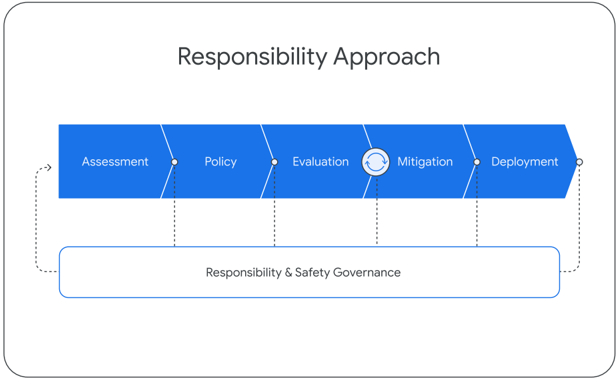
The image depicts a linear, cyclical diagram illustrating a "Responsibility Approach". It outlines a five-stage process: Assessment, Policy, Evaluation, Mitigation, and Deployment, all underpinned by "Responsibility & Safety Governance". The diagram uses a horizontal, flowing blue bar with circular markers to represent each stage. Dashed arrows indicate a cyclical flow, returning from Deployment to Assessment.
### Components/Axes
* **Title:** "Responsibility Approach" (Top-center)
* **Stages:** Assessment, Policy, Evaluation, Mitigation, Deployment (Horizontally aligned within the blue bar)
* **Underlying Framework:** "Responsibility & Safety Governance" (Below the blue bar)
* **Flow Indicators:** Dashed arrows indicating cyclical progression.
* **Stage Markers:** Small white circles within the blue bar, each labeled with a stage name.
### Detailed Analysis or Content Details
The diagram presents a sequential process with a feedback loop.
1. **Assessment:** The first stage, marked by a solid circle.
2. **Policy:** The second stage, marked by a solid circle.
3. **Evaluation:** The third stage, marked by a circle with a lighter blue fill and a white circular highlight.
4. **Mitigation:** The fourth stage, marked by a solid circle.
5. **Deployment:** The fifth stage, marked by a solid circle.
The dashed arrows indicate that after Deployment, the process loops back to Assessment, suggesting continuous improvement and re-evaluation. The "Responsibility & Safety Governance" framework is positioned as the foundation supporting the entire process.
### Key Observations
The diagram emphasizes a continuous cycle of responsibility and safety. The highlighted "Evaluation" stage suggests it is a critical point in the process, potentially involving review or decision-making. The cyclical nature implies an iterative approach to risk management and responsible development.
### Interpretation
This diagram illustrates a structured approach to responsible development or implementation, likely within a technological or organizational context. The five stages represent a logical progression from initial assessment to final deployment, with ongoing evaluation and mitigation to ensure safety and responsible practices. The "Responsibility & Safety Governance" framework underscores the importance of a foundational commitment to these principles. The cyclical nature suggests a commitment to continuous improvement and adaptation based on ongoing evaluation. The diagram doesn't provide specific data or metrics, but rather a conceptual model for a process. It's a high-level overview, intended to communicate the core principles of a responsible approach.