## Diagram: Responsibility Approach Process Flow
### Overview
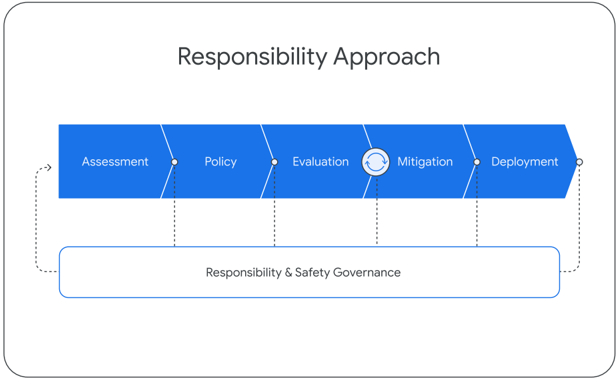
The image displays a process flow diagram titled "Responsibility Approach." It illustrates a sequential, five-stage workflow underpinned by a continuous governance framework. The design uses a clean, corporate style with blue arrow-shaped stages and a white governance box, connected by dotted lines to indicate oversight and feedback.
### Components/Axes
* **Title:** "Responsibility Approach" (centered at the top).
* **Main Process Flow:** A horizontal sequence of five blue, arrow-shaped boxes pointing from left to right, indicating a forward progression.
* **Stage 1:** "Assessment"
* **Stage 2:** "Policy"
* **Stage 3:** "Evaluation"
* **Stage 4:** "Mitigation"
* **Stage 5:** "Deployment"
* **Iterative Element:** A circular arrow icon is positioned between the "Evaluation" and "Mitigation" stages, indicating a potential feedback loop or iterative cycle between these two phases.
* **Governance Framework:** A single, wide, white rectangular box with a blue border is positioned below the main process flow. It is labeled "Responsibility & Safety Governance."
* **Connections:** Dotted lines extend vertically from the bottom of each of the five blue stage boxes down to the top of the "Responsibility & Safety Governance" box. A dotted line also connects from the left side of the "Assessment" box down and around to the left side of the governance box, and similarly from the right side of the "Deployment" box down and around to the right side of the governance box, creating a visual enclosure.
### Detailed Analysis
The diagram presents a linear, stage-gated process for implementing a "Responsibility Approach." The flow is strictly left-to-right:
1. **Assessment** → 2. **Policy** → 3. **Evaluation** → 4. **Mitigation** → 5. **Deployment**.
The key non-linear element is the circular arrow between **Evaluation** and **Mitigation**. This suggests that after evaluation, the process may loop back to mitigation for refinement before proceeding to deployment, or that mitigation strategies are continuously re-evaluated.
The "Responsibility & Safety Governance" component is not a stage but a foundational layer. The dotted lines connecting every stage to this box indicate that governance is an ongoing, parallel activity that informs and oversees each step of the process. The outer dotted lines connecting the first and last stages to the governance box further emphasize that this framework encompasses the entire lifecycle, from beginning to end.
### Key Observations
* **Process Structure:** The core workflow is linear and sequential, suggesting a formal, step-by-step methodology.
* **Iterative Loop:** The only break in linearity is the explicit loop between Evaluation and Mitigation, highlighting this as a critical point for review and adjustment.
* **Governance Integration:** Governance is depicted as a constant, underlying support structure rather than a discrete step. This implies that responsibility and safety are not afterthoughts but are integrated into every phase.
* **Visual Hierarchy:** The blue stages are the primary visual focus, with the governance box serving as a supporting base. The title clearly frames the entire diagram's purpose.
### Interpretation
This diagram outlines a systematic framework for embedding responsibility and safety into a project or product lifecycle, likely in a technical, corporate, or policy context. The process begins with **Assessment** (understanding risks/needs), leads to **Policy** (creating rules/guidelines), then to **Evaluation** (testing against policies), followed by **Mitigation** (addressing identified issues), and culminates in **Deployment**.
The critical insight is the **Evaluation-Mitigation loop**. This signifies that the approach is not merely a checklist but a dynamic process where findings from evaluation directly inform mitigation strategies, which may then require re-evaluation. This creates a cycle of continuous improvement before final deployment.
The overarching **"Responsibility & Safety Governance"** layer acts as the system's conscience and control mechanism. It ensures that each stage adheres to established principles, providing oversight, accountability, and a consistent framework. The diagram argues that true responsibility is achieved not just through a sequence of actions, but through the persistent application of governance throughout that sequence. It visually advocates for "shifting left" – integrating safety and responsibility from the very first assessment stage rather than bolting it on at the end.