\n
## Heatmap: Token Activation Across Neural Network Layers
### Overview
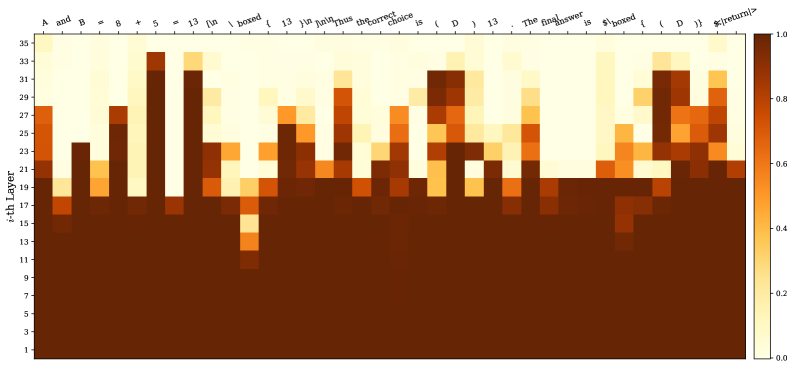
The image is a heatmap visualization depicting the activation intensity (likely attention weights or neuron activations) of individual tokens from a mathematical expression across the 35 layers of a neural network model. The visualization uses a color gradient to represent numerical values, with darker colors indicating higher values.
### Components/Axes
* **Chart Type:** Heatmap.
* **X-Axis (Horizontal):** Represents a sequence of tokens from a mathematical statement. The tokens are, from left to right:
`A`, `and`, `B`, `=`, `8`, `+`, `5`, `=`, `13`, `\boxed{`, `13`, `yin`, `yin`, `the`, `correct`, `choice`, `is`, `(`, `D`, `)`, `13`, `.`, `The`, `final`, `answer`, `is`, `\boxed{`, `(`, `D`, `)`, `}`, `\text{final}`.
* **Language Note:** The tokens include English words (`and`, `the`, `correct`, `choice`, `is`, `final`, `answer`), mathematical symbols (`=`, `+`, `(`, `)`), numbers (`8`, `5`, `13`), LaTeX commands (`\boxed`, `\text`), and what appear to be model-specific or tokenized representations (`yin`, `yin`).
* **Y-Axis (Vertical):** Labeled "i-th Layer". It is a linear scale representing the layer number in the neural network, ranging from 1 at the bottom to 35 at the top, with major tick marks every 2 layers (1, 3, 5, ..., 35).
* **Color Scale/Legend:** Located on the far right of the chart. It is a vertical bar showing a gradient from light yellow/cream at the bottom (labeled `0.0`) to dark brown at the top (labeled `1.0`). Intermediate labels are `0.2`, `0.4`, `0.6`, `0.8`. This scale maps the color of each cell in the heatmap to a numerical value between 0 and 1.
### Detailed Analysis
* **Spatial Layout:** The heatmap is a grid where each column corresponds to a token on the x-axis and each row corresponds to a layer on the y-axis. The color of each cell indicates the activation value for that token at that layer.
* **Data Trend & Value Extraction:**
* **General Trend:** Activation values are highest (dark brown, ~0.8-1.0) in the lowest layers (approximately layers 1-15) across nearly all tokens. This forms a solid dark band at the bottom of the chart.
* **Layer-Specific Patterns:**
* **Layers 1-15:** Almost uniformly high activation (dark brown) for all tokens. Values are consistently near 1.0.
* **Layers 16-20:** Activation begins to分化 (differentiate). Some tokens retain high values (e.g., `A`, `B`, `=`, `8`, `+`, `5`, `=`, `13`), while others drop to medium (orange, ~0.4-0.6) or low (light yellow, ~0.0-0.2) values.
* **Layers 21-35:** Activation becomes highly token-specific. A pattern of "spikes" of high activation appears for certain tokens at specific higher layers.
* **Token-Specific High-Activation Points (Approximate):**
* `A`: High activation persists up to ~Layer 27.
* `and`: Notable high activation spike at ~Layer 23.
* `B`: High activation persists up to ~Layer 29.
* `=` (first): High activation spike at ~Layer 33.
* `8`: High activation spike at ~Layer 27.
* `+`: High activation spike at ~Layer 25.
* `5`: High activation spike at ~Layer 33.
* `=` (second): High activation spike at ~Layer 29.
* `13` (first): High activation spike at ~Layer 25.
* `\boxed{`: High activation spike at ~Layer 21.
* `13` (second): High activation spike at ~Layer 27.
* `yin` (both): Show medium-high activation (~0.6-0.8) in layers 25-31.
* `the`: High activation spike at ~Layer 29.
* `correct`: High activation spike at ~Layer 27.
* `choice`: High activation spike at ~Layer 25.
* `is` (first): High activation spike at ~Layer 23.
* `(`: High activation spike at ~Layer 31.
* `D`: Shows a distinct vertical band of medium-high activation from ~Layer 23 to Layer 31.
* `)` (first): High activation spike at ~Layer 31.
* `13` (third): High activation spike at ~Layer 29.
* `.`: High activation spike at ~Layer 25.
* `The`: High activation spike at ~Layer 23.
* `final`: High activation spike at ~Layer 25.
* `answer`: High activation spike at ~Layer 23.
* `is` (second): High activation spike at ~Layer 21.
* `\boxed{` (second): High activation spike at ~Layer 21.
* `(` (second): High activation spike at ~Layer 31.
* `D` (second): High activation spike at ~Layer 31.
* `)` (second): High activation spike at ~Layer 31.
* `}`: High activation spike at ~Layer 29.
* `\text{final}`: High activation spike at ~Layer 27.
### Key Observations
1. **Low-Layer Uniformity:** The foundational layers (1-15) show uniformly high activation for all tokens, suggesting these layers process basic, shared features of the input sequence.
2. **Mid-Layer Differentiation:** Around layers 16-20, the model begins to assign different importance levels to different tokens.
3. **High-Layer Specialization:** In the upper layers (21-35), activation is highly sparse and token-specific. Only a few tokens show high activation at any given layer, indicating specialized processing or decision-making at these depths.
4. **Key Token Highlighting:** Tokens crucial to the mathematical reasoning and final answer (`=`, `+`, numbers, `D`, parentheses, `\boxed`) show repeated high-activation spikes in the upper layers. The token `D` is particularly notable for having a sustained band of elevated activation.
5. **Structural Token Processing:** Syntactic or structural tokens like `\boxed{`, `(`, `)`, and `.` also show high activation in upper layers, indicating the model is attending to the format and structure of the answer.
### Interpretation
This heatmap likely visualizes the **attention pattern** or **activation strength** of a transformer-based language model solving a math word problem. The sequence of tokens represents the problem statement and the model's generated solution chain-of-thought leading to the final answer `\boxed{(D)}`.
* **What the data suggests:** The model's processing follows a clear hierarchical pattern. Early layers handle universal token representation. Mid-layers begin parsing the problem's structure. Upper layers perform highly focused, token-specific computation, repeatedly "attending to" or "activating on" the key numerical values (`8`, `5`, `13`), operators (`+`, `=`), and the final answer choice (`D`) to verify and construct the solution.
* **How elements relate:** The x-axis sequence tells a story: from defining variables (`A and B = 8 + 5 = 13`), to stating the task (`the correct choice is (D) 13`), to formatting the final answer (`The final answer is \boxed{(D)}`). The y-axis shows *when* (at what processing depth) each part of this story is most important. The color intensity shows *how important* it is.
* **Notable Patterns/Anomalies:**
* The token `D` has a unique, sustained activation profile, suggesting it is a critical pivot point in the model's reasoning.
* The repetition of high activation for `\boxed{` and parentheses in the final layers indicates the model is strongly focused on producing the answer in the correct, boxed format.
* The tokens `yin yin` are anomalous; their medium-high activation in mid-upper layers is unexplained by the visible math problem and may be an artifact of tokenization, a model-internal token, or a misalignment in the visualization.