## Handwritten Digits with Associated Metrics
### Overview
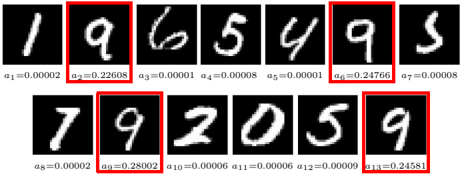
The image displays two rows of handwritten digits (0-9) on black backgrounds, each annotated with a numerical value labeled as "a₁" to "a₁₃". The digits are stylized and vary in stroke thickness, with some enclosed in red boxes. The numerical values range from 0.00001 to 0.28002, suggesting a quantitative metric tied to each digit.
### Components/Axes
- **Digits**: 13 handwritten numerals (1, 9, 6, 5, 4, 9, 5, 7, 9, 2, 0, 5, 9) arranged in two rows (top: 7 digits, bottom: 6 digits).
- **Metrics**: Each digit has a corresponding "a" value (e.g., "a₁=0.00002", "a₂=0.22608") displayed below it.
- **Annotations**: Red boxes highlight four digits: "9" (a₂), "9" (a₆), "9" (a₉), and "9" (a₁₃).
### Detailed Analysis
1. **Top Row**:
- **a₁=0.00002**: Digit "1" (no red box).
- **a₂=0.22608**: Digit "9" (red box).
- **a₃=0.00001**: Digit "6" (no red box).
- **a₄=0.00008**: Digit "5" (no red box).
- **a₅=0.00001**: Digit "4" (no red box).
- **a₆=0.24766**: Digit "9" (red box).
- **a₇=0.00008**: Digit "5" (no red box).
2. **Bottom Row**:
- **a₈=0.00002**: Digit "7" (no red box).
- **a₉=0.28002**: Digit "9" (red box).
- **a₁₀=0.00006**: Digit "2" (no red box).
- **a₁₁=0.00006**: Digit "0" (no red box).
- **a₁₂=0.00009**: Digit "5" (no red box).
- **a₁₃=0.24581**: Digit "9" (red box).
### Key Observations
- **High a-values**: Digits "9" (a₂, a₆, a₉, a₁₃) have significantly higher metrics (0.22608–0.28002) compared to others (≤0.00009).
- **Red Box Correlation**: All red-boxed digits are "9", suggesting a potential relationship between the digit "9" and elevated a-values.
- **Low a-values**: Most digits (1, 6, 5, 4, 7, 2, 0, 5) have near-zero metrics, indicating a possible threshold for significance.
### Interpretation
The data likely represents a classification or confidence scoring system, where the digit "9" consistently achieves higher scores (a-values). The red boxes emphasize these outliers, implying "9" may be a focal point in the dataset. The stark contrast between high and low a-values suggests a binary or tiered categorization, possibly for error analysis, model performance evaluation, or feature weighting in a machine learning context. The repetition of "9" with high scores could indicate bias, overfitting, or a specific use case where "9" is prioritized.