## Heatmaps: Jailbreakbench ASR and Malicious Instruct ASR
### Overview
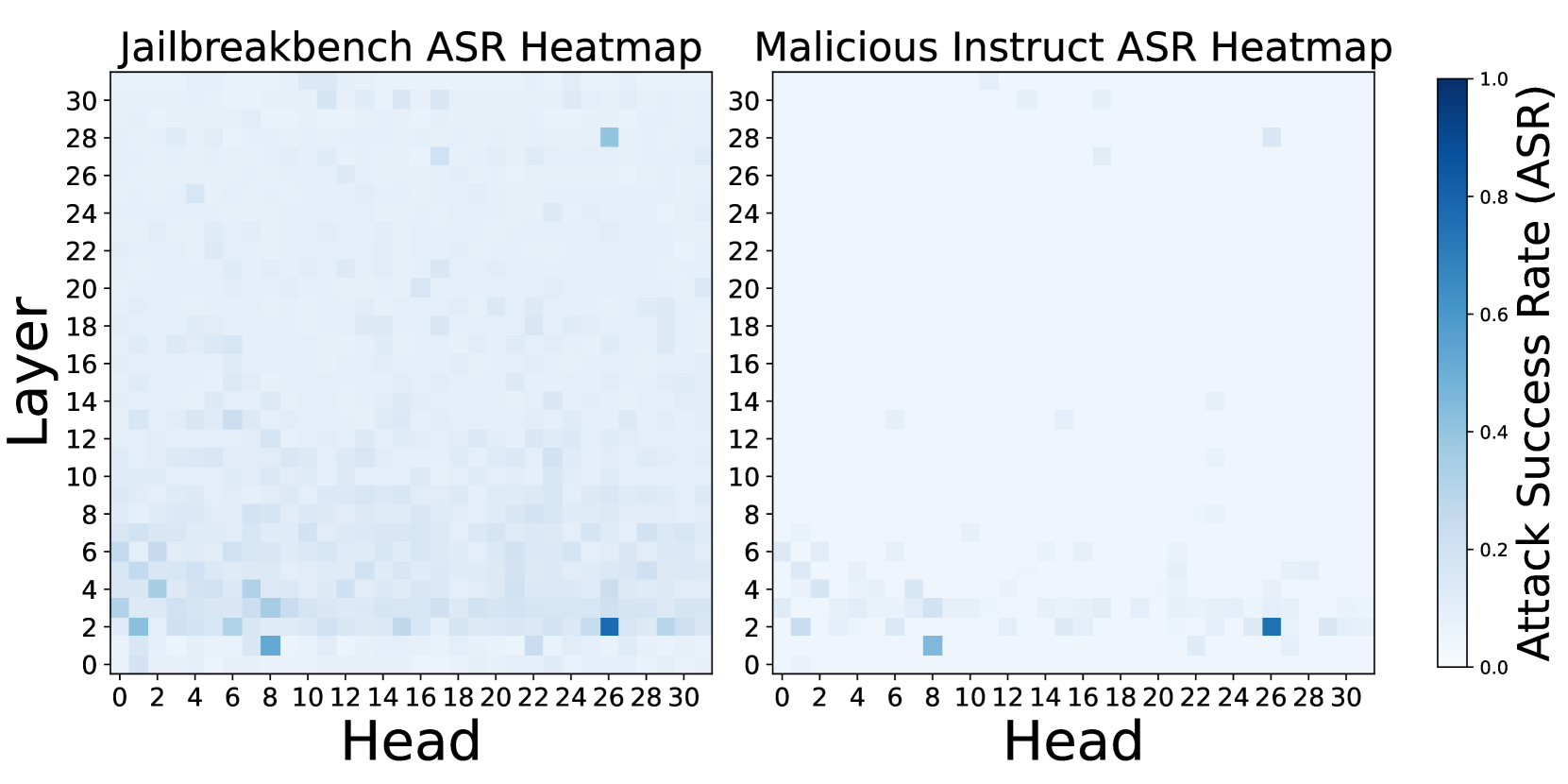
The image contains two side-by-side heatmaps comparing Attack Success Rate (ASR) distributions across model layers and attention heads for two attack types: "Jailbreakbench" and "Malicious Instruct." Both heatmaps use a light-to-dark blue gradient to represent ASR values from 0.0 to 1.0, with darker blue indicating higher success rates. The majority of the heatmaps are sparsely populated with dark blue squares, suggesting concentrated regions of vulnerability.
### Components/Axes
- **X-axis (Head)**: Ranges from 0 to 30, labeled "Head" for both heatmaps.
- **Y-axis (Layer)**: Ranges from 0 to 30, labeled "Layer" for both heatmaps.
- **Legend**: Positioned on the right, titled "Attack Success Rate (ASR)" with a gradient from white (0.0) to dark blue (1.0).
- **Titles**:
- Left heatmap: "Jailbreakbench ASR Heatmap"
- Right heatmap: "Malicious Instruct ASR Heatmap"
### Detailed Analysis
#### Jailbreakbench ASR Heatmap
- **Key Data Points**:
- Dark blue square at **Head 28, Layer 28** (brightest region).
- Dark blue square at **Head 26, Layer 2**.
- Dark blue square at **Head 2, Layer 2**.
- **Distribution**:
- High ASR values are concentrated in the top-right corner (Head 28, Layer 28) and lower-left regions (Heads 2–26, Layers 2).
- Remaining areas are uniformly light blue, indicating low ASR (<0.2).
#### Malicious Instruct ASR Heatmap
- **Key Data Points**:
- Dark blue square at **Head 26, Layer 26**.
- Dark blue square at **Head 2, Layer 2**.
- Dark blue square at **Head 28, Layer 28**.
- **Distribution**:
- High ASR values form a diagonal pattern from **Head 2, Layer 2** to **Head 28, Layer 28**.
- Other regions remain light blue, with no significant clustering outside the diagonal.
### Key Observations
1. **Sparse High-ASR Regions**: Both heatmaps show only 3–4 regions with high ASR, suggesting attacks exploit specific model components.
2. **Diagonal Pattern in Malicious Instruct**: The diagonal alignment of high-ASR regions in the Malicious Instruct heatmap implies a correlation between layer depth and head position for this attack type.
3. **Overlap in Vulnerabilities**: Both attack types share high-ASR regions at **Head 2, Layer 2**, indicating a shared weakness in early layers.
### Interpretation
The heatmaps reveal that both attack types target specific layers and attention heads, with Malicious Instruct showing a stronger diagonal correlation between layer depth and head position. The shared vulnerability at **Head 2, Layer 2** suggests this component is a critical failure point for multiple attack strategies. The diagonal pattern in Malicious Instruct may indicate that deeper layers (higher layer numbers) paired with corresponding heads amplify attack success, possibly due to increased model complexity or attention mechanisms in those regions. These findings highlight the need for targeted defenses in early layers and diagonal-aligned components for robust model security.