## Flowchart Diagram: Cookie Distribution System
### Overview
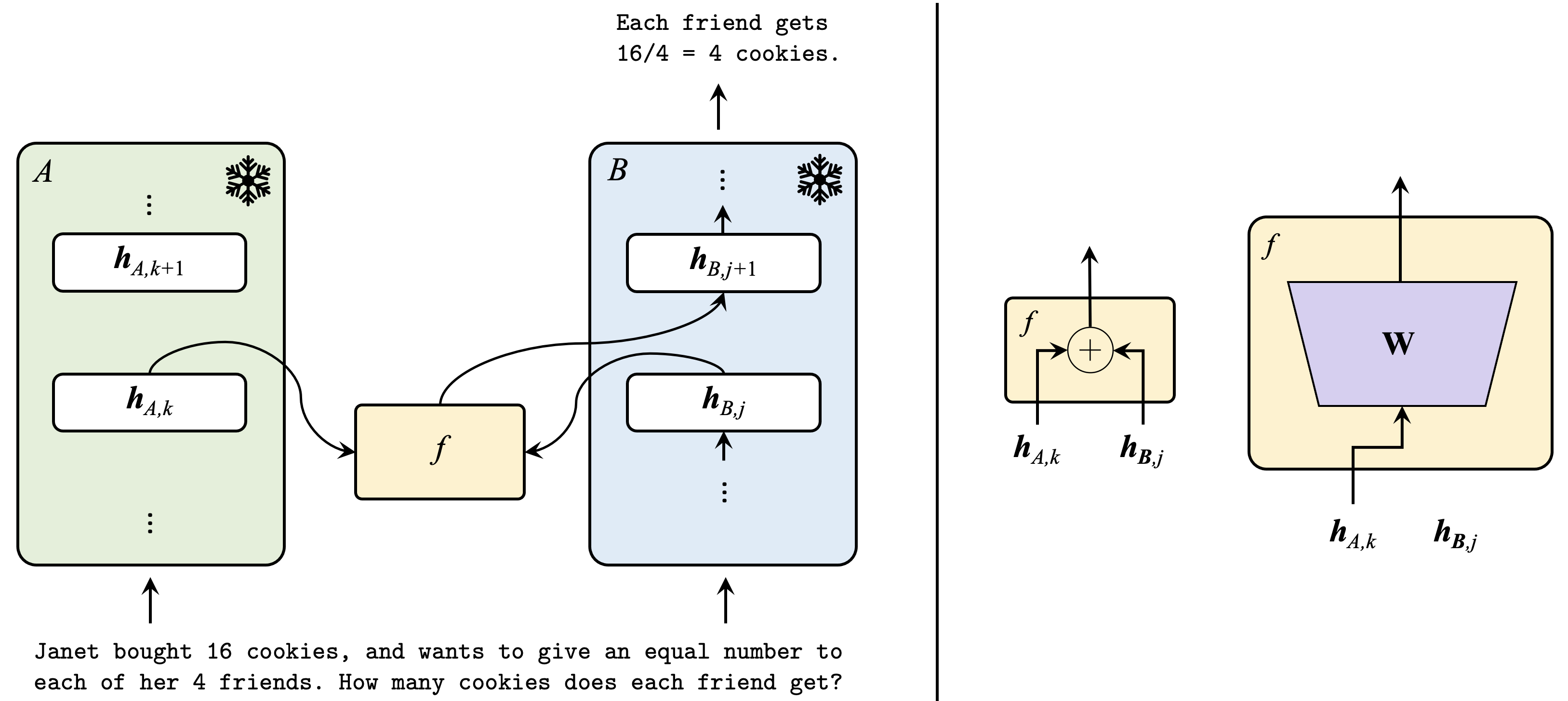
The image contains two interconnected diagrams and a word problem. The left diagram shows a system with two components (A and B) connected by a function f, while the right diagram simplifies this into a function f feeding into a component labeled W. The word problem describes distributing 16 cookies equally among 4 friends.
### Components/Axes
**Left Diagram:**
- **Box A (Green):** Contains hierarchical elements:
- `h_A,k` (bottom)
- `h_A,k+1` (top)
- Snowflake icon (top-right)
- **Box B (Blue):** Contains hierarchical elements:
- `h_B,j` (bottom)
- `h_B,j+1` (top)
- Snowflake icon (top-right)
- **Function f (Yellow):** Connects A and B with bidirectional arrows
- **Problem Text (Bottom):** "Janet bought 16 cookies... How many cookies does each friend get?"
**Right Diagram:**
- **Function f (Yellow):** Central element with bidirectional arrows
- **Component W (Purple Trapezoid):** Receives input from f
- **Input Elements:** `h_A,k` and `h_B,j` feeding into f
### Detailed Analysis
**Left Diagram Flow:**
1. Box A processes sequential elements (`h_A,k` → `h_A,k+1`)
2. Box B processes parallel elements (`h_B,j` → `h_B,j+1`)
3. Function f mediates between A and B with:
- Forward flow: A → f → B
- Feedback loop: B → f → A
4. Snowflake icons suggest variable parameters or stochastic elements
**Right Diagram Simplification:**
- Function f combines inputs from both A and B
- Component W represents the final output/result
- Arrows indicate directional flow from inputs to output
**Problem Context:**
- Mathematical operation: 16 cookies ÷ 4 friends = 4 cookies/friend
- Implied distribution mechanism matches the f → W flow
### Key Observations
1. **Hierarchical Processing:** Both A and B show tiered elements (k/k+1, j/j+1)
2. **Bidirectional Interaction:** f maintains feedback between A and B
3. **Simplification:** Right diagram abstracts the system into core components
4. **Problem-Solution Alignment:** The 4-cookie result matches the division operation
5. **Symbolic Elements:** Snowflakes may represent environmental factors or constraints
### Interpretation
The diagrams model a resource distribution system where:
- **A and B** represent distinct processing units with sequential/parallel operations
- **Function f** acts as a mediator/transformer between units
- **Component W** represents the final output/result
- The cookie problem serves as a concrete example of the system's purpose
The snowflake icons suggest the system incorporates variable parameters (e.g., changing conditions affecting distribution). The bidirectional flow between A and B implies iterative refinement or mutual adjustment. The trapezoidal W component in the right diagram likely represents aggregation or final processing, consistent with the arithmetic solution showing equal distribution.
The system appears designed to handle distributed resources (like cookies) through coordinated processing units, with f enabling dynamic interaction between components to achieve equitable outcomes.