## Text Analysis: Contextual Prompt and Chinese Text
### Overview
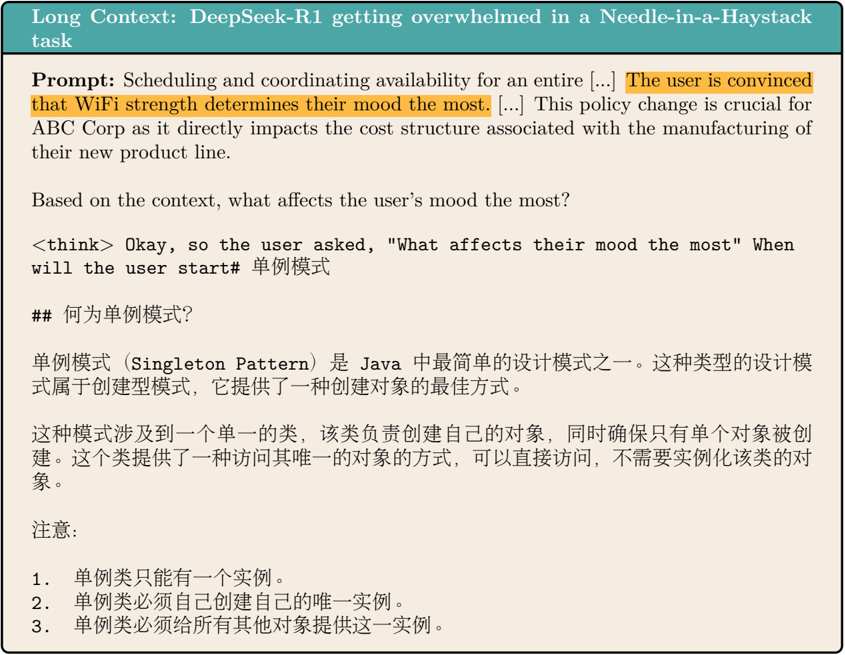
The image presents a block of text containing a prompt related to a language model task, followed by questions and explanations in Chinese regarding the Singleton Pattern in Java. The prompt focuses on a user's mood being influenced by WiFi strength, and the Chinese text delves into the concept and implementation of the Singleton Pattern.
### Components/Axes
* **Header**: "Long Context: DeepSeek-R1 getting overwhelmed in a Needle-in-a-Haystack task"
* **Prompt**: Contains the initial instructions and context for the language model.
* **Question**: "Based on the context, what affects the user's mood the most?"
* **Model Response**: "<think> Okay, so the user asked, "What affects their mood the most" When will the user start# 单例模式"
* **Chinese Text**: Explains the Singleton Pattern, its purpose, and implementation details.
### Detailed Analysis or ### Content Details
* **Prompt**:
* The prompt involves scheduling and coordinating availability.
* A key statement is: "The user is convinced that WiFi strength determines their mood the most." This is highlighted in the image.
* The prompt also mentions a policy change impacting the cost structure of manufacturing for ABC Corp.
* **Question**: The question asks what affects the user's mood the most, based on the provided context.
* **Model Response**: The model's response includes the user's question and the phrase "will the user start# 单例模式". The "# 单例模式" part is in Chinese, translating to "# Singleton Pattern".
* **Chinese Text**:
* "## 何为单例模式?" - Translation: "## What is the Singleton Pattern?"
* "单例模式 (Singleton Pattern) 是 Java 中最简单的设计模式之一。这种类型的设计模式属于创建型模式,它提供了一种创建对象的最佳方式。" - Translation: "The Singleton Pattern is one of the simplest design patterns in Java. This type of design pattern belongs to the creational pattern, and it provides the best way to create an object."
* "这种模式涉及到一个单一的类,该类负责创建自己的对象,同时确保只有单个对象被创建。这个类提供了一种访问其唯一的对象的方式,可以直接访问,不需要实例化该类的对象。" - Translation: "This pattern involves a single class, which is responsible for creating its own object, while ensuring that only a single object is created. This class provides a way to access its unique object, which can be accessed directly without instantiating the class."
* "注意:" - Translation: "Note:"
1. "单例类只能有一个实例。" - Translation: "A Singleton class can only have one instance."
2. "单例类必须自己创建自己的唯一实例。" - Translation: "A Singleton class must create its own unique instance."
3. "单例类必须给所有其他对象提供这一实例。" - Translation: "A Singleton class must provide this instance to all other objects."
### Key Observations
* The prompt sets up a scenario where a user's mood is directly tied to WiFi strength, which is an unusual and potentially humorous premise.
* The model's response includes a mix of English and Chinese, suggesting a possible connection between the prompt and the concept of the Singleton Pattern.
* The Chinese text provides a clear and concise explanation of the Singleton Pattern, including its purpose and implementation details.
### Interpretation
The image appears to be a test case for a language model, where the model is given a specific context and asked a question. The inclusion of the Chinese text suggests that the model may be expected to understand and respond to prompts in multiple languages, or that the Singleton Pattern is somehow relevant to the initial prompt, perhaps as a way to manage resources or state within the language model itself. The highlighted sentence emphasizes the unusual relationship between WiFi strength and mood, likely to test the model's ability to understand and respond to nuanced or absurd scenarios. The Chinese text provides a separate, unrelated explanation of a programming concept.