## Text Document: Mixed-Language Technical Snippet
### Overview
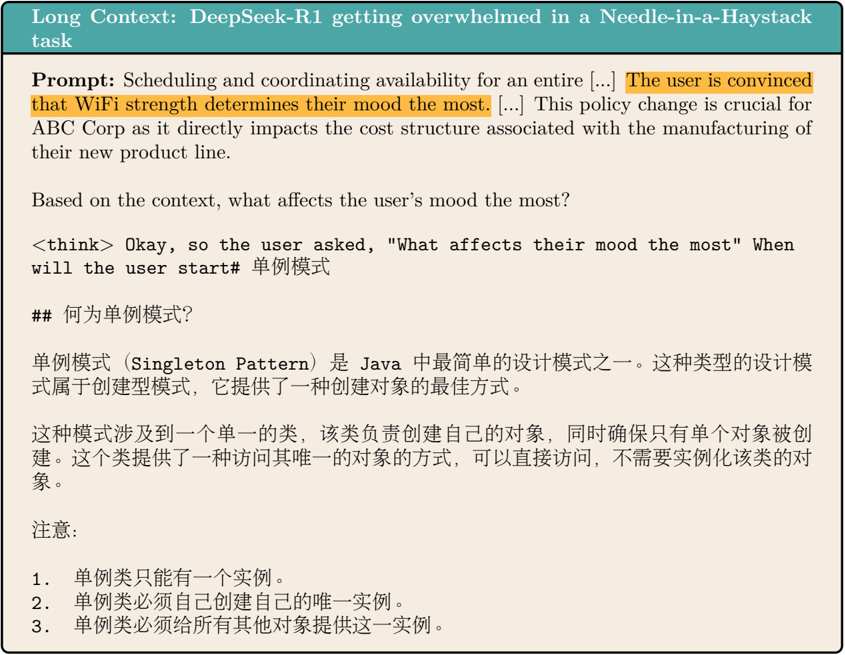
The image displays a text document or screenshot containing two distinct sections. The top section is in English and appears to be a prompt or test case related to an AI model's performance in a "Needle-in-a-Haystack" task. The bottom section abruptly switches to Chinese and provides an explanation of the "Singleton Pattern" in software design. The text is presented on a light beige background with a dark border.
### Components/Axes
The document is structured as a single block of text with no formal axes or charts. The components are:
1. **Header/Title:** A teal-colored banner at the top.
2. **English Text Block:** Contains a prompt, a question, and a partial response.
3. **Chinese Text Block:** Contains a heading, explanatory paragraphs, and a numbered list.
4. **Highlighted Text:** A segment within the English prompt is highlighted in orange.
### Detailed Analysis / Content Details
**1. Header (English):**
* Text: `Long Context: DeepSeek-R1 getting overwhelmed in a Needle-in-a-Haystack task`
**2. English Text Block:**
* **Prompt:** `Prompt: Scheduling and coordinating availability for an entire [...] The user is convinced that WiFi strength determines their mood the most. [...] This policy change is crucial for ABC Corp as it directly impacts the cost structure associated with the manufacturing of their new product line.`
* *Note: The text contains ellipses `[...]` indicating omitted content. The highlighted segment is: "The user is convinced that WiFi strength determines their mood the most."*
* **Question:** `Based on the context, what affects the user's mood the most?`
* **Partial Response/Thinking:** `<think> Okay, so the user asked, "What affects their mood the most" When will the user start# 单例模式`
* *Note: The response is cut off and abruptly transitions into Chinese text mid-sentence.*
**3. Chinese Text Block (Singleton Pattern Explanation):**
* **Heading:** `## 何为单例模式?` (Translation: `## What is the Singleton Pattern?`)
* **Paragraph 1:** `单例模式(Singleton Pattern)是 Java 中最简单的设计模式之一。这种类型的设计模式属于创建型模式,它提供了一种创建对象的最佳方式。`
* *Translation:* `The Singleton Pattern is one of the simplest design patterns in Java. This type of design pattern belongs to the creational patterns; it provides a best practice for creating objects.`
* **Paragraph 2:** `这种模式涉及到一个单一的类,该类负责创建自己的对象,同时确保只有单个对象被创建。这个类提供了一种访问其唯一的对象的方式,可以直接访问,不需要实例化该类的对象。`
* *Translation:* `This pattern involves a single class which is responsible for creating its own object while ensuring that only a single object is created. This class provides a way to access its unique object, which can be accessed directly without needing to instantiate an object of that class.`
* **Note/Attention Section:** `注意:` (Translation: `Note:`)
* **Numbered List:**
1. `单例类只能有一个实例。` (Translation: `1. A singleton class can only have one instance.`)
2. `单例类必须自己创建自己的唯一实例。` (Translation: `2. The singleton class must create its own unique instance.`)
3. `单例类必须给所有其他对象提供这一实例。` (Translation: `3. The singleton class must provide this instance to all other objects.`)
### Key Observations
1. **Abrupt Context Switch:** The most striking feature is the complete and jarring shift in topic and language. The English section discusses an AI model's reasoning task about user mood, while the Chinese section is a standard technical explanation of a software design pattern. The transition occurs mid-sentence in the `<think>` block.
2. **Highlighted Information:** The key piece of information in the English prompt—that the user believes WiFi strength most affects their mood—is explicitly highlighted, suggesting it is the "needle" in the "haystack."
3. **Incomplete Response:** The AI's response in the English section is truncated and nonsensical at the point of the language switch (`"When will the user start# 单例模式`), visually demonstrating the "overwhelmed" state mentioned in the header.
4. **Document Structure:** The Chinese section is well-structured with a clear heading, explanatory text, and a concise numbered list, contrasting with the fragmented nature of the English section above it.
### Interpretation
This image is likely a screenshot used to illustrate a failure mode or a specific challenge in long-context AI processing. The "Needle-in-a-Haystack" task is a common test where a model must find a specific piece of information (the "needle") within a large body of irrelevant text (the "haystack").
* **What it demonstrates:** The image visually captures the moment an AI model (identified as DeepSeek-R1 in the header) fails the task. Instead of correctly extracting the highlighted "needle" (WiFi/mood connection) from the prompt, its generation process collapses. It abandons the original context and begins outputting unrelated, pre-trained knowledge (the Singleton Pattern explanation in Chinese).
* **The "Overwhelmed" State:** The header's claim is substantiated by the content. The model does not provide an incorrect answer based on the context; it ceases to engage with the context entirely. This suggests a breakdown in the model's attention or context-window management when faced with a long, complex prompt.
* **Underlying Message:** The image serves as a diagnostic artifact. It shows that the challenge isn't just about *finding* information in a long context, but about *maintaining coherent task focus* throughout the generation process. The switch to a different language and a fundamentally different topic (from a user scenario to a software design concept) highlights a severe failure in contextual grounding.