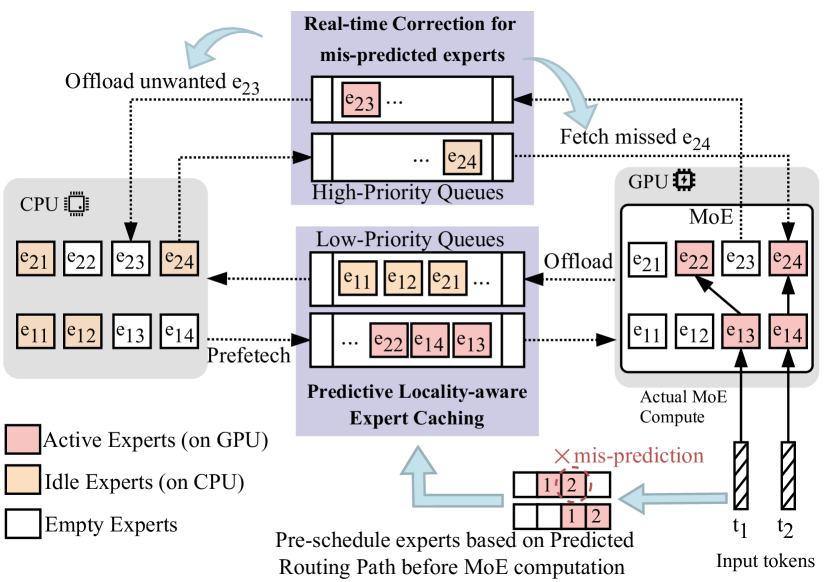
## Diagram: Real-time Correction System for Mis-predicted Experts in Hybrid CPU/GPU Architecture
### Overview
The diagram illustrates a dynamic resource management system for handling expert computations across CPU and GPU resources. It shows workflows for:
- Prefetching experts to CPU
- Offloading experts to GPU
- Real-time correction of mis-predicted experts
- Predictive locality-aware expert caching
- MoE (Mixture of Experts) computation
### Components/Axes
**Legend (bottom-left):**
- Red: Active Experts (on GPU)
- Orange: Idle Experts (on CPU)
- White: Empty Experts
**Key Components:**
1. **CPU Section (left):**
- Experts e11-e14
- Prefetching workflow to High/Low-Priority Queues
2. **GPU Section (right):**
- MoE Compute block
- Active experts e22, e23 (red)
- Idle experts e21, e24 (orange)
3. **Queues:**
- High-Priority Queues (top-center): Handle real-time corrections
- Low-Priority Queues (bottom-center): Manage predictive caching
4. **Flow Arrows:**
- Blue: Offload/prefetch operations
- Red: Mis-prediction correction path
- Black: Actual computation paths
### Detailed Analysis
**CPU Expert States:**
- Active (orange): e11, e12
- Idle (white): e13, e14
**GPU Expert States:**
- Active (red): e22, e23
- Idle (orange): e21, e24
**Queue Contents:**
- High-Priority Queues:
- Contains e23 (red) and e24 (orange)
- Shows "Offload unwanted e23" and "Fetch missed e24" operations
- Low-Priority Queues:
- Contains e11, e12, e21 (orange)
- Shows predictive caching of e22, e14, e13
**MoE Compute Block:**
- Actual computation shows:
- e22, e23 (red) as active
- e21, e24 (orange) as idle
- Input tokens t1, t2 with mis-prediction marker (×)
**Routing Path:**
- Pre-scheduled experts based on predicted routing path
- Shows mis-prediction in expert 2 (e2)
### Key Observations
1. **Resource Utilization:**
- GPU actively uses 50% of experts (e22, e23)
- CPU actively uses 50% of experts (e11, e12)
2. **Dynamic Adjustment:**
- System corrects mis-predictions in real-time (e23 offload, e24 fetch)
- Predictive caching pre-schedules experts but requires correction
3. **Priority Handling:**
- High-priority queues handle critical corrections
- Low-priority queues manage bulk prefetching
4. **Latency Management:**
- Prefetching reduces GPU idle time
- Real-time correction adds overhead but maintains accuracy
### Interpretation
This system demonstrates a sophisticated approach to hybrid computing resource management:
1. **Predictive Caching:** The low-priority queues pre-schedule experts based on predicted routing paths, reducing initial latency but requiring real-time adjustments when mis-predictions occur.
2. **Priority Queuing:** The separation into high/low-priority queues ensures critical corrections (like expert e23 offload) get immediate attention while bulk operations (e11-e14 prefetch) proceed in lower priority.
3. **Hybrid Optimization:** The system effectively balances CPU/GPU workloads by:
- Keeping 50% of experts active on each device
- Dynamically redistributing experts based on actual computation needs
- Maintaining 25% empty experts for potential overflow
4. **Error Handling:** The red × mis-prediction marker and correction arrows show the system's ability to adapt to prediction errors, though this introduces additional overhead.
The architecture suggests a trade-off between prediction accuracy and computational efficiency, with the real-time correction mechanism acting as a safety net for imperfect predictions. The 50/50 active/expert distribution across CPU/GPU indicates a balanced workload distribution strategy, while the 25% empty expert buffer provides headroom for unexpected computation demands.