## Geometric Diagram with Solution
### Overview
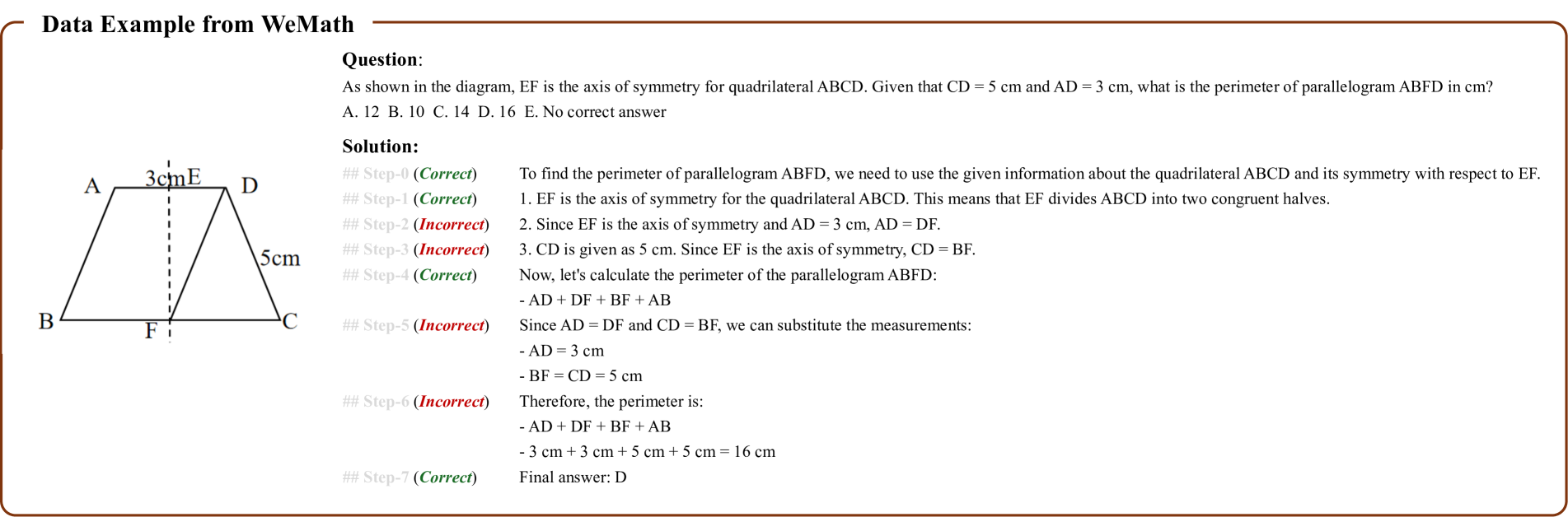
The image presents a geometry problem involving a quadrilateral ABCD with an axis of symmetry EF. The problem asks for the perimeter of parallelogram ABFD, given that CD = 5 cm and AD = 3 cm. The image includes a diagram of the quadrilateral and a step-by-step solution to the problem.
### Components/Axes
* **Title:** Data Example from WeMath
* **Question:** As shown in the diagram, EF is the axis of symmetry for quadrilateral ABCD. Given that CD = 5 cm and AD = 3 cm, what is the perimeter of parallelogram ABFD in cm?
* Possible answers: A. 12 B. 10 C. 14 D. 16 E. No correct answer
* **Diagram:**
* Quadrilateral ABCD
* Axis of symmetry: EF (dashed line)
* Point E on line AD
* Point F on line BC
* AD = 3 cm
* CD = 5 cm
* **Solution:** Step-by-step solution with correctness indicators.
### Detailed Analysis or ### Content Details
**Diagram Description:**
* A quadrilateral ABCD is shown. Side AD is parallel to side BC.
* A dashed line EF runs vertically, bisecting the quadrilateral. E lies on AD, and F lies on BC. EF is the axis of symmetry.
* The length of AD is labeled as 3 cm.
* The length of CD is labeled as 5 cm.
**Solution Steps:**
The solution is presented as a series of steps, each marked with "## Step-n" where n is the step number, and a correctness indicator "(Correct)" or "(Incorrect)".
* **Step-0 (Correct):** Implicitly states the goal: To find the perimeter of parallelogram ABFD, we need to use the given information about the quadrilateral ABCD and its symmetry with respect to EF.
* **Step-1 (Correct):** EF is the axis of symmetry for the quadrilateral ABCD. This means that EF divides ABCD into two congruent halves.
* **Step-2 (Incorrect):** Since EF is the axis of symmetry and AD = 3 cm, AD = DF.
* **Step-3 (Incorrect):** CD is given as 5 cm. Since EF is the axis of symmetry, CD = BF.
* **Step-4 (Correct):** Now, let's calculate the perimeter of the parallelogram ABFD: AD + DF + BF + AB
* **Step-5 (Incorrect):** Since AD = DF and CD = BF, we can substitute the measurements: AD = 3 cm
* **Step-6 (Incorrect):** BF = CD = 5 cm
* **Step-7 (Correct):** Therefore, the perimeter is: AD + DF + BF + AB = 3 cm + 3 cm + 5 cm + 5 cm = 16 cm. Final answer: D
### Key Observations
* The diagram shows a quadrilateral ABCD with an axis of symmetry EF.
* The solution attempts to find the perimeter of parallelogram ABFD.
* Several steps in the solution are marked as "Incorrect".
* The final answer provided is D, which corresponds to 16 cm.
### Interpretation
The image presents a geometry problem and a proposed solution. The solution contains errors, as indicated by the "(Incorrect)" labels. The correct steps are used to arrive at the correct answer of 16 cm. The problem leverages the concept of symmetry to deduce the lengths of sides DF and BF, which are necessary to calculate the perimeter of the parallelogram ABFD. The errors in the solution likely stem from misapplication of the symmetry property or incorrect substitution of values.