## Diagram: Geometry Problem Solution
### Overview
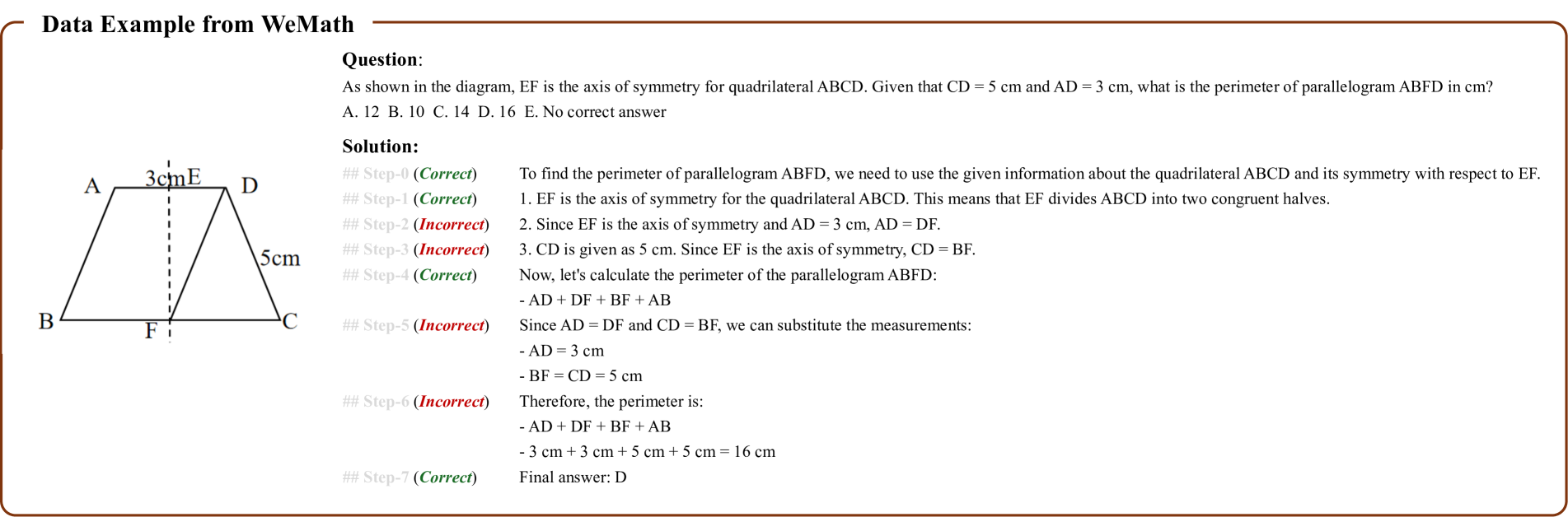
The image presents a geometry problem from WeMath, along with its solution. The problem involves a quadrilateral ABCD with EF as the axis of symmetry, and asks for the perimeter of parallelogram ABFD given AD = 3cm and CD = 5cm. The solution is presented in a step-by-step format, with correctness indicators (# Correct) and (# Incorrect) next to each step. A diagram of the quadrilateral is included.
### Components/Axes
The image consists of the following components:
* **Question:** Text describing the geometry problem.
* **Solution:** A numbered list of steps explaining the solution process.
* **Diagram:** A visual representation of the quadrilateral ABCD with EF as the axis of symmetry.
* **Correctness Indicators:** Labels indicating whether each step in the solution is correct or incorrect.
The diagram includes the following labels:
* A, B, C, D: Vertices of the quadrilateral.
* E, F: Points on sides AD and BC respectively, defining the axis of symmetry EF.
* 3cm: Length of AE and ED.
* 5cm: Length of BF and FC.
* EF: Axis of symmetry (dashed line).
### Content Details
**Question:**
"As shown in the diagram, EF is the axis of symmetry for quadrilateral ABCD. Given that CD = 5 cm and AD = 3 cm, what is the perimeter of parallelogram ABFD in cm?"
Options: A. 12 B. 10 C. 14 D. 16 E. No correct answer
**Solution:**
* **Step-1 (# Correct):** "To find the perimeter of parallelogram ABFD, we need to use the given information about the quadrilateral ABCD and its symmetry with respect to EF."
* **Step-2 (# Incorrect):** "Since EF is the axis of symmetry and AD = 3 cm, AD = DF."
* **Step-3 (# Incorrect):** "CD is given as 5 cm. Since EF is the axis of symmetry, CD = BF."
* **Step-4 (# Correct):** "Now, let's calculate the perimeter of the parallelogram ABFD: - AD + DF + BF + AB"
* **Step-5 (# Incorrect):** "Since AD = DF and CD = BF, we can substitute the measurements: - AD = 3 cm - BF = CD = 5 cm"
* **Step-6 (# Incorrect):** "Therefore, the perimeter is: - AD + DF + BF + AB = 3 cm + 3 cm + 5 cm + 5 cm = 16 cm"
* **Step-7 (# Correct):** "Final answer: D"
**Diagram Details:**
* Quadrilateral ABCD is shown with EF as a dashed line representing the axis of symmetry.
* AE = ED = 3cm
* BF = FC = 5cm
### Key Observations
* Steps 2, 3, 5, and 6 in the solution are marked as incorrect, despite the final answer being correct.
* The solution attempts to find the perimeter of ABFD by summing its sides.
* The diagram visually represents the given information about the quadrilateral and its symmetry.
* The solution incorrectly states AD = DF and CD = BF. It should be AB = DF and AD = BF.
### Interpretation
The problem tests understanding of symmetry in quadrilaterals and the properties of parallelograms. The solution attempts to leverage the symmetry to find the perimeter of ABFD. However, the intermediate steps contain logical errors in applying the symmetry property. The final answer is correct, but the reasoning is flawed. The incorrect steps highlight a misunderstanding of how the symmetry affects the side lengths of the parallelogram. The diagram is crucial for visualizing the problem and understanding the relationships between the different segments. The correctness indicators are useful for identifying the errors in the solution process. The solution demonstrates a common mistake of misapplying symmetry properties. The correct approach would be to recognize that AB = DF and AD = BF due to the symmetry.