## Diagram: Geometry Problem with Solution Steps
### Overview
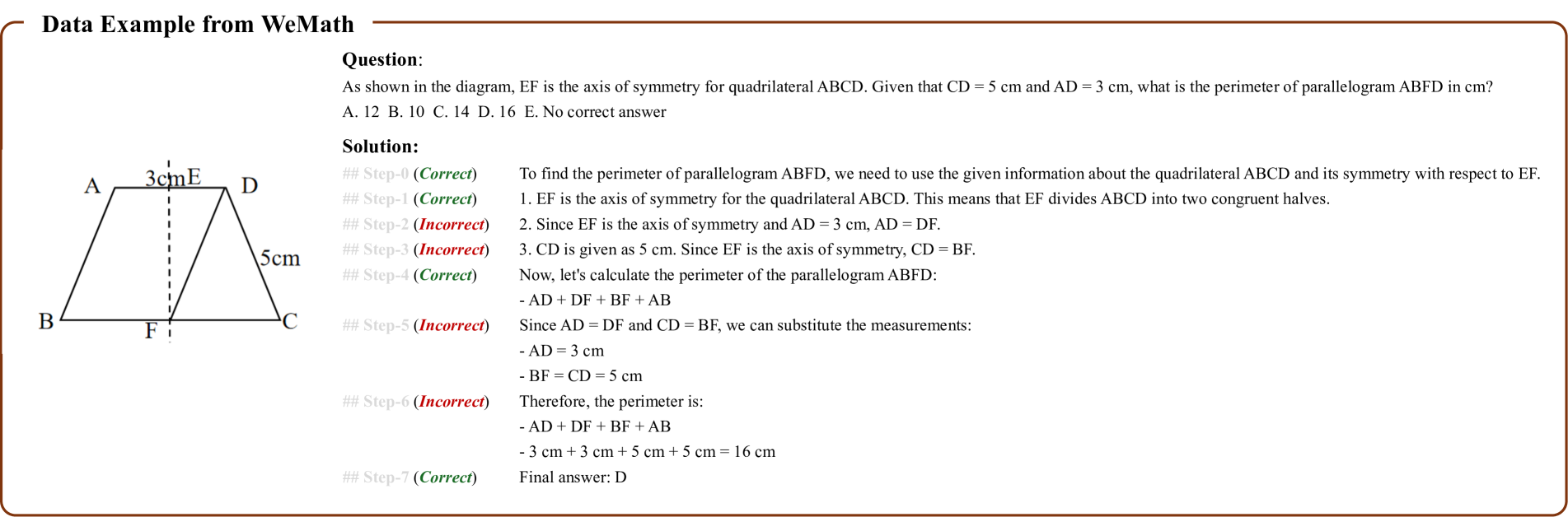
The image displays a geometry problem from a source titled "Data Example from WeMath." It consists of a labeled diagram of a quadrilateral on the left and a corresponding question with a multi-step solution on the right. The problem involves using symmetry to find the perimeter of a parallelogram.
### Components/Axes
**Diagram (Left Side):**
* A quadrilateral labeled with vertices **A**, **B**, **C**, and **D**.
* A dashed vertical line labeled **EF** runs through the center, identified as the axis of symmetry. Point **E** is on side AD, and point **F** is on side BC.
* A measurement label **"3cm"** is placed along the segment from **A** to **E**.
* A measurement label **"5cm"** is placed along side **CD**.
* The diagram visually suggests that ABCD is an isosceles trapezoid with EF as its line of symmetry.
**Text (Right Side):**
* **Header:** "Data Example from WeMath"
* **Question Section:**
* **Question Text:** "As shown in the diagram, EF is the axis of symmetry for quadrilateral ABCD. Given that CD = 5 cm and AD = 3 cm, what is the perimeter of parallelogram ABFD in cm?"
* **Multiple Choice Options:** A. 12, B. 10, C. 14, D. 16, E. No correct answer
* **Solution Section:** A step-by-step solution is provided, with each step prefixed by "## Step-X" and a correctness label in parentheses (Correct/Incorrect).
### Detailed Analysis
**Transcription of Solution Steps:**
* **## Step-0 (Correct):** To find the perimeter of parallelogram ABFD, we need to use the given information about the quadrilateral ABCD and its symmetry with respect to EF.
* **## Step-1 (Correct):** 1. EF is the axis of symmetry for the quadrilateral ABCD. This means that EF divides ABCD into two congruent halves.
* **## Step-2 (Incorrect):** 2. Since EF is the axis of symmetry and AD = 3 cm, AD = DF.
* **## Step-3 (Incorrect):** 3. CD is given as 5 cm. Since EF is the axis of symmetry, CD = BF.
* **## Step-4 (Correct):** Now, let's calculate the perimeter of the parallelogram ABFD:
* - AD + DF + BF + AB
* **## Step-5 (Incorrect):** Since AD = DF and CD = BF, we can substitute the measurements:
* - AD = 3 cm
* - BF = CD = 5 cm
* **## Step-6 (Incorrect):** Therefore, the perimeter is:
* - AD + DF + BF + AB
* - 3 cm + 3 cm + 5 cm + 5 cm = 16 cm
* **## Step-7 (Correct):** Final answer: D
### Key Observations
1. **Solution Logic Error:** The solution contains a critical logical error in Steps 2 and 3. The axis of symmetry EF implies that corresponding segments on either side are equal (e.g., AE = ED, BF = FC). However, it does **not** imply that a segment on one side (AD) is equal to a segment that crosses the axis (DF), nor that a side (CD) is equal to a segment on the opposite side (BF). The correct equalities from symmetry are: AE = ED, BF = FC, AB = DC, and ∠A = ∠D.
2. **Correct Final Answer Despite Errors:** The final numerical answer (16 cm) and the choice (D) are marked as correct. This suggests the problem's intended answer is 16 cm, but the provided solution path to reach it is flawed.
3. **Diagram vs. Text:** The diagram labels AD as 3cm, but the text of the question also states AD = 3 cm. The diagram labels CD as 5cm, which matches the question text.
### Interpretation
This image presents a pedagogical example, likely from an educational platform, demonstrating a common student mistake in applying symmetry properties. The core task is to find the perimeter of parallelogram ABFD.
* **What the Data Suggests:** The problem tests the understanding that symmetry about a line (EF) creates mirror-image congruence. The incorrect steps reveal a misapplication of this property, confusing which segments are congruent.
* **Relationship Between Elements:** The diagram is essential for visualizing the shape and the axis of symmetry. The solution text attempts to derive the answer from the diagram's properties but fails in its reasoning. The correctness labels (Correct/Incorrect) serve as a meta-commentary, highlighting where the reasoning breaks down.
* **Notable Anomaly:** The most significant anomaly is the disconnect between the incorrect reasoning (Steps 2, 3, 5, 6) and the correct final answer (Step 7). This implies that while the final answer (D. 16) is correct for the given problem, the explanatory solution provided is invalid. A correct solution would need to establish that ABFD is a parallelogram (likely by showing AB ∥ DF and AD ∥ BF) and then correctly deduce the lengths of its sides using the given measurements and symmetry (e.g., AB = CD = 5 cm, and AD = 3 cm is given; finding DF and BF would require additional correct geometric reasoning not present in the flawed steps).