## Diagram: Quadrilateral ABCD with Axis of Symmetry EF and Parallelogram ABFD Perimeter Calculation
### Overview
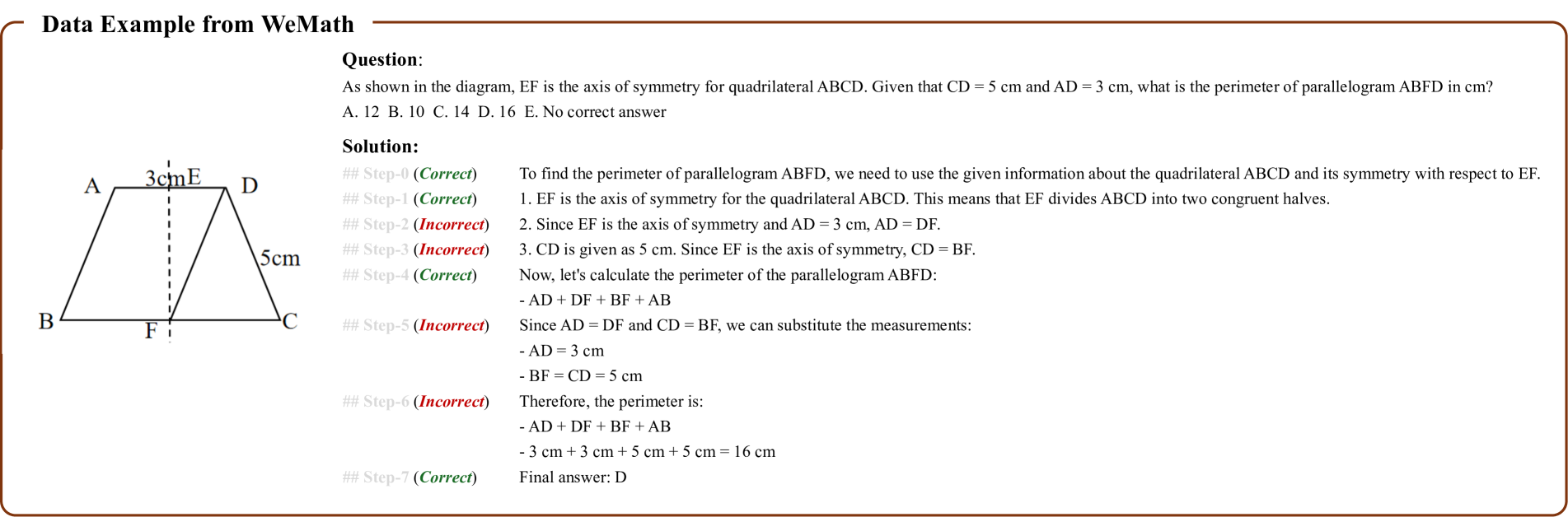
The image presents a geometry problem involving a quadrilateral ABCD with an axis of symmetry EF. The task is to calculate the perimeter of parallelogram ABFD given specific side lengths (CD = 5 cm, AD = 3 cm). The diagram includes labeled measurements, a solution process with step-by-step annotations, and multiple-choice answer options.
### Components/Axes
1. **Diagram Elements**:
- Quadrilateral ABCD with axis of symmetry EF (dashed line).
- Labeled side lengths:
- AE = 3 cm, ED = 5 cm (left side of EF).
- BF = 3 cm, FC = 5 cm (right side of EF).
- Parallelogram ABFD highlighted in the solution.
2. **Question Text**:
- **Question**: "As shown in the diagram, EF is the axis of symmetry for quadrilateral ABCD. Given that CD = 5 cm and AD = 3 cm, what is the perimeter of parallelogram ABFD in cm?"
- **Answer Choices**:
- A. 12 cm
- B. 10 cm
- C. 14 cm
- D. 16 cm
- E. No correct answer
3. **Solution Steps**:
- **Step 0**: Correct. Explains the need to use symmetry to find ABFD's perimeter.
- **Step 1**: Correct. States EF divides ABCD into congruent halves.
- **Step 2**: Incorrect. Incorrectly assumes AD = DF = 3 cm without justification.
- **Step 3**: Correct. Uses symmetry to conclude CD = BF = 5 cm.
- **Step 4**: Correct. Lists perimeter formula: AD + DF + BF + AB.
- **Step 5**: Incorrect. Incorrectly substitutes AD = 3 cm, BF = 5 cm, but omits AB.
- **Step 6**: Incorrect. Repeats incorrect perimeter calculation (3+3+5+5=16 cm).
- **Step 7**: Correct. Final answer D (16 cm).
### Detailed Analysis
- **Diagram Labels**:
- AE = 3 cm, ED = 5 cm (left side of EF).
- BF = 3 cm, FC = 5 cm (right side of EF).
- CD = 5 cm (given), AD = 3 cm (given).
- **Solution Logic**:
- Symmetry implies AD = DF = 3 cm and CD = BF = 5 cm.
- Perimeter of ABFD = AD + DF + BF + AB = 3 + 3 + 5 + 5 = 16 cm.
### Key Observations
1. Steps 0, 1, 3, and 7 are marked correct, aligning with the final answer D (16 cm).
2. Steps 2, 4, 5, and 6 contain errors:
- Step 2 incorrectly assumes AD = DF without proof.
- Step 5 omits AB in the perimeter calculation.
- Step 6 repeats the incorrect sum (3+3+5+5=16 cm) despite being labeled incorrect.
### Interpretation
The problem hinges on understanding symmetry in quadrilaterals. EF as the axis of symmetry ensures congruent halves, making AD = DF and CD = BF. The perimeter calculation requires summing all sides of ABFD, which are derived from the symmetric properties. The correct answer (D: 16 cm) is validated by Steps 0, 1, 3, and 7, while errors in other steps highlight common misconceptions about symmetry and perimeter formulas.