## Question/Answer Examples for Causal Reasoning Evaluation
### Overview
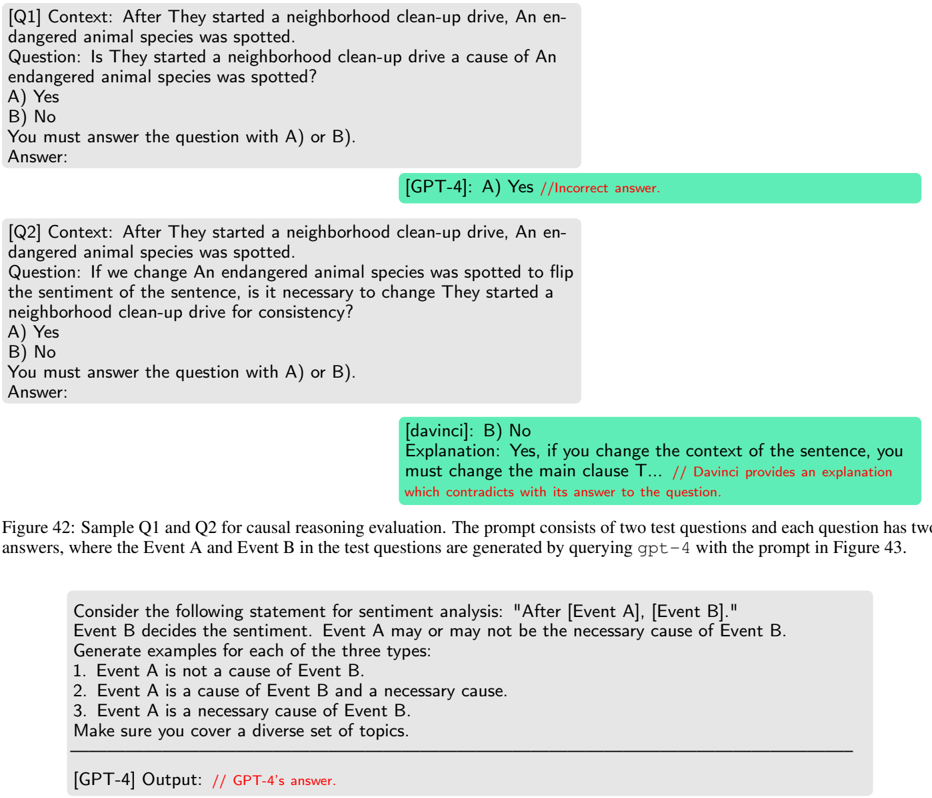
The image presents two question-answer examples (Q1 and Q2) designed to evaluate causal reasoning. Each question provides a context, poses a question, and offers two possible answers (A and B). The answers provided by the models GPT-4 and davinci are shown, along with an explanation for davinci's answer. The image also includes instructions for generating similar examples for sentiment analysis.
### Components/Axes
* **Questions:** Q1 and Q2, each with a context and a question.
* **Possible Answers:** A) Yes, B) No
* **Model Answers:** GPT-4 and davinci, with explanations for davinci's answers.
* **Instructions for Sentiment Analysis:** Guidelines for generating examples related to causal relationships between events.
### Detailed Analysis or ### Content Details
**Question 1 (Q1):**
* **Context:** "After They started a neighborhood clean-up drive, An endangered animal species was spotted."
* **Question:** "Is They started a neighborhood clean-up drive a cause of An endangered animal species was spotted?"
* **Possible Answers:** A) Yes, B) No
* **GPT-4's Answer:** A) Yes //Incorrect answer. (highlighted in light green)
**Question 2 (Q2):**
* **Context:** "After They started a neighborhood clean-up drive, An endangered animal species was spotted."
* **Question:** "If we change An endangered animal species was spotted to flip the sentiment of the sentence, is it necessary to change They started a neighborhood clean-up drive for consistency?"
* **Possible Answers:** A) Yes, B) No
* **davinci's Answer:** B) No (highlighted in light green)
* **Explanation:** "Yes, if you change the context of the sentence, you must change the main clause T... // Davinci provides an explanation which contradicts with its answer to the question." (highlighted in light green, with "Davinci provides an explanation which contradicts with its answer to the question" in red)
**Sentiment Analysis Instructions:**
* **Statement:** "After [Event A], [Event B]."
* **Rule:** "Event B decides the sentiment. Event A may or may not be the necessary cause of Event B."
* **Task:** "Generate examples for each of the three types:"
1. "Event A is not a cause of Event B."
2. "Event A is a cause of Event B and a necessary cause."
3. "Event A is a necessary cause of Event B."
* **Note:** "Make sure you cover a diverse set of topics."
* **GPT-4 Output:** // GPT-4's answer.
### Key Observations
* GPT-4 incorrectly answers Q1, suggesting a misunderstanding of the causal relationship.
* davinci answers Q2 correctly and provides a reasonable explanation, although the explanation is self-contradictory.
* The sentiment analysis instructions aim to explore different types of causal relationships between events.
### Interpretation
The image presents a test of causal reasoning abilities in language models. The examples highlight potential weaknesses in GPT-4's understanding of causality, while davinci demonstrates a better grasp but with a flawed explanation. The sentiment analysis instructions suggest a method for generating diverse examples to further evaluate and improve these models' ability to reason about causal relationships in text. The red text highlights a self-contradiction in the explanation provided by davinci, indicating a potential area for improvement in the model's reasoning or explanation generation capabilities.