## Line Chart: Hits@10 Values vs Training Epochs
### Overview
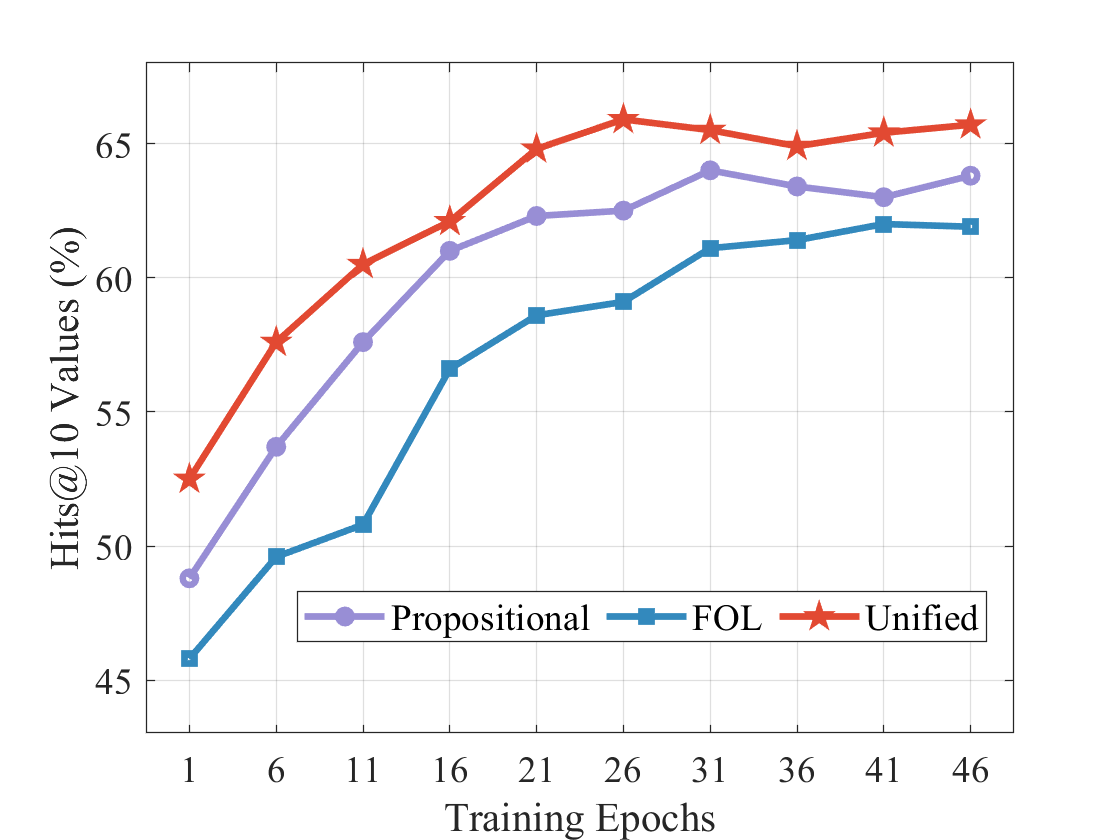
The chart compares three optimization methods (Proportional, FOL, Unified) across 46 training epochs, showing their performance in Hits@10 values (percentage). All three methods demonstrate upward trends, with Unified consistently outperforming the others.
### Components/Axes
- **X-axis**: Training Epochs (1 to 46, linear scale)
- **Y-axis**: Hits@10 Values (%) (45% to 65%, linear scale)
- **Legend**: Located at bottom-left, with:
- Purple circles: Proportional
- Blue squares: FOL
- Red stars: Unified
### Detailed Analysis
1. **Proportional (Purple Circles)**
- Starts at ~49% at epoch 1
- Gradual increase to ~64% by epoch 46
- Slope: ~0.3% per epoch (steady linear growth)
2. **FOL (Blue Squares)**
- Starts at ~46% at epoch 1
- Sharp initial rise (46% → 51% in first 5 epochs)
- Slows to ~0.2% per epoch after epoch 10
- Reaches ~62% by epoch 46
3. **Unified (Red Stars)**
- Starts at ~53% at epoch 1
- Consistent ~0.5% per epoch growth
- Peaks at ~66% by epoch 46
- Maintains 10-15% lead over Proportional throughout
### Key Observations
- Unified method shows highest performance across all epochs
- FOL demonstrates fastest initial improvement but plateaus
- Proportional maintains middle-ground performance
- All methods show diminishing returns after epoch 20
- No crossover points between methods after epoch 10
### Interpretation
The data suggests that while all three optimization methods improve with training, the Unified approach demonstrates superior long-term performance. The FOL method's rapid early gains may indicate effective initial parameter tuning, but its plateau suggests potential overfitting or saturation. The Proportional method's steady growth pattern implies balanced optimization without extreme fluctuations. The persistent gap between Unified and other methods highlights its architectural or algorithmic advantages in this specific task. The diminishing returns across all methods after epoch 20 suggest potential for optimization in training duration or resource allocation.