\n
## Diagram: Federated Learning System Architecture
### Overview
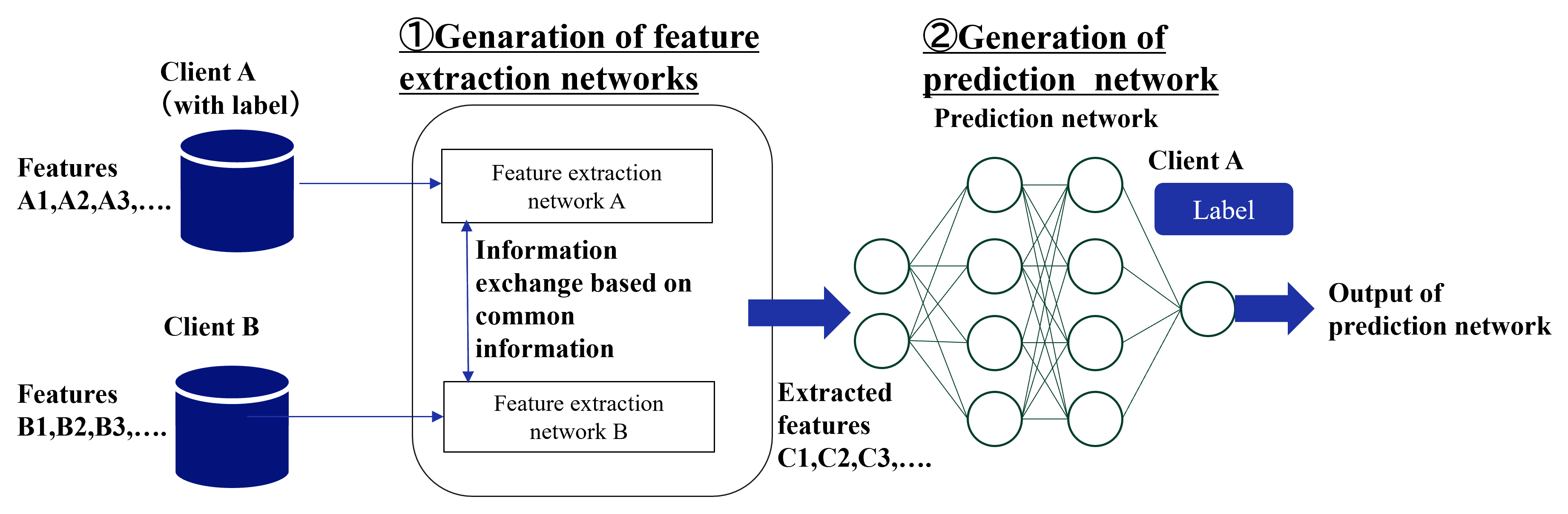
The image depicts a diagram illustrating a federated learning system architecture, specifically focusing on the generation of feature extraction networks and a prediction network. It shows two clients (A and B) contributing data and how information is exchanged to build these networks. The diagram is divided into two main sections, labeled "①Generation of feature extraction networks" and "②Generation of prediction network".
### Components/Axes
The diagram consists of the following components:
* **Clients:** Client A (with label) and Client B.
* **Data Storage:** Cylinders representing data storage for each client, labeled with "Features" and specific feature identifiers (A1, A2, A3,... for Client A and B1, B2, B3,... for Client B).
* **Feature Extraction Networks:** "Feature extraction network A" and "Feature extraction network B".
* **Information Exchange:** An arrow indicating "Information exchange based on common information" between the feature extraction networks.
* **Prediction Network:** A multi-layered neural network.
* **Extracted Features:** Labeled as "Extracted features C1, C2, C3,...".
* **Labels:** "Label" associated with Client A, and "Output of prediction network".
### Detailed Analysis or Content Details
**Section ①: Generation of feature extraction networks**
* Client A possesses data with features labeled A1, A2, A3, and continuing (indicated by "...").
* Client B possesses data with features labeled B1, B2, B3, and continuing (indicated by "...").
* Each client has a corresponding feature extraction network (Network A for Client A, Network B for Client B).
* There is a bidirectional arrow between the two feature extraction networks, labeled "Information exchange based on common information". This suggests a collaborative process where the networks share information to improve feature extraction.
**Section ②: Generation of prediction network**
* A prediction network is depicted as a multi-layered neural network with approximately 6 layers.
* The input to the prediction network is "Extracted features C1, C2, C3,...".
* Client A's "Label" is shown as an input to the prediction network.
* The output of the prediction network is labeled "Output of prediction network".
* The prediction network has connections between layers, indicating data flow.
### Key Observations
* The diagram highlights a federated learning approach where models are trained on decentralized data.
* The information exchange between feature extraction networks suggests a form of knowledge distillation or model aggregation.
* The prediction network utilizes extracted features and client labels to generate an output.
* The diagram does not provide specific numerical data or performance metrics. It is a conceptual illustration of the system architecture.
### Interpretation
The diagram illustrates a federated learning system where multiple clients contribute to the training of a global model without directly sharing their raw data. Clients A and B each have their own data and feature extraction networks. These networks exchange information to improve feature representation. The extracted features are then used by a central prediction network, along with client labels, to generate predictions. This approach preserves data privacy while leveraging the collective knowledge of multiple clients. The diagram emphasizes the collaborative nature of federated learning and the importance of feature extraction in achieving accurate predictions. The lack of specific data points suggests this is a high-level architectural overview rather than a performance analysis.