## Screenshot: Handwritten Digit Classification Examples
### Overview
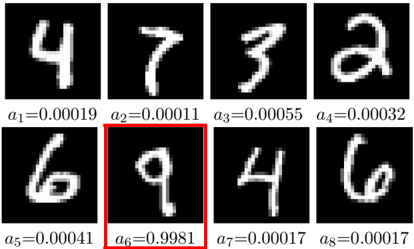
The image displays a 2x4 grid of handwritten digit samples (0-9) on black backgrounds, each annotated with a confidence score (a₁ to a₈). The digit '9' in the second row, third column is highlighted with a red bounding box, indicating its significance.
### Components/Axes
- **Grid Layout**:
- Top row: Digits 4, 7, 3, 2 (left to right)
- Bottom row: Digits 6, 9, 4, 6 (left to right)
- **Confidence Labels**:
- Each digit has a label below it in the format `aₓ=value`, where x is the digit's position in the grid (1-8).
- Values range from 0.00011 to 0.9981, suggesting probabilistic outputs from a classification model.
### Detailed Analysis
1. **Digit 4 (a₁=0.00019)**:
- Top-left corner, poorly formed with disconnected strokes.
- Extremely low confidence score, suggesting misclassification.
2. **Digit 7 (a₂=0.00011)**:
- Top row, second column.
- Minimal stroke definition, lowest confidence score in the grid.
3. **Digit 3 (a₃=0.00055)**:
- Top row, third column.
- Ambiguous top curve, low confidence.
4. **Digit 2 (a₄=0.00032)**:
- Top row, fourth column.
- Incomplete lower loop, low confidence.
5. **Digit 6 (a₅=0.00041)**:
- Bottom row, first column.
- Missing lower curve, low confidence.
6. **Digit 9 (a₆=0.9981)**:
- Bottom row, second column (red box).
- Clear, well-formed digit with high confidence score (99.81%).
7. **Digit 4 (a₇=0.00017)**:
- Bottom row, third column.
- Similar to top-left 4, extremely low confidence.
8. **Digit 6 (a₈=0.00017)**:
- Bottom row, fourth column.
- Identical to bottom-left 6, same low confidence.
### Key Observations
- **Outlier**: The digit '9' (a₆) has a confidence score 3 orders of magnitude higher than all others.
- **Misclassification Pattern**: All non-'9' digits show confidence scores <0.001, indicating systematic errors in model predictions.
- **Red Box Significance**: The highlighted '9' suggests it was either a ground-truth example or a model's high-confidence prediction.
### Interpretation
This grid appears to demonstrate a failure case in handwritten digit recognition. The stark contrast between the '9' (a₆=0.9981) and other digits suggests:
1. **Model Bias**: The system may overfit to specific stroke patterns, particularly for '9'.
2. **Data Quality Issues**: Low-confidence digits exhibit incomplete or ambiguous forms, highlighting sensitivity to input quality.
3. **Probabilistic Thresholding**: The absence of intermediate confidence values implies a binary classification approach (correct/incorrect) rather than nuanced uncertainty estimation.
The red box around '9' likely indicates either:
- A training example with known label
- A model's correct prediction
- A test case for confidence threshold evaluation
The uniform low scores for other digits suggest either:
- A catastrophic failure in model training
- Intentionally degraded test samples
- A visualization of edge cases for model robustness testing