\n
## Line Chart: Performance Scaling with Processors
### Overview
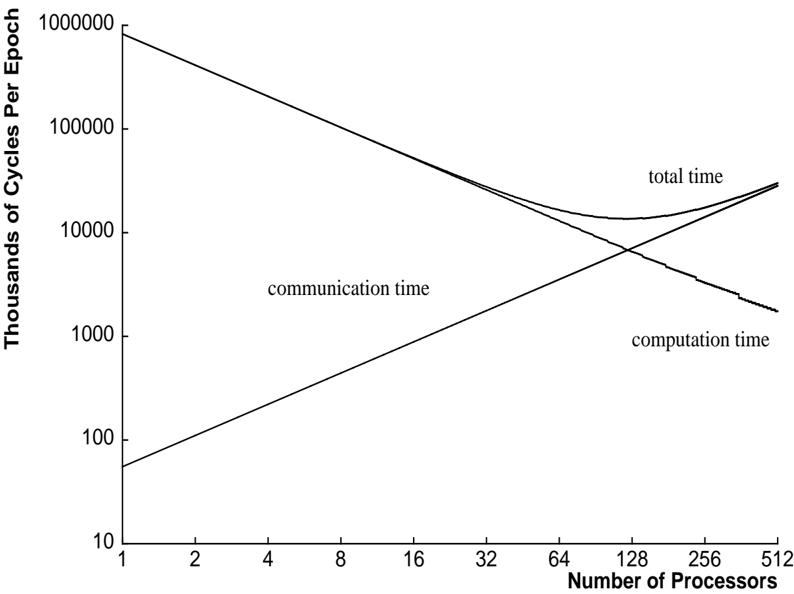
The image presents a line chart illustrating the relationship between the number of processors and the time taken for different components of a computational task, measured in thousands of cycles per epoch. The chart displays four curves: total time, communication time, computation time, and a fourth curve that appears to be a smoothed version of the total time. The x-axis represents the number of processors, and the y-axis represents the time in thousands of cycles per epoch, using a logarithmic scale.
### Components/Axes
* **X-axis:** Number of Processors (Scale: 1, 2, 4, 8, 16, 32, 64, 128, 256, 512)
* **Y-axis:** Thousands of Cycles Per Epoch (Logarithmic Scale: 10, 100, 1000, 10000, 100000)
* **Lines/Curves:**
* Total Time (Black, thicker line)
* Communication Time (Gray)
* Computation Time (Gray)
* Smoothed Total Time (Black, thinner line)
* **Legend:** Located in the center-right of the chart, labeling each line.
### Detailed Analysis
* **Total Time:** The total time curve starts at approximately 100,000 thousands of cycles per epoch with 1 processor. It initially decreases rapidly as the number of processors increases, reaching a minimum around 128 processors at approximately 8,000 thousands of cycles per epoch. After this point, the total time begins to increase slowly, reaching approximately 10,000 thousands of cycles per epoch with 512 processors.
* **Communication Time:** The communication time curve starts at approximately 100 thousands of cycles per epoch with 1 processor. It increases steadily as the number of processors increases, reaching approximately 3,000 thousands of cycles per epoch with 512 processors. The curve appears roughly linear on this logarithmic scale.
* **Computation Time:** The computation time curve starts at approximately 10,000 thousands of cycles per epoch with 1 processor. It decreases rapidly as the number of processors increase, reaching approximately 1,000 thousands of cycles per epoch with 128 processors. It then plateaus and slightly increases to approximately 1,500 thousands of cycles per epoch with 512 processors.
* **Smoothed Total Time:** This curve closely follows the total time curve, but is smoother. It starts at approximately 100,000 thousands of cycles per epoch with 1 processor, decreases to a minimum of approximately 7,000 thousands of cycles per epoch around 128 processors, and then increases to approximately 9,000 thousands of cycles per epoch with 512 processors.
### Key Observations
* The total time is initially dominated by computation time, which decreases rapidly with increasing processors.
* As the number of processors increases, communication time becomes a more significant factor, eventually contributing to the increase in total time.
* There appears to be an optimal number of processors (around 128) where the total time is minimized. Beyond this point, adding more processors leads to diminishing returns and eventually an increase in total time.
* The smoothed total time curve suggests that the fluctuations in the total time curve are likely due to noise or variability in the measurements.
### Interpretation
The chart demonstrates the trade-offs involved in parallelizing a computational task. Initially, increasing the number of processors significantly reduces the computation time, leading to a decrease in total time. However, as the number of processors increases, the overhead associated with communication between processors becomes more significant. This communication overhead eventually outweighs the benefits of increased computation, leading to an increase in total time.
The optimal number of processors represents the point where the benefits of increased computation are balanced by the costs of increased communication. Beyond this point, adding more processors is counterproductive. This type of behavior is common in parallel computing and highlights the importance of carefully considering the communication patterns and overhead when designing parallel algorithms. The smoothed total time curve suggests that the observed behavior is robust and not simply due to random fluctuations. The logarithmic scale on the y-axis emphasizes the large range of time values and the relative changes in performance as the number of processors increases.