\n
## Diagram: Building Floor Plan
### Overview
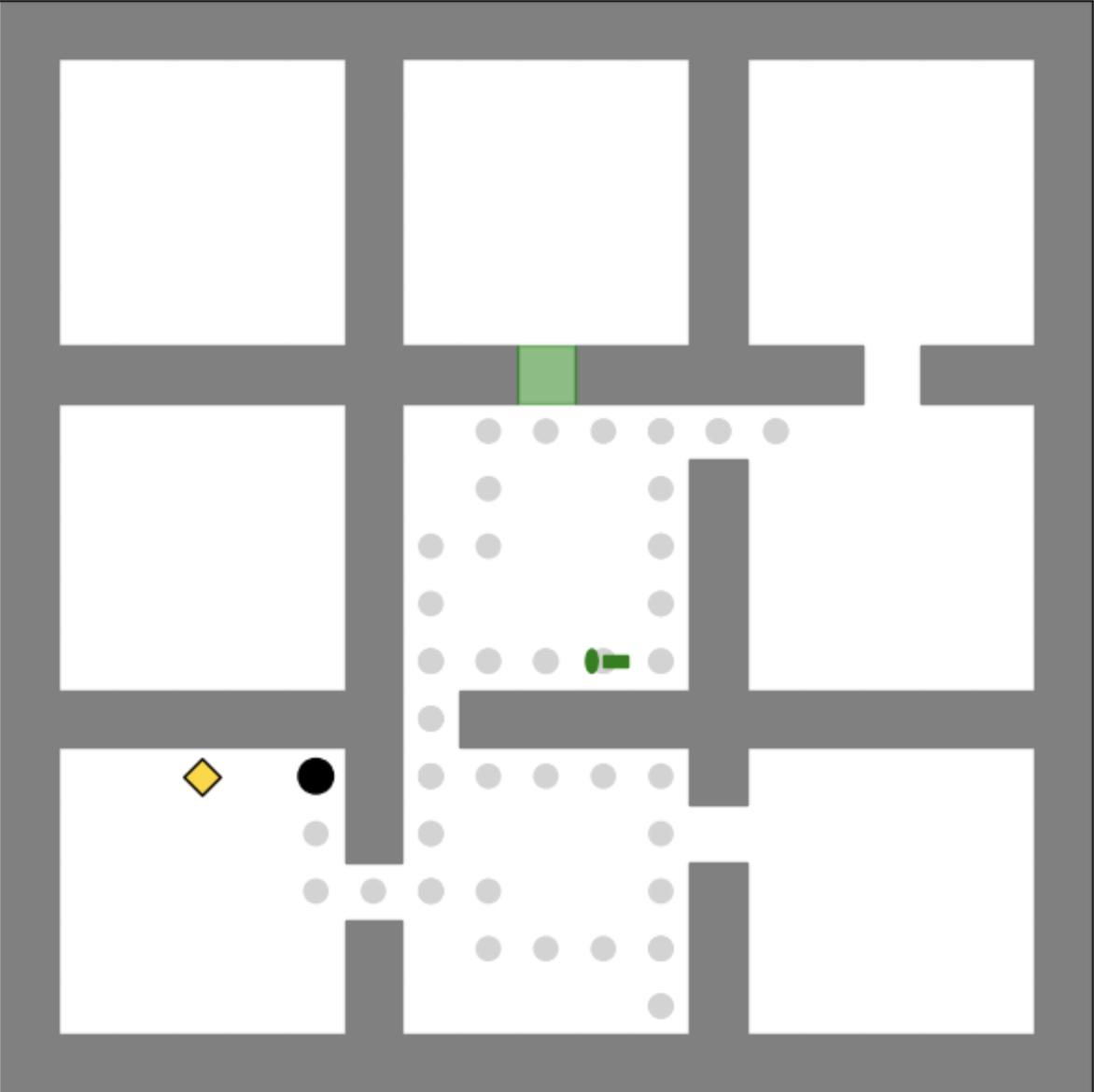
The image depicts a simplified floor plan of a building or complex. The plan is rendered in a minimalist style, using solid colors and dotted lines to represent walls and pathways. There are several distinct areas within the structure, connected by corridors and open spaces. The diagram includes three distinct markers: a yellow diamond, a black circle, and two green shapes (a rectangle and a small square).
### Components/Axes
The diagram does not have traditional axes or a legend in the conventional sense. However, the elements can be categorized as follows:
* **Walls:** Represented by solid gray blocks.
* **Pathways/Open Spaces:** Represented by white areas and dotted lines.
* **Markers:**
* Yellow Diamond
* Black Circle
* Green Rectangle
* Green Square
### Detailed Analysis or Content Details
The floor plan consists of several interconnected rectangular areas. A large central area is defined by a dotted line perimeter, suggesting an open courtyard or garden. This central area is connected to surrounding rooms via corridors.
* **Yellow Diamond:** Located in the bottom-left corner of the diagram, within a white rectangular space.
* **Black Circle:** Positioned slightly to the right and above the yellow diamond, also within a white rectangular space.
* **Green Rectangle:** Located in the top-center of the diagram, within a white rectangular space. It is oriented horizontally.
* **Green Square:** Positioned in the center-left of the diagram, adjacent to a gray wall and a dotted line pathway. It is oriented vertically.
The diagram does not contain any numerical data or specific measurements. The relative positions of the markers are the only quantifiable information available.
### Key Observations
The arrangement of the rooms and pathways suggests a deliberate design, possibly for a public building or institution. The markers could represent points of interest, such as entrances, exits, or specific features within the building. The central courtyard area is a prominent feature, potentially serving as a focal point or gathering space.
### Interpretation
The diagram likely represents a schematic layout of a building, intended to convey the spatial relationships between different areas. The markers may indicate important locations or destinations within the building. Without additional context, it is difficult to determine the specific purpose of the building or the significance of the markers. The simplicity of the diagram suggests it is intended for general orientation rather than detailed architectural planning. The lack of labels or annotations limits the amount of information that can be extracted from the image. It is possible that the diagram is part of a larger set of plans or a navigational aid. The diagram is a visual representation of spatial organization, and its meaning is dependent on the context in which it is used.