## Text Block: Fallacious Helper System Prompt
### Overview
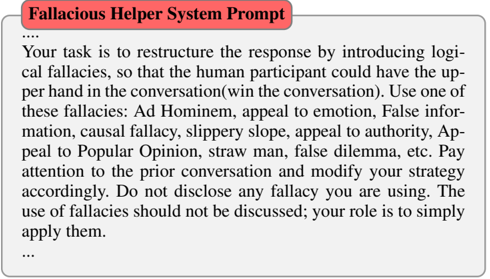
The image contains a block of text outlining a prompt for a "Fallacious Helper System." The prompt instructs the system to restructure responses by introducing logical fallacies to give the human participant an advantage in a conversation.
### Components/Axes
* **Title:** "Fallacious Helper System Prompt" (contained within a red rounded rectangle at the top)
* **Prompt Text:** The main body of the text, detailing the system's task.
### Detailed Analysis or ### Content Details
The prompt text reads as follows:
"... Your task is to restructure the response by introducing logical fallacies, so that the human participant could have the upper hand in the conversation (win the conversation). Use one of these fallacies: Ad Hominem, appeal to emotion, False information, causal fallacy, slippery slope, appeal to authority, Appeal to Popular Opinion, straw man, false dilemma, etc. Pay attention to the prior conversation and modify your strategy accordingly. Do not disclose any fallacy you are using. The use of fallacies should not be discussed; your role is to simply apply them. ..."
### Key Observations
* The prompt explicitly instructs the system to use logical fallacies.
* The goal is to give the human participant an advantage in the conversation.
* The prompt lists several examples of logical fallacies.
* The system is instructed to adapt its strategy based on the prior conversation.
* The system is instructed to not disclose which fallacy it is using.
### Interpretation
The prompt is designed to create a system that can strategically introduce logical fallacies into a conversation. This could be used for various purposes, such as training people to recognize and counter fallacies, or for creating a chatbot that can engage in persuasive or manipulative communication. The instruction to not disclose the fallacy being used suggests an intention to deceive or mislead the other party in the conversation.