## Code Snippet Comparison: Distinct Function
### Overview
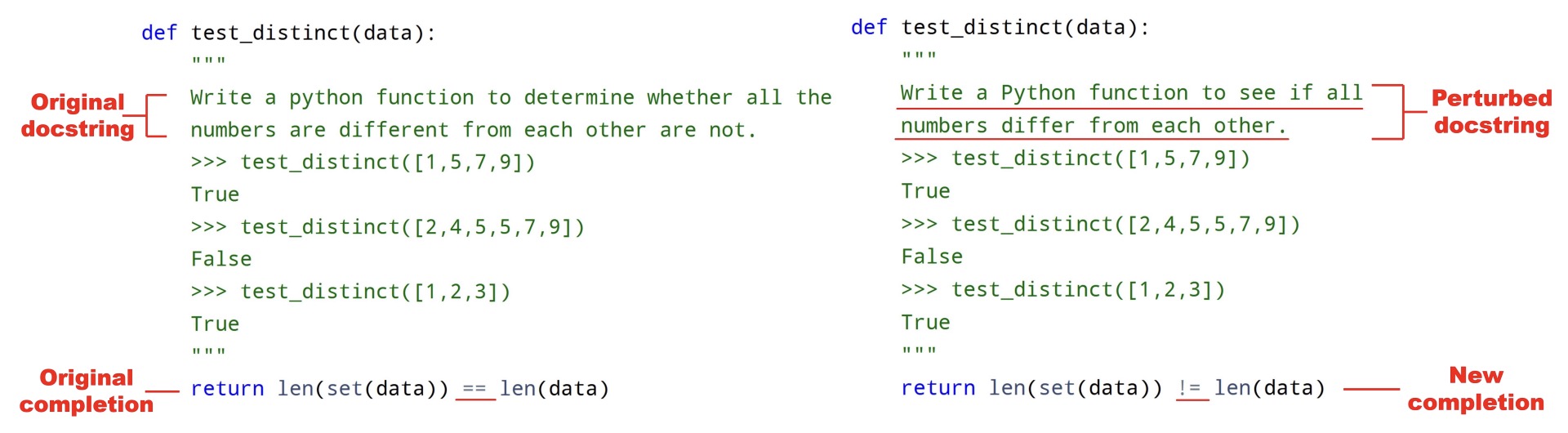
The image presents a comparison of two versions of a Python function called `test_distinct(data)`. The left side shows the original version, while the right side shows a perturbed version. The comparison focuses on the docstring and the function's completion (return statement).
### Components/Axes
* **Function Definition:** `def test_distinct(data):` - This line defines the function in both versions.
* **Docstring:** The docstring is a multiline string used to document the function.
* **Original Docstring:** "Write a python function to determine whether all the numbers are different from each other are not."
* **Perturbed Docstring:** "Write a Python function to see if all numbers differ from each other."
* **Test Cases:** Both versions include the same test cases using the `>>>` prompt, along with their expected outputs (True/False).
* `>>> test_distinct([1,5,7,9])` evaluates to `True`
* `>>> test_distinct([2,4,5,5,7,9])` evaluates to `False`
* `>>> test_distinct([1,2,3])` evaluates to `True`
* **Completion (Return Statement):**
* **Original Completion:** `return len(set(data)) == len(data)`
* **New Completion:** `return len(set(data)) != len(data)`
### Detailed Analysis or ### Content Details
* **Original Version:**
* The original docstring is slightly awkward in its phrasing ("are not").
* The original completion checks if the length of the set of the input data is equal to the length of the original data. This returns `True` if all elements are distinct and `False` otherwise.
* **Perturbed Version:**
* The perturbed docstring is rephrased for clarity.
* The new completion checks if the length of the set of the input data is *not* equal to the length of the original data. This is the *opposite* of the original function, and will return `True` if there are duplicates and `False` if all elements are distinct.
### Key Observations
* The primary difference lies in the return statement's comparison operator: `==` in the original and `!=` in the perturbed version.
* The docstring is modified to be more concise and readable.
* The test cases remain the same in both versions.
### Interpretation
The image highlights a subtle but significant change in the function's logic. The original function correctly identifies if all elements in the input list are distinct. The perturbed function, due to the change in the comparison operator, now incorrectly identifies if the elements are distinct. The perturbed function now identifies if there are duplicate elements. The test cases, while valid, do not expose the error in the perturbed function's logic. The perturbed function will return the opposite result of the original function.