\n
## Code Snippet: Python Function Definition - `test_distinct`
### Overview
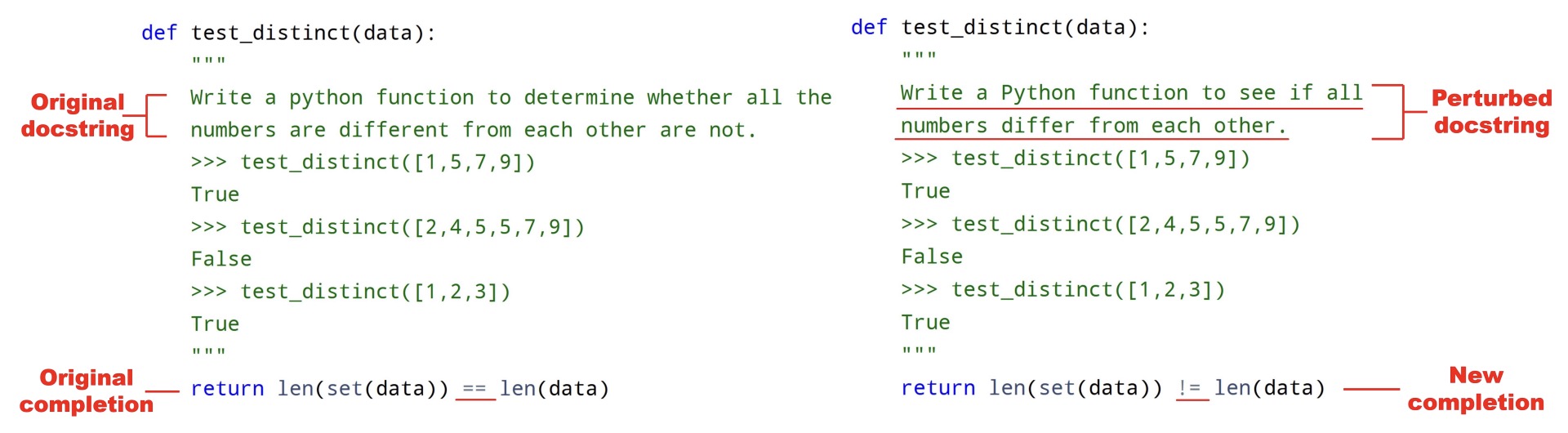
The image presents two versions of a Python function definition named `test_distinct`. The code defines a function that checks if all numbers in a given list are distinct (unique). The image highlights differences between an "Original" and a "Perturbed" version of the code, specifically in the docstring and the function's completion.
### Components/Axes
The image consists of two code blocks, positioned side-by-side. Each block contains:
* A function definition line: `def test_distinct(data):`
* A docstring enclosed in triple double quotes (`"""..."""`).
* Example usages of the function with expected outputs.
* The function's implementation (return statement).
* Annotations indicating "Original" and "New" versions, and "Original docstring" and "Perturbed docstring".
### Detailed Analysis or Content Details
**Original Code Block (Left):**
* **Function Definition:** `def test_distinct(data):`
* **Original Docstring:**
```
"""Write a python function to determine whether all the numbers are different from each other are not."""
```
* **Example Usages & Outputs:**
* `>>> test_distinct([1,5,7,9])`
* `True`
* `>>> test_distinct([2,4,5,5,7,9])`
* `False`
* `>>> test_distinct([1,2,3])`
* `True`
* **Original Completion:** `return len(set(data)) == len(data)`
**New Code Block (Right):**
* **Function Definition:** `def test_distinct(data):`
* **Perturbed Docstring:**
```
"""Write a Python function to see if all numbers differ from each other."""
```
* **Example Usages & Outputs:**
* `>>> test_distinct([1,5,7,9])`
* `True`
* `>>> test_distinct([2,4,5,5,7,9])`
* `False`
* `>>> test_distinct([1,2,3])`
* `True`
* **New Completion:** `return len(set(data)) != len(data)`
**Differences:**
* **Docstring:** The original docstring contains a grammatical error ("are different from each other are not."). The perturbed docstring corrects this to "differ from each other." The original docstring also uses "python" while the perturbed docstring uses "Python".
* **Completion:** The original code uses `==` (equality) in the return statement, while the new code uses `!=` (inequality). This changes the function's logic.
### Key Observations
The primary difference lies in the return statement's comparison operator. The original code correctly checks if the length of the set (unique elements) is equal to the length of the original list. If they are equal, it means all elements are distinct. The perturbed code incorrectly uses `!=`, which would return `True` if the lengths are *not* equal (meaning there are duplicates).
### Interpretation
The image demonstrates a subtle but critical bug introduced during code modification. The change in the comparison operator fundamentally alters the function's behavior. The perturbed docstring is a minor improvement in clarity, but the incorrect return statement renders the function useless. This highlights the importance of careful testing and code review, even for seemingly small changes. The image is a clear example of a regression introduced by a code modification. The original code is correct, while the new code is incorrect. The image is a demonstration of a code change that introduces a bug.