## Code Comparison Diagram: Original vs. Perturbed Python Function
### Overview
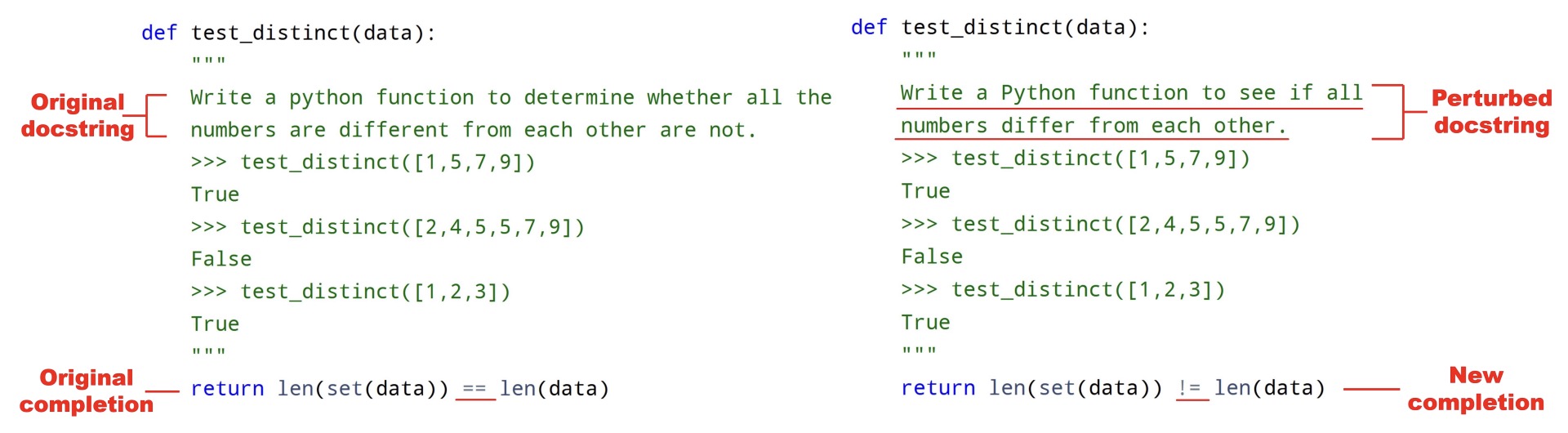
The image displays a side-by-side comparison of two versions of a Python function named `test_distinct`. The left column shows the "Original" version, and the right column shows a "Perturbed" version. Red annotations highlight the specific textual differences between the two, focusing on the docstring and the return statement's logical operator.
### Components/Axes
The image is structured as two vertical code blocks placed side-by-side.
**Left Column (Original):**
* **Function Definition:** `def test_distinct(data):`
* **Docstring (Original docstring):** A multi-line string describing the function's purpose and providing examples.
* **Return Statement (Original completion):** `return len(set(data)) == len(data)`
**Right Column (Perturbed):**
* **Function Definition:** `def test_distinct(data):`
* **Docstring (Perturbed docstring):** A slightly rephrased version of the original docstring.
* **Return Statement (New completion):** `return len(set(data)) != len(data)`
**Annotations (Red Text & Lines):**
* **Top-Left:** "Original docstring" with a line pointing to the docstring in the left column.
* **Top-Right:** "Perturbed docstring" with a line pointing to the docstring in the right column.
* **Bottom-Left:** "Original completion" with a line pointing to the return statement in the left column.
* **Bottom-Right:** "New completion" with a line pointing to the return statement in the right column.
* **Underlines:** Red underlines highlight the changed text within the docstrings and the changed operator (`==` vs. `!=`) in the return statements.
### Detailed Analysis / Content Details
**1. Original Function (Left Column):**
```python
def test_distinct(data):
"""
Write a python function to determine whether all the
numbers are different from each other are not.
>>> test_distinct([1,5,7,9])
True
>>> test_distinct([2,4,5,5,7,9])
False
>>> test_distinct([1,2,3])
True
"""
return len(set(data)) == len(data)
```
* **Docstring Text:** "Write a python function to determine whether all the numbers are different from each other are not."
* **Docstring Examples:**
* Input `[1,5,7,9]` -> Output `True`
* Input `[2,4,5,5,7,9]` -> Output `False`
* Input `[1,2,3]` -> Output `True`
* **Return Logic:** The function returns `True` if the length of the set of `data` (which contains only unique elements) is equal to the length of the original `data` list. This correctly identifies if all elements are distinct.
**2. Perturbed Function (Right Column):**
```python
def test_distinct(data):
"""
Write a Python function to see if all
numbers differ from each other.
>>> test_distinct([1,5,7,9])
True
>>> test_distinct([2,4,5,5,7,9])
False
>>> test_distinct([1,2,3])
True
"""
return len(set(data)) != len(data)
```
* **Docstring Text:** "Write a Python function to see if all numbers differ from each other." (Changes: "python" -> "Python", "determine whether... are different from each other are not" -> "see if... differ from each other").
* **Docstring Examples:** Identical to the original.
* **Return Logic:** The function now returns `True` if the length of the set is **NOT** equal to the length of the original list. This inverts the logic, causing the function to return `True` when there are duplicates and `False` when all elements are distinct.
### Key Observations
1. **Critical Logical Inversion:** The most significant change is the operator in the return statement, flipped from `==` to `!=`. This completely inverts the function's boolean output for any given input.
2. **Docstring Perturbation:** The docstring text is altered with minor wording changes ("Python" capitalized, "see if" instead of "determine whether", "differ" instead of "are different"), but the semantic meaning and the provided examples remain identical.
3. **Example Consistency:** The doctest examples are unchanged between versions. This creates a potential inconsistency in the perturbed version, as the examples show the *original* expected behavior (`True` for distinct lists), but the code now implements the *opposite* logic.
4. **Visual Annotation:** The red annotations and underlines serve as a clear visual guide, isolating the exact points of divergence between the two code snippets.
### Interpretation
This diagram illustrates a **code perturbation** or **adversarial example** for a software testing or machine learning context. It demonstrates how minimal, targeted text changes can have a profound impact on program behavior.
* **What it suggests:** The perturbation is likely designed to test the robustness of a code analysis tool, a code generation model, or a developer's attention to detail. The docstring change is a superficial "distractor," while the operator change is a critical, functional bug.
* **Relationship between elements:** The side-by-side layout and explicit annotations force a direct comparison, highlighting that surface-level text similarity (the docstring) can mask a fundamental logical error. The unchanged examples in the right column act as a trap; a reviewer relying solely on the docstring's examples would not detect the broken functionality.
* **Notable anomaly:** The core anomaly is the **semantic inversion** of the function. The perturbed function `test_distinct` now effectively becomes `test_has_duplicates`. This is a classic example of a "logic bomb" or a subtle regression bug that could be introduced accidentally during code refactoring or maliciously.
* **Broader implication:** This visual serves as a cautionary example for software development and AI code generation. It emphasizes the necessity of:
1. **Testing code against its specification,** not just its docstring examples.
2. **Careful code review** that examines logic, not just comments.
3. **Robust evaluation metrics** for AI code models that go beyond textual similarity to verify functional correctness.