## Chart: Average Incorrect Flips per Iteration
### Overview
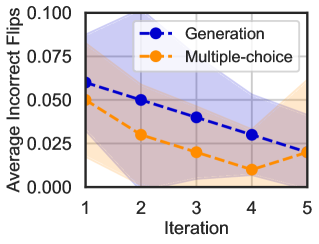
This image displays a 2D line chart with error bands, illustrating the "Average Incorrect Flips" over "Iteration" for two different methods: "Generation" and "Multiple-choice". The chart shows a general downward trend for both methods, indicating a reduction in incorrect flips as iterations increase.
### Components/Axes
The chart is contained within a white background, with a grey grid visible behind the data series.
* **Y-axis (Left)**:
* **Title**: "Average Incorrect Flips"
* **Scale**: Ranges from 0.000 to 0.100.
* **Major Ticks and Labels**: 0.000, 0.025, 0.050, 0.075, 0.100.
* **X-axis (Bottom)**:
* **Title**: "Iteration"
* **Scale**: Ranges from 1 to 5.
* **Major Ticks and Labels**: 1, 2, 3, 4, 5.
* **Legend (Top-right)**:
* Positioned in the upper right quadrant of the plotting area.
* **Entry 1**: A blue dashed line with circular markers. Label: "Generation"
* **Entry 2**: An orange dashed line with circular markers. Label: "Multiple-choice"
### Detailed Analysis
The chart presents two data series, each represented by a dashed line with circular markers and an associated shaded error band.
1. **Generation Series (Blue Dashed Line with Blue Circles)**:
* **Visual Trend**: This line shows a consistent downward trend, indicating that the average incorrect flips decrease with each iteration. The rate of decrease appears somewhat linear.
* **Data Points (Approximate)**:
* Iteration 1: Approximately 0.060
* Iteration 2: Approximately 0.050
* Iteration 3: Approximately 0.040
* Iteration 4: Approximately 0.030
* Iteration 5: Approximately 0.020
* **Error Band**: A light blue/purple shaded area surrounds the blue line, representing the uncertainty or variability. This band is wider at earlier iterations (e.g., Iteration 1, spanning roughly 0.04 to 0.09) and narrows towards later iterations (e.g., Iteration 5, spanning roughly 0.01 to 0.03).
2. **Multiple-choice Series (Orange Dashed Line with Orange Circles)**:
* **Visual Trend**: This line also shows a general downward trend, but with a slight upward turn at the final iteration. It decreases more steeply initially than the "Generation" series.
* **Data Points (Approximate)**:
* Iteration 1: Approximately 0.050
* Iteration 2: Approximately 0.030
* Iteration 3: Approximately 0.020
* Iteration 4: Approximately 0.010
* Iteration 5: Approximately 0.020
* **Error Band**: A light orange/brown shaded area surrounds the orange line. Similar to the "Generation" series, this band is wider at earlier iterations (e.g., Iteration 1, spanning roughly 0.02 to 0.07) and narrows towards later iterations (e.g., Iteration 5, spanning roughly 0.01 to 0.03).
### Key Observations
* At **Iteration 1**, "Generation" has a higher average incorrect flips (approx. 0.060) compared to "Multiple-choice" (approx. 0.050).
* "Multiple-choice" shows a steeper initial decrease in incorrect flips from Iteration 1 to Iteration 4.
* "Generation" shows a more consistent, almost linear, decrease across all iterations.
* At **Iteration 4**, "Multiple-choice" achieves its lowest point (approx. 0.010), performing better than "Generation" (approx. 0.030).
* At **Iteration 5**, "Multiple-choice" slightly increases its average incorrect flips (approx. 0.020), while "Generation" continues its decrease, reaching approximately 0.020. This results in both methods having very similar performance at Iteration 5.
* The error bands for both series overlap significantly across all iterations, especially from Iteration 3 onwards, suggesting that the difference between the two methods might not be statistically significant at all points, particularly towards the end. The overlap is most pronounced at Iteration 5.
* Both methods demonstrate an improvement (reduction in incorrect flips) over iterations, indicating a learning or refinement process.
### Interpretation
The data suggests that both "Generation" and "Multiple-choice" methods become more accurate (fewer incorrect flips) as the number of iterations increases. This implies that iterative processes are beneficial for reducing errors in the context being measured.
Initially, the "Multiple-choice" method appears to have a slight advantage, starting with fewer incorrect flips and showing a more rapid improvement up to Iteration 4. However, its performance slightly degrades or stabilizes at Iteration 5, showing a minor increase in incorrect flips. This could indicate a plateau, an overfitting issue, or simply more variability at that specific iteration for the "Multiple-choice" approach.
The "Generation" method, while starting with a higher error rate, demonstrates a more stable and consistent improvement across all iterations, maintaining a steady downward trend. By Iteration 5, both methods converge to a very similar level of average incorrect flips (approximately 0.020), and their error bands overlap substantially. This convergence suggests that, in the long run (or after 5 iterations), the performance difference between "Generation" and "Multiple-choice" becomes negligible in terms of average incorrect flips.
The significant overlap of the error bands throughout the chart, particularly at the later iterations, is a critical point. It implies that while there might be observed differences in the mean values, the uncertainty associated with these measurements means that the true performance of the two methods might not be statistically distinct at many points, especially towards the end of the observed iterations. Further statistical analysis would be needed to confirm if any observed differences are truly significant. The narrowing of the error bands over iterations for both methods suggests that the performance becomes more consistent or predictable with more iterations.