## Textual Document: Prompt Template for Multimodal Mathematical Problem Solving
### Overview
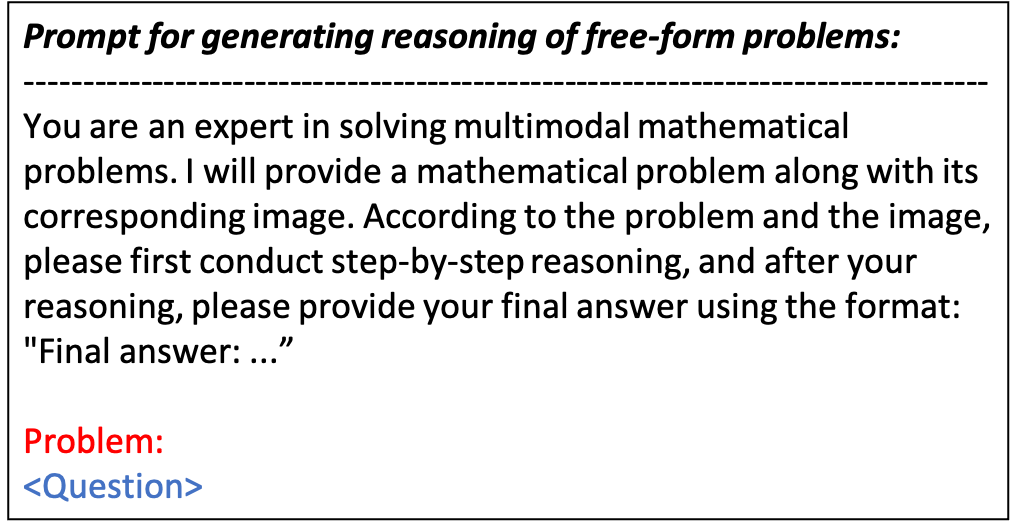
The image displays a structured text prompt designed to instruct an AI model on how to process and solve multimodal mathematical problems. The document acts as a template, establishing a persona for the AI, defining the required workflow (reasoning before answering), and specifying the output format.
### Components/Sections
The document is organized into three distinct vertical sections:
1. **Header:** A bolded title defining the purpose of the prompt.
2. **Instructional Body:** The core directive for the AI model.
3. **Input Placeholder:** A specific area designated for the user to input the problem.
### Content Details
**1. Header (Top)**
* **Text:** "Prompt for generating reasoning of free-form problems:"
* **Formatting:** Bold, left-aligned.
**2. Separator**
* A dashed line spans the width of the text block, separating the header from the body.
**3. Instructional Body (Center)**
* **Text:** "You are an expert in solving multimodal mathematical problems. I will provide a mathematical problem along with its corresponding image. According to the problem and the image, please first conduct step-by-step reasoning, and after your reasoning, please provide your final answer using the format: \"Final answer: ...\""
* **Key Directives:**
* **Persona:** "Expert in solving multimodal mathematical problems."
* **Input Expectation:** A mathematical problem + an image.
* **Process:** "First conduct step-by-step reasoning."
* **Output Constraint:** Must use the specific format "Final answer: ..."
**4. Input Placeholder (Bottom)**
* **Text:** "Problem:" (colored in red)
* **Text:** "<Question>" (colored in blue, enclosed in angle brackets)
### Key Observations
* **Chain-of-Thought Enforcement:** The prompt explicitly mandates a "step-by-step reasoning" process. This is a standard technique in Large Language Model (LLM) prompting to improve accuracy in complex reasoning tasks by forcing the model to decompose the problem before committing to a final answer.
* **Multimodal Context:** The prompt explicitly acknowledges the "multimodal" nature of the task, requiring the model to synthesize information from both the provided text and the image.
* **Color Coding:** The use of red for "Problem:" and blue for "<Question>" suggests this is likely a template used in a coding environment or a structured prompt interface where placeholders are visually distinct from the instructions.
### Interpretation
This document serves as a "System Prompt" or "Instructional Template." Its primary function is to constrain the behavior of an AI model to ensure high-quality, verifiable outputs.
By requiring the model to act as an "expert" and explicitly demanding "step-by-step reasoning," the prompt aims to mitigate common AI failure modes, such as jumping to conclusions or making calculation errors. The requirement for a specific output format ("Final answer: ...") is designed to facilitate automated parsing or grading of the AI's response, making it highly suitable for benchmarking, automated testing, or educational platforms where the reasoning process is as important as the final result.