## Text-Based Prompt Template: Free-Form Problem Reasoning
### Overview
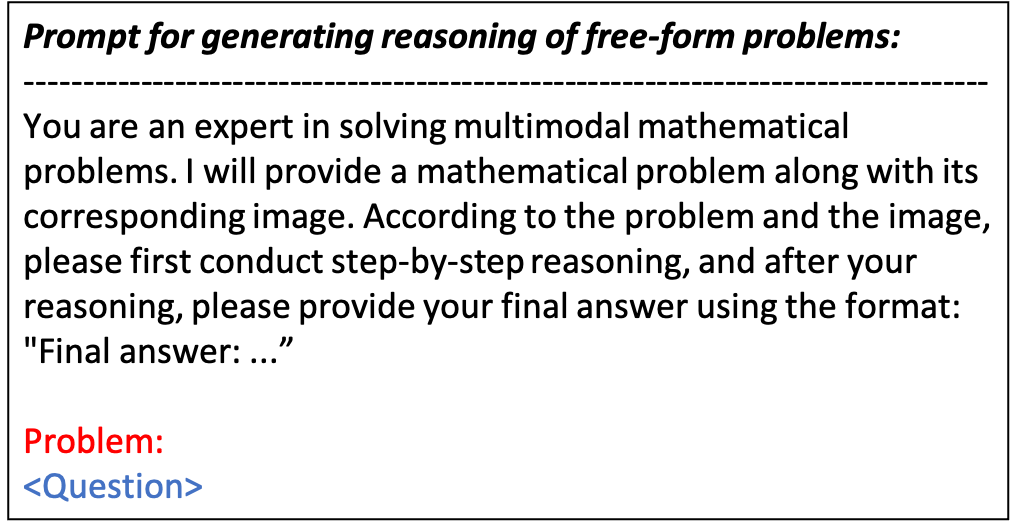
The image displays a text-based prompt template designed to instruct an AI model on how to approach and solve free-form mathematical problems. The template is presented within a simple bordered box and contains structured instructions, a placeholder for a problem, and formatting cues (color, dashed lines) to organize the content.
### Components/Axes
The image is a single, self-contained text block with the following structural elements:
1. **Header/Title**: Located at the top, in bold text: "Prompt for generating reasoning of free-form problems:"
2. **Separator**: A dashed line (`-------------------`) directly below the title.
3. **Instructional Paragraph**: The main body of text, which defines the AI's role and the required output format.
4. **Problem Section**: Located at the bottom, initiated by a red-colored label "Problem:" followed by a blue-colored placeholder tag `<Question>`.
### Content Details
The complete textual content of the image is transcribed below. All text is in English.
**Title:**
`Prompt for generating reasoning of free-form problems:`
**Separator:**
`-------------------`
**Instructional Text:**
`You are an expert in solving multimodal mathematical problems. I will provide a mathematical problem along with its corresponding image. According to the problem and the image, please first conduct step-by-step reasoning, and after your reasoning, please provide your final answer using the format: "Final answer: ..."`
**Problem Section:**
`Problem:` (displayed in red font)
`<Question>` (displayed in blue font, serving as a placeholder)
### Key Observations
* **Formatting Cues**: The template uses visual formatting to denote different sections. The title is bold, a dashed line creates a visual break, and color is used to highlight the "Problem:" label (red) and the question placeholder (blue).
* **Structured Workflow**: The instructions explicitly define a two-step process for the AI: 1) Provide step-by-step reasoning, and 2) Deliver a final answer in a specific, quoted format.
* **Multimodal Context**: The prompt specifies that the AI will receive both a textual problem and a corresponding image, indicating it is designed for a multimodal AI system.
* **Placeholder Usage**: The `<Question>` tag is a clear placeholder, indicating where the specific mathematical problem text would be inserted when using this template.
### Interpretation
This image is not a data chart but a **meta-instructional document**. Its purpose is to standardize how an AI model should process and respond to complex, open-ended mathematical problems that may involve visual data.
* **What it demonstrates**: It reveals a methodology for eliciting structured, transparent reasoning from an AI. By mandating a "step-by-step" process before the final answer, the template aims to make the AI's problem-solving logic auditable and to reduce the likelihood of a purely guessed or opaque final result.
* **How elements relate**: The title sets the context. The dashed line separates the title from the core instructions. The instructional paragraph defines the AI's persona ("expert"), the input modalities (text + image), and the required output structure. The final "Problem:" section is the designated slot for the actual task, creating a clear separation between the *instructions for how to work* and the *work itself*.
* **Notable Design Choice**: The use of a specific, quoted format for the final answer (`"Final answer: ..."`) is a key design feature. It creates a predictable, machine-readable endpoint for the response, which is crucial for automated evaluation or downstream processing of the AI's output. This template is a tool for controlling and standardizing AI behavior in a research or application setting.