## Line Chart: MRCR - Cumulative Average Score vs. Number of Tokens in Context
### Overview
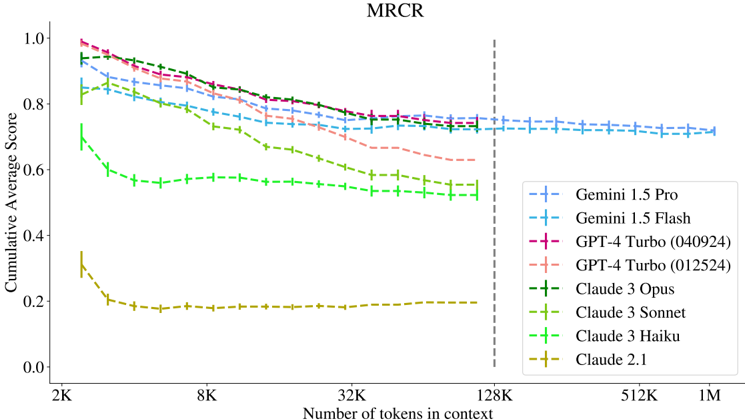
The image displays a line chart titled "MRCR" that plots the performance of eight different large language models (LLMs) as a function of their context window size. The chart illustrates how the "Cumulative Average Score" (y-axis) changes as the "Number of tokens in context" (x-axis) increases from 2,000 (2K) to 1,000,000 (1M) tokens. The general trend for most models is a decline in score as context length increases, though the rate and severity of decline vary significantly between models.
### Components/Axes
* **Title:** "MRCR" (centered at the top).
* **Y-Axis:**
* **Label:** "Cumulative Average Score".
* **Scale:** Linear, ranging from 0.0 to 1.0, with major tick marks at 0.0, 0.2, 0.4, 0.6, 0.8, and 1.0.
* **X-Axis:**
* **Label:** "Number of tokens in context".
* **Scale:** Logarithmic (base 2), with labeled tick marks at 2K, 8K, 32K, 128K, 512K, and 1M.
* **Legend:** Positioned in the bottom-right quadrant of the chart area. It contains eight entries, each with a unique color, line style (dashed), and marker symbol (+).
* **Reference Line:** A vertical dashed gray line is drawn at the 128K token mark on the x-axis.
### Detailed Analysis
**Legend and Data Series (from top to bottom at the 2K token starting point):**
1. **GPT-4 Turbo (040924):** Dark magenta/purple line with '+' markers. Starts highest at ~0.99 (2K). Shows a steady, moderate decline to ~0.75 at 128K. Data ends at 128K.
2. **Claude 3 Opus:** Dark green line with '+' markers. Starts at ~0.97 (2K). Declines steadily, closely following but slightly below GPT-4 Turbo (040924), reaching ~0.73 at 128K. Data ends at 128K.
3. **Gemini 1.5 Pro:** Blue line with '+' markers. Starts at ~0.93 (2K). Declines gradually and linearly, crossing above the GPT-4 Turbo (012524) line around 32K. Reaches ~0.72 at 128K and continues a very slow decline to ~0.71 at 1M.
4. **GPT-4 Turbo (012524):** Light salmon/pink line with '+' markers. Starts at ~0.98 (2K). Declines more steeply than its 040924 counterpart, dropping to ~0.67 at 128K. Data ends at 128K.
5. **Gemini 1.5 Flash:** Light blue/cyan line with '+' markers. Starts at ~0.85 (2K). Declines at a moderate, steady rate, reaching ~0.71 at 128K and ~0.70 at 1M.
6. **Claude 3 Sonnet:** Light olive/yellow-green line with '+' markers. Starts at ~0.83 (2K). Shows a pronounced decline, dropping to ~0.58 at 128K. Data ends at 128K.
7. **Claude 3 Haiku:** Bright green line with '+' markers. Starts at ~0.70 (2K). Experiences a sharp initial drop to ~0.57 by 8K, then declines more slowly to ~0.52 at 128K. Data ends at 128K.
8. **Claude 2.1:** Olive/brown line with '+' markers. Starts significantly lower than all others at ~0.33 (2K). Drops quickly to ~0.19 by 8K and then remains nearly flat, plateauing around 0.19-0.20 through 128K. Data ends at 128K.
**Spatial Grounding & Trend Verification:**
* The legend is placed in the bottom-right, overlapping the lower portion of the chart but not obscuring critical data points for the top-performing models.
* **Trend Check:** All lines slope downward or remain flat as they move right (increasing tokens). No line shows an upward trend. The steepness of the slope correlates with the severity of performance degradation with longer contexts.
### Key Observations
1. **Performance Hierarchy at Short Context (2K):** There is a clear tiered structure. GPT-4 Turbo (040924) and Claude 3 Opus lead (~0.97-0.99), followed by Gemini 1.5 Pro and GPT-4 Turbo (012524) (~0.93-0.98), then Gemini 1.5 Flash and Claude 3 Sonnet (~0.83-0.85), then Claude 3 Haiku (~0.70), with Claude 2.1 as a significant outlier at the bottom (~0.33).
2. **Degradation Patterns:**
* **Most Resilient:** Gemini 1.5 Pro and Gemini 1.5 Flash show the most gradual, linear declines and are the only models with data extending to 1M tokens, maintaining scores above 0.70.
* **Moderate Decline:** GPT-4 Turbo (040924) and Claude 3 Opus decline steadily but remain the top performers up to 128K.
* **Steep Decline:** GPT-4 Turbo (012524), Claude 3 Sonnet, and especially Claude 3 Haiku show steeper drops in performance as context grows.
* **Flatline Low Performance:** Claude 2.1 starts very low and shows almost no change after an initial drop, indicating a possible performance floor.
3. **The 128K Benchmark:** The vertical dashed line at 128K tokens serves as a common evaluation point for seven of the eight models (all except the Gemini models, which extend further). At this point, the top cluster (GPT-4 Turbo 040924, Claude 3 Opus, Gemini 1.5 Pro) is tightly grouped between ~0.72-0.75.
4. **Model Version Impact:** The two GPT-4 Turbo versions (040924 vs. 012524) show a notable performance gap, with the 040924 version consistently outperforming the 012524 version across all context lengths, suggesting significant updates between versions.
### Interpretation
This chart benchmarks the "needle-in-a-haystack" or retrieval-augmented generation (RAG) capability of major LLMs across vastly different context lengths, as measured by the MRCR (likely "Multi-Row Contextual Retrieval" or similar) metric. The data suggests a fundamental trade-off: **maintaining high accuracy on specific information retrieval tasks becomes exponentially harder as the volume of information in the context window increases.**
* **Technological Differentiation:** The Gemini 1.5 models' ability to maintain performance out to 1M tokens, albeit with a decline, highlights a potential architectural or training advantage for extremely long-context tasks. The tight clustering of top models at 128K suggests convergence in performance for "standard" long-context windows among leading models.
* **Practical Implications:** For applications requiring high precision retrieval from very long documents (e.g., legal contract analysis, comprehensive codebase review), the choice of model and context length is critical. Using a model like Claude 3 Haiku or an older version like Claude 2.1 with a long context would likely yield poor results. The steep decline of some models indicates they may "lose their place" or fail to attend to relevant information amidst distractors as context grows.
* **Anomaly:** Claude 2.1's performance is a stark outlier, suggesting it either was not designed for this type of task, represents a much earlier stage of long-context capability, or the metric is particularly unsuited to its architecture. Its flat line indicates it fails consistently regardless of context length beyond a very low threshold.
* **Underlying Question:** The chart prompts investigation into *why* performance degrades. Is it a limitation of attention mechanisms, a training data artifact, or an inherent challenge of information density? The variance between model families (Gemini, GPT, Claude) and within families (Claude 3 Opus vs. Haiku, GPT-4 Turbo versions) provides rich data for such analysis.