## Diagram: Plausible Explanation Flowchart
### Overview
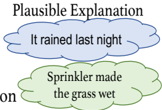
The image displays a simple, two-step causal diagram presented in a hand-drawn, sketch-like style. It illustrates two potential explanations for an observed effect (wet grass). The diagram uses cloud-shaped text boxes connected by a directional arrow to show a proposed logical relationship or sequence of events.
### Components/Axes
* **Title/Header:** Centered at the top of the image is the text "Plausible Explanation" in a standard, sans-serif font.
* **Primary Elements:** Two cloud-shaped text bubbles.
* **Left Cloud:** Contains the text "It rained last night".
* **Right Cloud:** Contains the text "Sprinkler made the grass wet".
* **Connector:** A single, hand-drawn arrow points from the left cloud to the right cloud, indicating a directional relationship.
* **Partial Text:** On the far left edge of the image, the letters "on" are partially visible, suggesting this diagram may be cropped from a larger context or slide.
### Detailed Analysis
* **Text Transcription:**
* **Title:** "Plausible Explanation"
* **Left Cloud Text:** "It rained last night"
* **Right Cloud Text:** "Sprinkler made the grass wet"
* **Partial Text:** "on" (incomplete, context unknown).
* **Spatial Layout & Flow:**
* The title is positioned at the top-center.
* The "It rained last night" cloud is positioned in the center-left.
* The "Sprinkler made the grass wet" cloud is positioned in the center-right.
* The arrow originates from the right side of the left cloud and terminates at the left side of the right cloud, creating a clear left-to-right flow.
* **Visual Style:** The clouds and arrow are drawn with a soft, irregular outline, giving an informal, conceptual feel. The text inside the clouds is in a clean, legible font.
### Key Observations
1. **Causal Implication:** The arrow explicitly links the two statements, suggesting that "It rained last night" is being presented as a cause, explanation, or preceding event for "Sprinkler made the grass wet."
2. **Logical Tension:** The content of the two statements presents a potential contradiction or alternative explanations. Rain and a sprinkler are two distinct causes for wet grass. The diagram's structure (arrow from rain to sprinkler) is unusual for presenting alternatives, which are typically shown as parallel branches.
3. **Incomplete Context:** The partial word "on" at the left edge indicates this is likely a segment of a larger presentation, possibly the end of a bullet point or sentence like "Focus on..." or "Based on..."
### Interpretation
This diagram appears to be a pedagogical or explanatory tool, likely used to discuss logic, reasoning, or scientific explanation. Its primary function is to visually model a proposed causal chain.
* **What it Suggests:** The diagram asserts a specific, perhaps counter-intuitive, plausible explanation: that the event of raining last night is the reason or cause for the sprinkler having made the grass wet. This could be illustrating a logical fallacy (e.g., *post hoc ergo propter hoc*), a mistaken assumption, or a specific scenario where one event influences another (e.g., rain triggering an automatic sprinkler system to turn off, but the statement is phrased as the sprinkler causing wetness).
* **Relationship Between Elements:** The arrow is the critical component, transforming two independent observations into a single explanatory narrative. It forces the viewer to consider a relationship that may not be immediately obvious or correct.
* **Notable Anomalies:** The core anomaly is the direction of causality implied. In common understanding, rain and sprinklers are separate causes. The diagram challenges the viewer to question this assumption or to consider a specific context where this chain makes sense. The informal, sketched style suggests it's meant for brainstorming or illustrating a thought process rather than presenting a definitive fact.
**Language Note:** All text in the image is in English.