## Diagram: Plausible Explanations for Wet Grass
### Overview
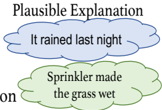
This image displays a simple diagram illustrating two plausible explanations for why grass might be wet. The explanations are presented within cloud-shaped text boxes.
### Components/Axes
There are no axes or legends in this diagram. The components are:
* **Title:** "Plausible Explanation" (positioned above the cloud shapes).
* **Explanation 1:** A blue cloud shape containing the text "It rained last night".
* **Explanation 2:** A green cloud shape containing the text "Sprinkler made the grass wet".
* **Connecting Text:** The word "on" is present to the left of the green cloud, suggesting a connection or continuation from a preceding element not shown in the image.
### Content Details
* **Plausible Explanation:** This is the overarching label for the presented scenarios.
* **It rained last night:** This is a textual explanation presented in a blue cloud.
* **Sprinkler made the grass wet:** This is a textual explanation presented in a green cloud.
* **on:** This word appears to be a connector, implying that the following explanations are related to a preceding statement or observation.
### Key Observations
The diagram presents two distinct and common reasons for wet grass. The use of different colored clouds (blue for rain, green for sprinkler) visually differentiates the explanations.
### Interpretation
This diagram visually represents a basic form of causal reasoning or hypothesis generation. Given an observation (presumably that the grass is wet, though not explicitly stated in this cropped image), two potential causes are offered. The "Plausible Explanation" title indicates that these are reasonable, albeit not necessarily confirmed, reasons. The presence of the word "on" suggests this is part of a larger context, possibly a decision tree or a list of possibilities being considered. The diagram is straightforward and aims to convey simple, relatable scenarios.