## Code Snippet: Theorem Definition
### Overview
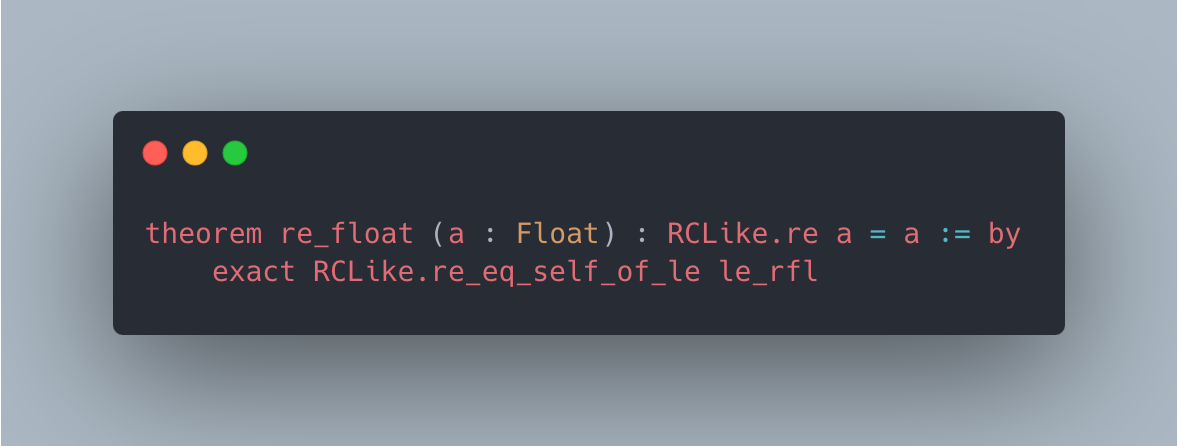
The image displays a code snippet defining a theorem named `re_float`. The code appears to be written in a formal language, likely a proof assistant like Lean or Coq. The theorem states a property related to real numbers (Floats) and their representation within a specific context (RCLike).
### Components/Axes
* **Window Decorations:** The code is presented within a dark-themed window with standard macOS-style close (red), minimize (yellow), and maximize (green) buttons in the top-left corner.
* **Code:** The code consists of two lines:
* `theorem re_float (a : Float) : RCLike.re a = a := by`
* `exact RCLike.re_eq_self_of_le le_rfl`
### Detailed Analysis or ### Content Details
The code snippet defines a theorem named `re_float`.
* The theorem takes a variable `a` of type `Float` as input.
* The theorem states that `RCLike.re a = a`. This suggests that `RCLike.re` is a function or property that extracts the real part of a `Float` within the `RCLike` context, and the theorem asserts that this real part is equal to the original `Float` value.
* The `:= by` indicates the start of the proof.
* The `exact RCLike.re_eq_self_of_le le_rfl` line provides the proof. It uses a function or lemma named `RCLike.re_eq_self_of_le` and applies it to `le_rfl`. This suggests that the proof relies on the reflexivity of the less-than-or-equal-to relation (`le_rfl`) and a property (`RCLike.re_eq_self_of_le`) that connects the real part extraction with the less-than-or-equal-to relation.
### Key Observations
* The code uses a formal syntax common in proof assistants.
* The theorem relates a `Float` value to its real part within a specific context (`RCLike`).
* The proof relies on reflexivity and a specific property related to the real part extraction.
### Interpretation
The code snippet defines and proves a theorem stating that extracting the real part of a `Float` value within the `RCLike` context results in the original `Float` value. This theorem likely serves as a fundamental property within a larger formalization of real number theory or numerical computation. The proof demonstrates how this property can be derived from more basic axioms or lemmas. The `RCLike` context likely provides a specific representation or interpretation of real numbers within the formal system.