\n
## Screenshot: Code Snippet in a Terminal/Editor Window
### Overview
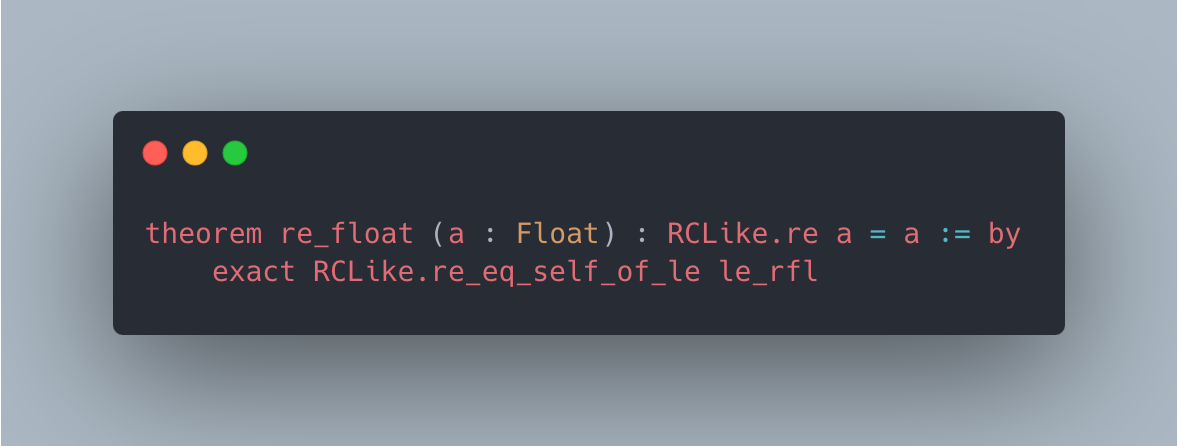
The image displays a screenshot of a dark-themed code editor or terminal window containing a single line of code written in what appears to be a formal verification or theorem-proving language (likely Lean 4, based on syntax). The window is centered against a soft, gradient background.
### Components/Axes
* **Window Frame:** A dark gray, rectangular window with rounded corners and a subtle drop shadow, giving it a floating appearance.
* **Window Controls:** Three colored circular buttons are positioned in the top-left corner of the window frame. From left to right: red, yellow, green. These are standard macOS-style window control buttons for close, minimize, and maximize/zoom.
* **Code Content Area:** The main body of the window contains a single line of monospaced text with syntax highlighting.
* **Background:** The area surrounding the window is a smooth, gradient background transitioning from a lighter gray at the top to a slightly darker gray at the bottom.
### Detailed Analysis
**Text Transcription (Exact):**
```
theorem re_float (a : Float) : RCLike.re a = a := by
exact RCLike.re_eq_self_of_le le_rfl
```
**Syntax Highlighting & Formatting:**
* The text is rendered in a monospaced font.
* **Color Coding:**
* Keywords (`theorem`, `by`, `exact`) are in a salmon/pink color.
* The type `Float` is in a yellow/gold color.
* The theorem name (`re_float`), variable (`a`), and most other identifiers (`RCLike.re`, `RCLike.re_eq_self_of_le`, `le_rfl`) are in a light gray or off-white color.
* Operators and punctuation (`(`, `)`, `:`, `=`, `:=`) are in the same light gray color.
* The code is indented on the second line, indicating it is the proof script following the `:= by` keyword.
### Key Observations
1. **Language Identification:** The syntax (`theorem ... : ... := by`, `exact`) is characteristic of the Lean 4 theorem prover and programming language.
2. **Code Purpose:** The code defines a theorem named `re_float`. It asserts that for any term `a` of type `Float`, the expression `RCLike.re a` is equal to `a`.
3. **Proof Method:** The proof is completed in a single step using the `exact` tactic, applying a pre-existing lemma or theorem named `RCLike.re_eq_self_of_le` with the argument `le_rfl`.
4. **Contextual Inference:** The namespace `RCLike` suggests this is part of a library dealing with complex numbers or algebraic structures where `re` denotes the real part. The theorem states that the "real part" of a `Float` is the float itself, which is a tautology if `Float` is considered a subtype of real numbers.
### Interpretation
This image is a technical artifact from the domain of formal methods and dependent type theory. It captures a moment of formal verification where a programmer or mathematician has proven a basic property about floating-point numbers within a specific mathematical framework (`RCLike`).
* **What it demonstrates:** The snippet shows the conciseness and expressiveness of modern theorem-proving languages. A fundamental property is stated and proven in two lines. The use of `le_rfl` (likely short for "less-than-or-equal reflexivity") as an argument hints at the underlying logical structure, possibly relating to an ordering property of real numbers.
* **Relationship between elements:** The window controls and syntax highlighting are purely presentational, framing the core informational content: the formal statement and proof of a theorem. The code itself is the primary data.
* **Notable aspects:** The most significant observation is the *content* of the theorem. It is a foundational, almost trivial, statement. Its presence in a codebase likely serves as a building block for more complex proofs involving real numbers or complex analysis where `Float` is used as a concrete representation. The screenshot might be used in documentation, a tutorial, or a presentation to illustrate basic syntax or a specific library (`RCLike`).