## Line Chart: Interestingness vs. Number of Steps
### Overview
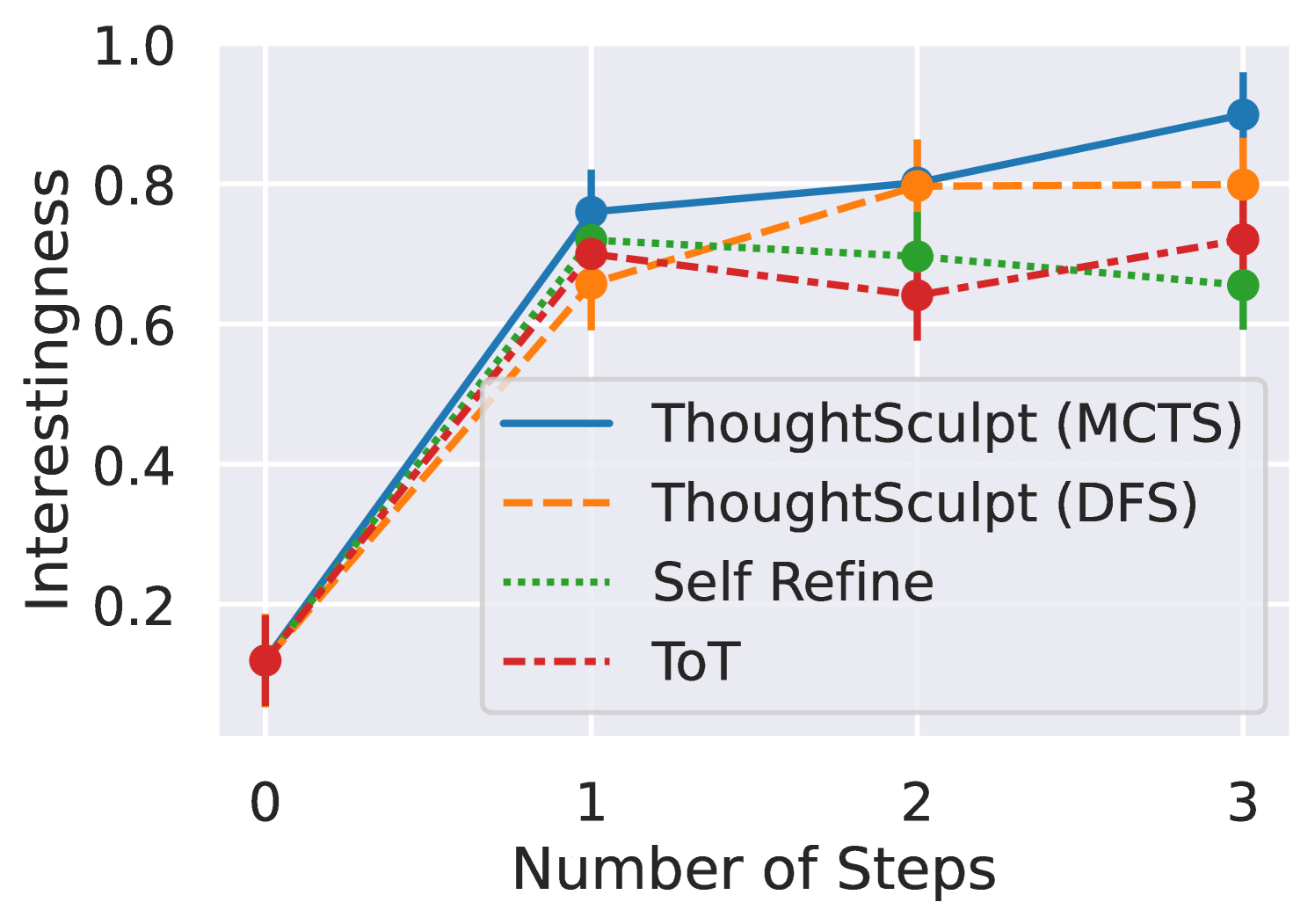
This image displays a line chart illustrating the "Interestingness" metric across different "Number of Steps" for four distinct methods: ThoughtSculpt (MCTS), ThoughtSculpt (DFS), Self Refine, and ToT. The chart shows how the interestingness of each method evolves as the number of steps increases from 0 to 3.
### Components/Axes
* **Y-axis Title**: "Interestingness"
* **Scale**: Linear, ranging from 0.0 to 1.0.
* **Markers**: 0.0, 0.2, 0.4, 0.6, 0.8, 1.0.
* **X-axis Title**: "Number of Steps"
* **Scale**: Linear, ranging from 0 to 3.
* **Markers**: 0, 1, 2, 3.
* **Legend**: Located in the bottom-right quadrant of the chart. It maps line styles and colors to the respective methods:
* **Blue Solid Line with Circle Markers**: ThoughtSculpt (MCTS)
* **Orange Dashed Line with Circle Markers**: ThoughtSculpt (DFS)
* **Green Dotted Line with Circle Markers**: Self Refine
* **Red Dashed Line with Circle Markers**: ToT
### Detailed Analysis
The chart presents data points with error bars for each method at each step.
**ThoughtSculpt (MCTS) - Blue Solid Line:**
* **Trend**: Slopes upward consistently.
* **Data Points (approximate values with uncertainty)**:
* Step 0: 0.17 ± 0.02
* Step 1: 0.78 ± 0.01
* Step 2: 0.82 ± 0.01
* Step 3: 0.90 ± 0.01
**ThoughtSculpt (DFS) - Orange Dashed Line:**
* **Trend**: Slopes upward initially, then plateaus and slightly decreases.
* **Data Points (approximate values with uncertainty)**:
* Step 0: 0.17 ± 0.02
* Step 1: 0.70 ± 0.02
* Step 2: 0.81 ± 0.01
* Step 3: 0.80 ± 0.01
**Self Refine - Green Dotted Line:**
* **Trend**: Slopes upward initially, then shows a slight dip and then a gradual increase.
* **Data Points (approximate values with uncertainty)**:
* Step 0: 0.17 ± 0.02
* Step 1: 0.70 ± 0.01
* Step 2: 0.65 ± 0.02
* Step 3: 0.72 ± 0.01
**ToT - Red Dashed Line:**
* **Trend**: Slopes upward initially, then shows a dip and a slight increase.
* **Data Points (approximate values with uncertainty)**:
* Step 0: 0.15 ± 0.02
* Step 1: 0.72 ± 0.01
* Step 2: 0.64 ± 0.02
* Step 3: 0.70 ± 0.01
### Key Observations
* **Initial Performance**: All four methods start with very similar "Interestingness" values at Step 0, around 0.15-0.17.
* **Rapid Improvement**: All methods show a significant increase in "Interestingness" from Step 0 to Step 1.
* **Divergence at Later Steps**: After Step 1, the methods begin to diverge.
* ThoughtSculpt (MCTS) consistently increases its "Interestingness" and achieves the highest value at Step 3.
* ThoughtSculpt (DFS) shows a plateau and slight decrease after Step 2.
* Self Refine and ToT show a dip in "Interestingness" at Step 2 before a slight recovery at Step 3.
* **Top Performer**: ThoughtSculpt (MCTS) appears to be the most effective method in terms of increasing "Interestingness" over the steps, particularly from Step 2 onwards.
* **Error Bars**: The error bars are generally small, indicating relatively low variance in the measurements for each data point.
### Interpretation
The chart demonstrates the performance of different methods in generating "interesting" outputs over a series of steps. The initial similarity suggests that all methods are capable of producing some level of interestingness at the outset. The rapid increase from Step 0 to Step 1 indicates a common learning or exploration phase.
The divergence in performance at later steps highlights the distinct characteristics of each method. ThoughtSculpt (MCTS) shows a sustained improvement, suggesting its strategy is robust and continues to yield more interesting results with more steps. ThoughtSculpt (DFS), while performing well initially, seems to reach a point of diminishing returns or a different optimization objective that leads to a plateau.
The dip observed in Self Refine and ToT at Step 2, followed by a slight recovery, could indicate a trade-off or a more complex optimization landscape where intermediate steps might temporarily reduce interestingness before a better solution is found. However, their overall performance at Step 3 is lower than ThoughtSculpt (MCTS).
In essence, the data suggests that for maximizing "Interestingness" over an increasing number of steps, ThoughtSculpt (MCTS) is the superior method among those evaluated. The other methods, while showing promise, exhibit different patterns of performance that might be indicative of different underlying mechanisms or objectives. The error bars suggest that the observed trends are statistically reliable.