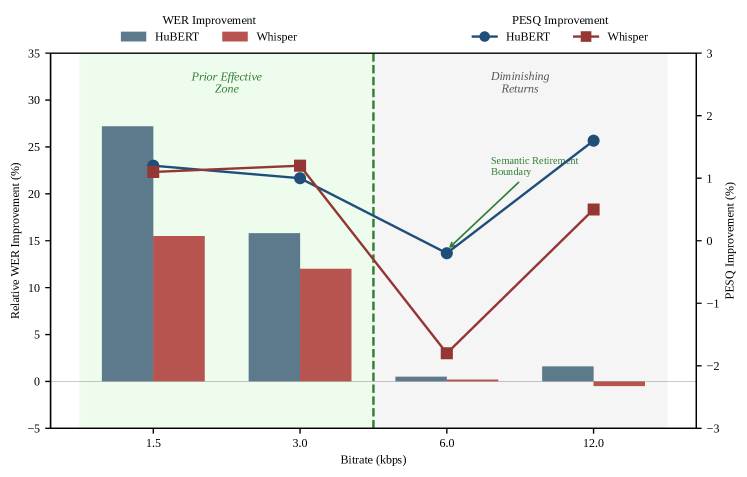
## Line/Bar Chart: WER and PESQ Improvement Comparison Across Bitrates
### Overview
The chart compares Word Error Rate (WER) and Perceptual Evaluation of Speech Quality (PESQ) improvements between two models (HuBERT and Whisper) across four bitrates (1.5, 3.0, 6.0, and 12.0 kbp). It includes two y-axes: left for WER improvement (%) and right for PESQ improvement (%), with a legend distinguishing the models by color (blue for HuBERT, red for Whisper). Two zones are annotated: "Prior Effective Zone" (green shading) and "Diminishing Returns" (gray shading), with a "Semantic Retirement Boundary" line (green dashed) connecting PESQ data points at 6.0 and 12.0 kbp.
### Components/Axes
- **X-axis**: Bitrate (kbp), labeled with markers at 1.5, 3.0, 6.0, and 12.0.
- **Left Y-axis**: Relative WER Improvement (%), ranging from -5% to 35%.
- **Right Y-axis**: PESQ Improvement (%), ranging from -3% to 3%.
- **Legend**: Top-left, with blue squares for HuBERT and red squares for Whisper.
- **Zones**:
- "Prior Effective Zone" (green shading, left of dashed vertical line at 3.0 kbp).
- "Diminishing Returns" (gray shading, right of dashed line).
- **Semantic Retirement Boundary**: Green dashed line connecting PESQ data points at 6.0 and 12.0 kbp.
### Detailed Analysis
#### WER Improvement (Left Y-axis)
- **HuBERT (blue bars)**:
- 1.5 kbp: ~27% improvement.
- 3.0 kbp: ~16% improvement.
- 6.0 kbp: ~0% improvement.
- 12.0 kbp: ~0% improvement.
- **Whisper (red bars)**:
- 1.5 kbp: ~15% improvement.
- 3.0 kbp: ~12% improvement.
- 6.0 kbp: ~0% improvement.
- 12.0 kbp: ~0% improvement.
#### PESQ Improvement (Right Y-axis)
- **HuBERT (blue line)**:
- 1.5 kbp: ~23% improvement.
- 3.0 kbp: ~21% improvement.
- 6.0 kbp: ~13% improvement.
- 12.0 kbp: ~25% improvement.
- **Whisper (red line)**:
- 1.5 kbp: ~22% improvement.
- 3.0 kbp: ~23% improvement.
- 6.0 kbp: ~3% improvement.
- 12.0 kbp: ~18% improvement.
### Key Observations
1. **WER Trends**:
- Both models show significant WER improvement at 1.5–3.0 kbp, with HuBERT outperforming Whisper.
- WER improvement plateaus near 0% at 6.0 and 12.0 kbp, indicating no further gains beyond 3.0 kbp.
2. **PESQ Trends**:
- HuBERT maintains higher PESQ improvement across all bitrates, with a notable rebound at 12.0 kbp.
- Whisper’s PESQ improvement drops sharply at 6.0 kbp and recovers slightly at 12.0 kbp.
3. **Zones**:
- The "Prior Effective Zone" (1.5–3.0 kbp) aligns with peak performance for both metrics.
- The "Diminishing Returns" zone (6.0–12.0 kbp) shows reduced gains, particularly for Whisper.
### Interpretation
The data suggests that **lower bitrates (1.5–3.0 kbp)** are optimal for both WER and PESQ improvements, with HuBERT consistently outperforming Whisper. Beyond 3.0 kbp, WER improvements stagnate, while PESQ improvements for Whisper decline significantly, highlighting a trade-off between bitrate and quality. The "Semantic Retirement Boundary" implies that higher bitrates (6.0–12.0 kbp) may not yield meaningful semantic gains, especially for Whisper. HuBERT’s resilience at 12.0 kbp suggests better scalability, but both models exhibit diminishing returns in the gray-shaded zone. This aligns with the hypothesis that compression beyond 3.0 kbp offers limited practical benefits for speech quality and error reduction.