## Diagram: Aircraft Collision Avoidance Geometry
### Overview
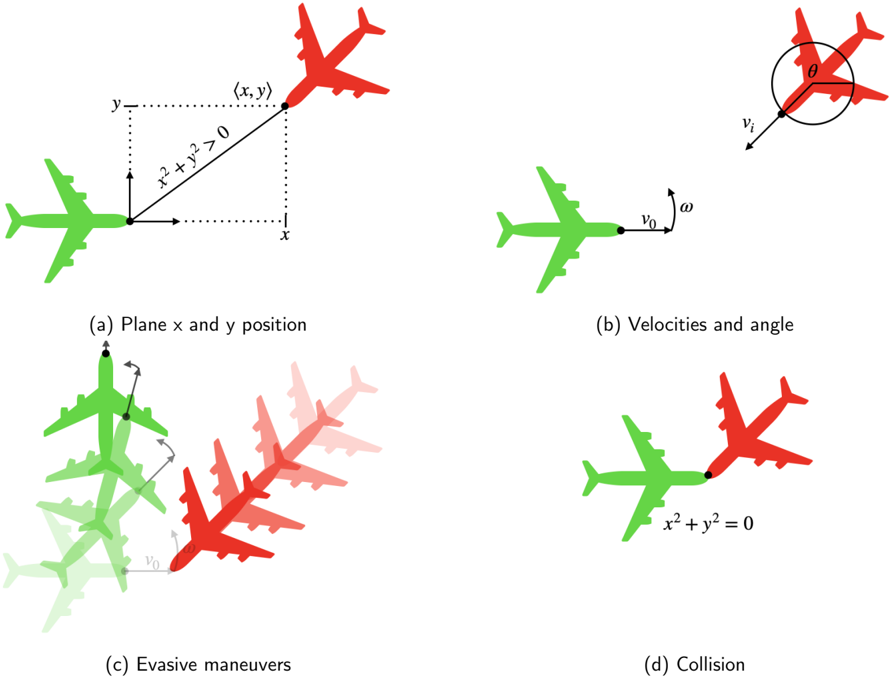
The image is a composite of four labeled technical diagrams (a, b, c, d) illustrating the geometric and kinematic relationships between two aircraft in a potential collision scenario. One aircraft is colored green (likely the "ownship" or primary aircraft) and the other is red (likely the "intruder" or target aircraft). The diagrams progress from defining relative position and velocity to showing evasive maneuvers and the collision condition.
### Components/Axes
The image is divided into four quadrants, each with a specific label and focus:
* **(a) Plane x and y position**: Top-left quadrant. Shows a 2D Cartesian coordinate system.
* **(b) Velocities and angle**: Top-right quadrant. Shows velocity vectors and angular relationships.
* **(c) Evasive maneuvers**: Bottom-left quadrant. Shows a time-sequence of aircraft positions.
* **(d) Collision**: Bottom-right quadrant. Shows the point of contact.
**Common Elements:**
* **Aircraft Icons:** Two stylized aircraft silhouettes. Green is consistently positioned at or near the origin in (a) and (b). Red is the intruder.
* **Coordinate System:** A standard x-y axis is explicitly shown in (a), with the green aircraft at the origin (0,0).
* **Mathematical Notation:** Equations and variables are used to define states.
### Detailed Analysis
#### **Diagram (a): Plane x and y position**
* **Components:** Green aircraft at origin. Red aircraft at a point labeled `(x, y)`. Dotted lines project from the red aircraft to the x and y axes, indicating its coordinates.
* **Labels & Text:**
* Axis labels: `x` (horizontal), `y` (vertical).
* Coordinate label: `(x, y)` next to the red aircraft.
* Equation: `x² + y² > 0` is written along the line connecting the two aircraft.
* **Spatial Grounding:** The green aircraft is at the bottom-left of this sub-diagram. The red aircraft is at the top-right. The connecting line represents the relative position vector.
* **Interpretation:** This defines the relative position of the intruder (red) with respect to the ownship (green). The equation `x² + y² > 0` states that the squared distance between them is positive, meaning they are not at the same point (i.e., they have not collided).
#### **Diagram (b): Velocities and angle**
* **Components:** Green aircraft with a velocity vector `v₀` pointing to the right and an angular velocity `ω` indicated by a curved arrow. Red aircraft with an incoming velocity vector `vᵢ` and an angle `θ` defined relative to a reference line (likely the line of sight or ownship heading).
* **Labels & Text:**
* Green aircraft: `v₀` (linear velocity), `ω` (angular velocity/turn rate).
* Red aircraft: `vᵢ` (intruder velocity), `θ` (angle, likely aspect or bearing angle).
* **Spatial Grounding:** The green aircraft is on the left, moving right. The red aircraft is in the top-right, with its velocity vector pointing down and to the left, towards the green aircraft's projected path. The angle `θ` is measured at the red aircraft.
* **Interpretation:** This diagram introduces the kinematic state. The ownship has a forward velocity and a turn rate. The intruder has an incoming velocity at a specific angle, defining the collision geometry.
#### **Diagram (c): Evasive maneuvers**
* **Components:** A sequence of semi-transparent ("ghosted") green and red aircraft icons showing their positions over time. The green aircraft is shown executing a turn (changing heading). The red aircraft follows a straight or slightly curved path. Fading opacity indicates earlier positions.
* **Labels & Text:**
* The label `(c) Evasive maneuvers` is below the diagram.
* A velocity vector `v₀` is shown on one of the green aircraft instances.
* **Spatial Grounding:** The sequence flows from the bottom-left (earlier time, lighter opacity) to the top-right (later time, solid opacity). The green aircraft's path curves upward, while the red aircraft's path converges from the right.
* **Trend Verification:** The green aircraft's trajectory shows a clear change in direction (a turn), while the red aircraft's trajectory appears more linear. The fading effect shows the history of movement.
* **Interpretation:** This illustrates a dynamic scenario where the ownship (green) performs an evasive turn to avoid the intruder (red). The multiple positions show the evolution of the encounter over time.
#### **Diagram (d): Collision**
* **Components:** The green and red aircraft icons are shown touching at a single point.
* **Labels & Text:**
* The label `(d) Collision` is below the diagram.
* The equation `x² + y² = 0` is written below the point of contact.
* **Spatial Grounding:** The aircraft are centered in the sub-diagram, with their nose cones touching.
* **Interpretation:** This depicts the collision condition. The equation `x² + y² = 0` is the mathematical definition of a collision in this 2D plane: the squared distance between the two aircraft is zero, meaning their positions `(x, y)` are identical.
### Key Observations
1. **Color Coding:** Consistent use of green for the ownship and red for the intruder throughout all diagrams.
2. **Mathematical Progression:** The diagrams tell a story using equations: from a safe state (`x² + y² > 0`) to a collision state (`x² + y² = 0`).
3. **Visual Narrative:** The sequence (a) -> (b) -> (c) -> (d) logically progresses from defining the problem (position, velocity) to showing a solution (evasive maneuver) and the consequence of failure (collision).
4. **Use of Transparency:** Diagram (c) effectively uses opacity to convey time and motion history in a static image.
### Interpretation
This set of diagrams is a foundational illustration for aircraft collision avoidance systems, likely from a technical paper or textbook on air traffic management, robotics, or path planning.
* **Core Concept:** It models a two-aircraft encounter in a 2D plane. The ownship must use its control inputs (velocity `v₀`, turn rate `ω`) to ensure the relative position `(x, y)` never satisfies the collision condition `x² + y² = 0`.
* **Relationship Between Elements:** Diagrams (a) and (b) establish the state variables (position, velocity, angle). Diagram (c) shows the application of control (evasive maneuver) to influence those state variables. Diagram (d) shows the failure state the system is designed to avoid.
* **Underlying Principle:** The equations highlight that collision avoidance is fundamentally a problem of maintaining a non-zero distance. The evasive maneuver in (c) is an attempt to steer the system's state away from the `x² + y² = 0` manifold.
* **Implied Context:** The simplicity of the 2D model suggests this is a conceptual or introductory explanation. Real-world systems would involve 3D space, more complex aircraft dynamics, sensor uncertainty, and predictive algorithms. The diagrams effectively communicate the geometric essence of the problem.