## Diagram: Field Extension Lattice
### Overview
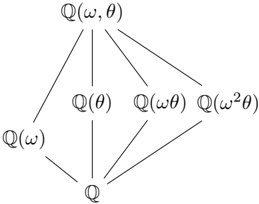
The image is a Hasse diagram representing the lattice of subfields of a field extension. It shows the relationships between different fields, indicating which fields are contained within others.
### Components/Axes
* **Nodes:** Each node represents a field extension of the rational numbers, denoted by Q.
* **Edges:** Lines connecting the nodes indicate inclusion. A field A is below field B if A is a subfield of B.
* **Labels:** The labels on the nodes specify the field extensions.
### Detailed Analysis
The diagram shows the following field extensions:
* **Top Node:** Q(ω, θ) - This is the largest field in the diagram, containing all other fields.
* **Intermediate Nodes:**
* Q(θ) - A field extension of Q by θ.
* Q(ωθ) - A field extension of Q by ωθ.
* Q(ω²θ) - A field extension of Q by ω²θ.
* Q(ω) - A field extension of Q by ω.
* **Bottom Node:** Q - The field of rational numbers, contained in all other fields.
The connections indicate the following inclusions:
* Q(ω, θ) contains Q(θ), Q(ωθ), Q(ω²θ), and Q(ω).
* Q(θ), Q(ωθ), Q(ω²θ), and Q(ω) all contain Q.
### Key Observations
* The diagram illustrates the subfield structure of Q(ω, θ).
* Q is the base field, and Q(ω, θ) is the extension field.
* The intermediate fields represent different ways to extend Q.
### Interpretation
The diagram represents the lattice of subfields of the field extension Q(ω, θ) over Q. It shows how different field extensions are related to each other through inclusion. The diagram is a visual representation of the algebraic structure of these fields and their relationships. The diagram suggests that Q(ω, θ) can be obtained by extending Q in multiple ways, either by adjoining θ, ωθ, ω²θ, or ω. The diagram also shows that Q is the smallest field contained in all the other fields.