## Diagram: Mathematical Function Dependency Graph
### Overview
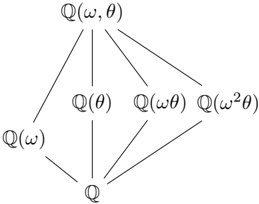
The image depicts a hierarchical diagram illustrating relationships between mathematical functions or variables labeled with expressions involving ω (omega) and θ (theta). Arrows indicate directional dependencies or transformations between nodes.
### Components/Axes
- **Nodes**:
- Top node: `Q(ω,θ)`
- Middle layer: `Q(θ)`, `Q(ωθ)`, `Q(ω²θ)`
- Bottom layer: `Q(ω)`, `Q`
- **Arrows**:
- From `Q(ω,θ)` to `Q(θ)`, `Q(ωθ)`, and `Q(ω²θ)`
- From `Q(θ)` to `Q(ω)`
- From `Q(ω)` to `Q`
- Direct arrow from `Q(ω,θ)` to `Q(ω)`
### Detailed Analysis
- **Labels**:
- All labels are mathematical expressions involving ω and θ.
- `Q(ω,θ)`: Likely a bivariate function or parameterized quantity.
- `Q(θ)`: Univariate function dependent on θ.
- `Q(ωθ)`: Product of ω and θ as input to Q.
- `Q(ω²θ)`: Squared ω multiplied by θ as input.
- `Q(ω)`: Univariate function dependent on ω.
- `Q`: Generic or base function (no explicit parameters).
- **Flow/Relationships**:
- `Q(ω,θ)` is the root node, branching into three intermediate nodes (`Q(θ)`, `Q(ωθ)`, `Q(ω²θ)`).
- `Q(θ)` propagates to `Q(ω)`, which then feeds into the terminal node `Q`.
- A direct connection from `Q(ω,θ)` to `Q(ω)` suggests a shortcut or alternative dependency.
### Key Observations
1. **Hierarchical Structure**: The diagram implies a top-down dependency chain, with `Q(ω,θ)` as the primary source.
2. **Parameterized Transformations**: The use of ω and θ in labels suggests parameterized operations (e.g., scaling, squaring).
3. **Redundancy**: The direct arrow from `Q(ω,θ)` to `Q(ω)` may indicate an explicit dependency bypassing intermediate steps.
### Interpretation
This diagram likely represents a computational or mathematical workflow where:
- `Q(ω,θ)` serves as an initial input or source.
- Intermediate nodes (`Q(θ)`, `Q(ωθ)`, `Q(ω²θ)`) represent derived quantities or transformations.
- The terminal node `Q` aggregates or finalizes the process, potentially synthesizing results from `Q(ω)` and other paths.
- The direct link from `Q(ω,θ)` to `Q(ω)` could signify a simplified or alternative computation path.
The structure emphasizes parameterized dependencies, with ω and θ acting as scaling or transformation factors. The absence of numerical values suggests a symbolic or theoretical framework rather than empirical data.