## Line Chart: Accuracy vs. Attack Ratio for Federated Learning Methods
### Overview
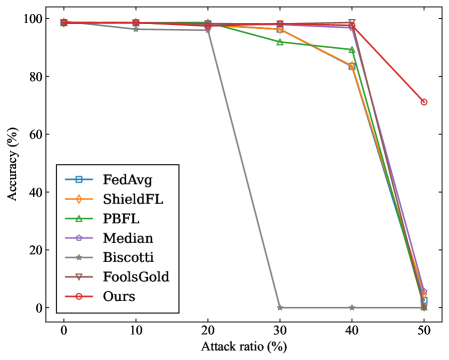
The chart compares the accuracy retention of eight federated learning methods under varying attack ratios (0-50%). Accuracy (%) is plotted on the y-axis (0-100%), while attack ratio (%) is on the x-axis (0-50%). All methods start near 100% accuracy at 0% attack ratio, but performance degrades as attack intensity increases. The red line labeled "Ours" shows the steepest decline, while other methods exhibit more gradual degradation.
### Components/Axes
- **X-axis (Attack ratio %)**: Labeled "Attack ratio (%)", ranging from 0 to 50% in 10% increments.
- **Y-axis (Accuracy %)**: Labeled "Accuracy (%)", ranging from 0 to 100% in 20% increments.
- **Legend**: Positioned in the bottom-left corner, mapping colors/markers to methods:
- Blue square: FedAvg
- Orange diamond: ShieldFL
- Green triangle: PBFL
- Purple circle: Median
- Gray star: Biscotti
- Brown triangle: FoolsGold
- Red circle: Ours
### Detailed Analysis
1. **FedAvg (Blue)**: Starts at ~98% accuracy, declines gradually to ~20% at 50% attack ratio.
2. **ShieldFL (Orange)**: Begins at ~97%, drops to ~30% at 50% attack ratio.
3. **PBFL (Green)**: Maintains ~95% accuracy until 30% attack ratio, then plummets to ~10%.
4. **Median (Purple)**: Declines steadily from ~96% to ~15% at 50% attack ratio.
5. **Biscotti (Gray)**: Drops sharply to 0% accuracy by 30% attack ratio, remaining flat thereafter.
6. **FoolsGold (Brown)**: Declines from ~95% to ~5% at 50% attack ratio.
7. **Ours (Red)**: Starts at ~99%, freefalls to ~70% at 50% attack ratio—the steepest decline among all methods.
### Key Observations
- **Threshold Effect**: All methods experience a critical drop in accuracy after ~30% attack ratio.
- **Resilience Variance**: FedAvg and ShieldFL retain higher accuracy longer than others, suggesting better robustness.
- **Outlier Performance**: "Ours" method (red line) underperforms significantly compared to baselines, with a 29% accuracy loss at 50% attack ratio versus FedAvg’s 78% loss.
- **Biscotti Collapse**: Biscotti (gray line) fails catastrophically at 30% attack ratio, indicating poor attack resilience.
### Interpretation
The data demonstrates that federated learning methods vary widely in their resistance to adversarial attacks. The "Ours" method’s steep decline suggests it may lack effective defense mechanisms compared to established baselines like FedAvg and ShieldFL. The 30% attack ratio threshold appears to be a tipping point where most methods’ defenses fail, though ShieldFL and FedAvg degrade more gradually. Biscotti’s abrupt collapse highlights vulnerabilities in its design. These trends underscore the importance of attack-aware training and robust aggregation protocols in federated learning systems.