## State Machine Diagram: Item Management System
### Overview
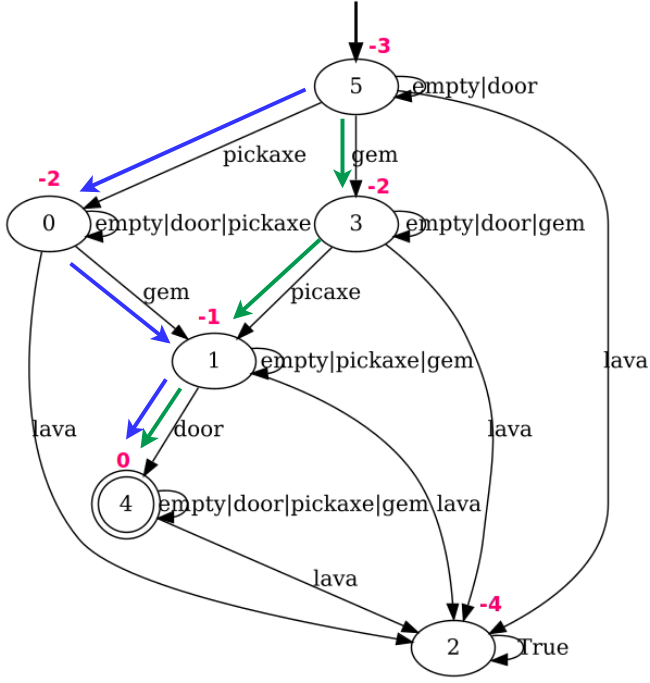
The diagram depicts a state machine with six nodes (0-5) representing different combinations of items (empty, door, pickaxe, gem, lava) and transitions between states. Arrows indicate possible state transitions, labeled with actions (e.g., "pickaxe", "gem") and numerical values in parentheses, likely representing costs or penalties.
### Components/Axes
- **Nodes**: Six circular nodes labeled 0-5, each containing a state description combining items (e.g., "empty/door/pickaxe").
- **Transitions**: Directed arrows between nodes, labeled with actions and numerical values (e.g., "gem (-1)", "pickaxe (-2)").
- **Colors**: Arrows use blue, green, and black, but no legend explains their significance.
- **Special Markers**: Node 4 is circled, and node 2 has a "True" label.
### Detailed Analysis
#### Node Labels
- **Node 0**: `empty/door/pickaxe`
- **Node 1**: `empty/pickaxe/gem`
- **Node 2**: `True`
- **Node 3**: `empty/door/gem`
- **Node 4**: `empty/door/pickaxe/gem/lava`
- **Node 5**: `empty/door`
#### Transition Labels and Costs
- **Node 0 → Node 1**: `gem (-1)`
- **Node 0 → Node 5**: `pickaxe (-2)`
- **Node 1 → Node 3**: `pickaxe (-2)`
- **Node 1 → Node 4**: `lava`
- **Node 2 → Node 4**: `lava`
- **Node 3 → Node 5**: `gem (-3)`
- **Node 4 → Node 2**: `True`
- **Node 5 → Node 0**: `empty/door/pickaxe`
#### Spatial Grounding
- Nodes are arranged in a circular/non-linear layout.
- Node 4 (circled) is centrally positioned, suggesting importance.
- Node 2 ("True") is at the bottom-right, potentially a terminal state.
### Key Observations
1. **Cost Structure**: Transitions with negative values (e.g., `-1`, `-2`, `-3`, `-4`) likely represent penalties or resource costs.
2. **State Complexity**: Node 4 contains the most items (`empty/door/pickaxe/gem/lava`), indicating a highly equipped state.
3. **Terminal State**: Node 2 ("True") may represent a goal or completion state, accessible only via Node 4.
4. **Circular Flow**: Node 5 connects back to Node 0, suggesting a loop in the system.
### Interpretation
This diagram models a resource management system where states represent inventory configurations, and transitions involve acquiring/dropping items with associated costs. The negative values imply diminishing returns or energy expenditure for actions. The circled Node 4 and terminal "True" state (Node 2) suggest a progression toward a final goal, requiring specific item combinations. The lack of a legend for arrow colors leaves their purpose ambiguous, but their directional flow emphasizes state dependencies.
## [Chart/Diagram Type]: State Machine Diagram
### Overview
The diagram represents a state machine with six nodes (0-5) and transitions between them, labeled with actions and numerical costs.
### Components/Axes
- **Nodes**: Six circular nodes labeled 0-5, each containing a state description combining items (e.g., "empty/door/pickaxe").
- **Transitions**: Directed arrows between nodes, labeled with actions (e.g., "pickaxe", "gem") and numerical values in parentheses (e.g., "-1", "-2").
- **Special Markers**: Node 4 is circled, and Node 2 is labeled "True".
### Detailed Analysis
#### Node Labels
- **Node 0**: `empty/door/pickaxe`
- **Node 1**: `empty/pickaxe/gem`
- **Node 2**: `True`
- **Node 3**: `empty/door/gem`
- **Node 4**: `empty/door/pickaxe/gem/lava`
- **Node 5**: `empty/door`
#### Transition Labels and Costs
- **Node 0 → Node 1**: `gem (-1)`
- **Node 0 → Node 5**: `pickaxe (-2)`
- **Node 1 → Node 3**: `pickaxe (-2)`
- **Node 1 → Node 4**: `lava`
- **Node 2 → Node 4**: `lava`
- **Node 3 → Node 5**: `gem (-3)`
- **Node 4 → Node 2**: `True`
- **Node 5 → Node 0**: `empty/door/pickaxe`
#### Spatial Grounding
- Nodes are arranged in a circular/non-linear layout.
- Node 4 (circled) is centrally positioned, suggesting importance.
- Node 2 ("True") is at the bottom-right, potentially a terminal state.
### Key Observations
1. **Cost Structure**: Transitions with negative values (e.g., `-1`, `-2`, `-3`, `-4`) likely represent penalties or resource costs.
2. **State Complexity**: Node 4 contains the most items (`empty/door/pickaxe/gem/lava`), indicating a highly equipped state.
3. **Terminal State**: Node 2 ("True") may represent a goal or completion state, accessible only via Node 4.
4. **Circular Flow**: Node 5 connects back to Node 0, suggesting a loop in the system.
### Interpretation
This diagram models a resource management system where states represent inventory configurations, and transitions involve acquiring/dropping items with associated costs. The negative values imply diminishing returns or energy expenditure for actions. The circled Node 4 and terminal "True" state (Node 2) suggest a progression toward a final goal, requiring specific item combinations. The lack of a legend for arrow colors leaves their purpose ambiguous, but their directional flow emphasizes state dependencies.