## Diagram: Neural Network Tensor Core Architecture
### Overview
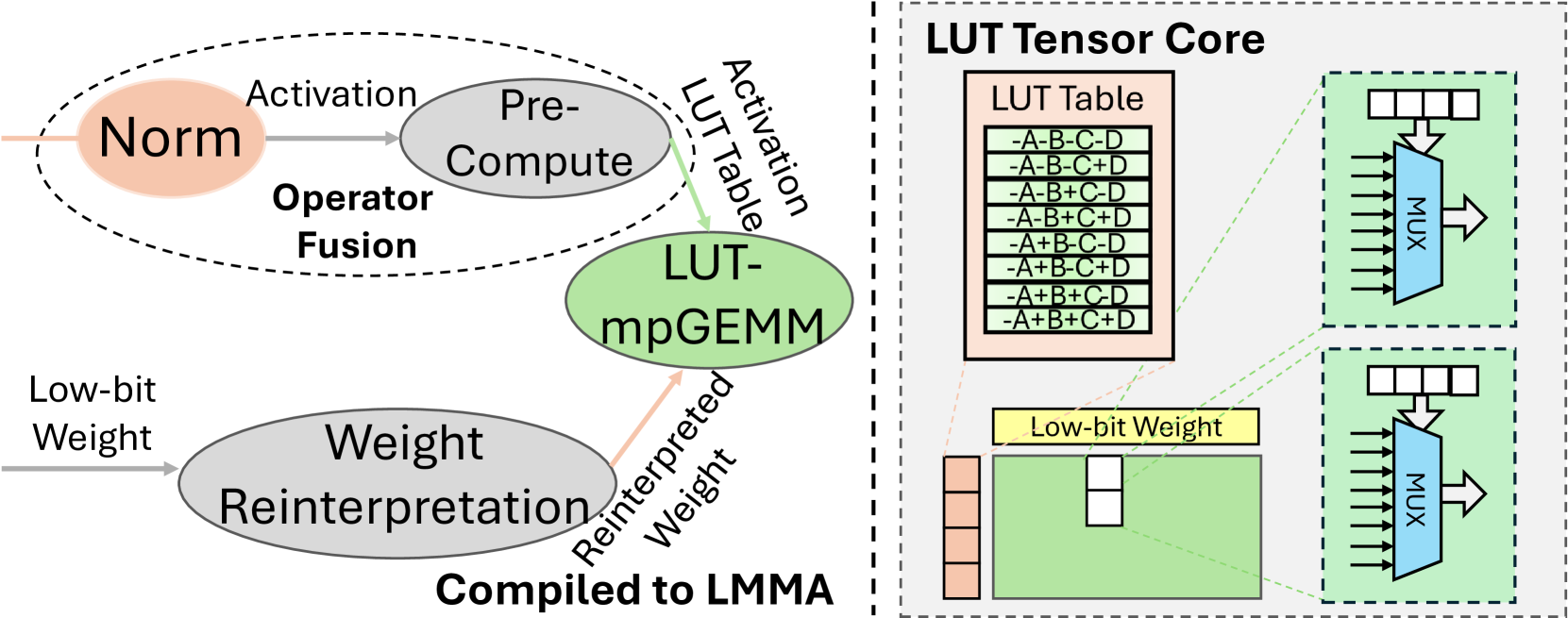
The image depicts a technical diagram of a neural network tensor core architecture, divided into two sections:
1. **Left**: A flowchart illustrating data flow and component interactions.
2. **Right**: A detailed LUT Tensor Core diagram showing memory structures, data paths, and processing units.
---
### Components/Axes
#### Left Diagram (Flowchart):
- **Ovals (Processes)**:
- **Norm** (orange): Normalization step.
- **Pre-Compute** (gray): Preprocessing for activation.
- **LUT-mpGEMM** (green): Lookup Table-based General Matrix Multiply.
- **Weight Reinterpretation** (gray): Conversion of low-bit weights.
- **Arrows (Data Flow)**:
- **Activation** (dashed line): Connects "Norm" to "Pre-Compute."
- **Operator Fusion** (dashed line): Links "Pre-Compute" to "LUT-mpGEMM."
- **LUT Table** (dashed line): Connects "LUT-mpGEMM" to "Reinterpreted Weight."
- **Reinterpreted Weight** (dashed line): Feeds into "Compiled to LMMA."
- **Text Labels**:
- "Low-bit Weight" (left of "Weight Reinterpretation").
- "Compiled to LMMA" (bottom of flowchart).
#### Right Diagram (LUT Tensor Core):
- **LUT Table**:
- A 8x4 grid of entries (e.g., `-A-B-C-D`, `-A-B-C+D`, etc.), representing signed combinations of 4-bit inputs.
- Background: Light green.
- **Low-bit Weight**:
- A 4x1 column of orange blocks (representing 4-bit weights).
- Background: Yellow.
- **MUX (Multiplexer)**:
- Two blue blocks labeled "MUX," with arrows indicating data flow from LUT Table and Low-bit Weight.
- **Legend**:
- **Orange**: Norm, Weight Reinterpretation.
- **Gray**: Pre-Compute, Weight Reinterpretation.
- **Green**: LUT-mpGEMM, LUT Table.
- **Yellow**: Low-bit Weight.
- **Blue**: MUX.
---
### Detailed Analysis
#### Left Diagram:
1. **Norm → Pre-Compute**:
- Normalized data is activated and precomputed for further processing.
2. **Operator Fusion**:
- Combines operations (e.g., activation and LUT lookup) to optimize computation.
3. **LUT-mpGEMM**:
- Uses a Lookup Table (LUT) to accelerate matrix multiplication (GEMM).
4. **Weight Reinterpretation**:
- Converts low-bit weights (e.g., 4-bit) into a format compatible with the tensor core.
5. **Compiled to LMMA**:
- Final stage where weights are compiled into a low-memory, high-throughput format.
#### Right Diagram:
1. **LUT Table Structure**:
- Entries like `-A-B-C-D` represent all possible 4-bit signed combinations (8 rows × 4 columns).
- Designed for efficient address calculation in tensor operations.
2. **Low-bit Weight Integration**:
- 4-bit weights are fed into the MUX alongside LUT outputs.
3. **MUX Functionality**:
- Selects between LUT outputs and low-bit weights for processing.
---
### Key Observations
1. **Color Coding**:
- Components are color-coded to distinguish between normalization (orange), preprocessing (gray), LUT-based operations (green), and memory structures (yellow/blue).
2. **Data Flow**:
- The left diagram emphasizes computational steps, while the right diagram focuses on hardware implementation (LUTs, MUX).
3. **LUT-mpGEMM Role**:
- Central to optimizing matrix operations by reducing memory access via lookup tables.
---
### Interpretation
This architecture demonstrates a hybrid approach to neural network acceleration:
- **Efficiency**: LUT-mpGEMM reduces computational complexity by precomputing common operations.
- **Memory Optimization**: Low-bit weights (4-bit) and LMMA compilation minimize memory bandwidth requirements.
- **Hardware-Software Co-Design**: The LUT Tensor Core integrates memory (LUT Table) and processing (MUX) to balance speed and resource usage.
**Notable Trends**:
- The use of LUTs suggests a focus on reducing dynamic computation in favor of static memory lookups.
- Low-bit weight reinterpretation indicates quantization for energy-efficient inference.
**Uncertainties**:
- Exact bit-widths for weights (assumed 4-bit based on labels).
- Specific activation functions or normalization methods (not explicitly stated).