TECHNICAL ASSET FINGERPRINT
37b99f1118a4602c1efe9854
Click to view fullscreen
Press ESC or click to close
FOUND IN PAPERS
EXPERT: gemini-2.0-flash VERSION 1
RUNTIME: nugit/gemini/gemini-2.0-flash
INTEL_VERIFIED
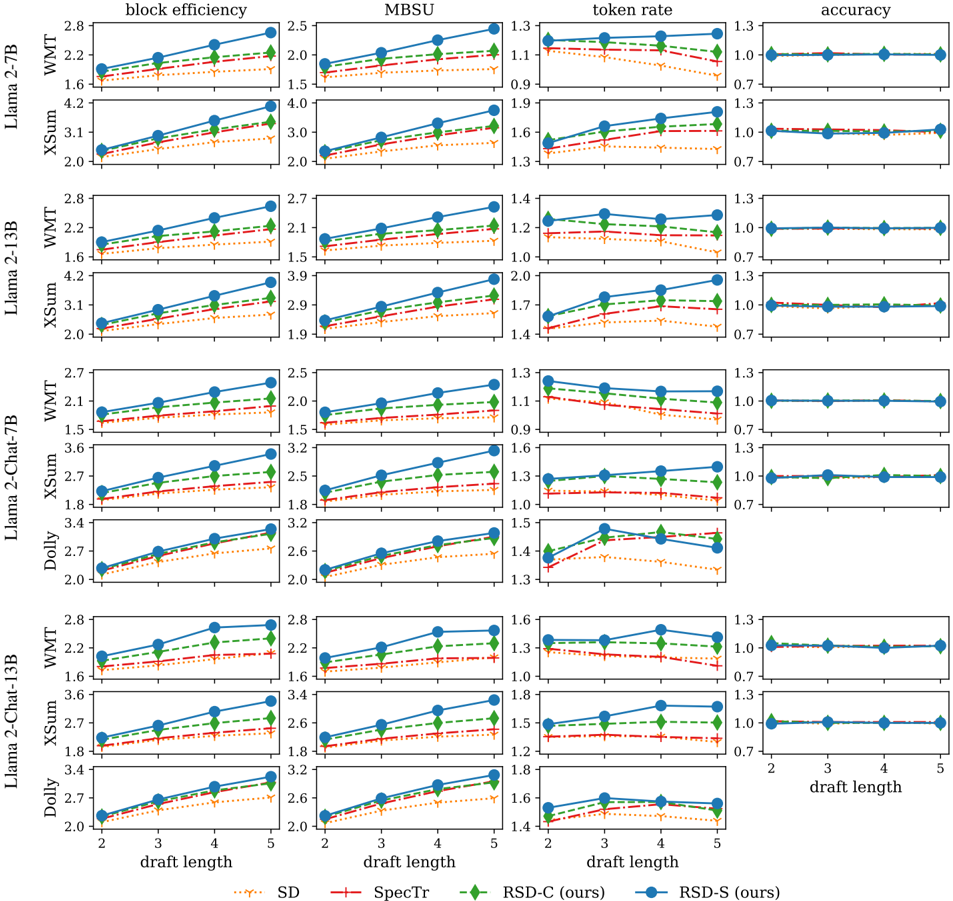
## Chart: Performance Metrics vs. Draft Length
### Overview
The image presents a series of line charts comparing the performance of different models (Llama 2-7B, Llama 2-13B, Llama 2-Chat-7B, and Dolly) across four metrics: block efficiency, MBSU, token rate, and accuracy. The x-axis represents the draft length, ranging from 2 to 5. Four different methods (SD, SpecTr, RSD-C (ours), and RSD-S (ours)) are compared for each model and metric.
### Components/Axes
* **Rows:** Each row represents a different model and summarization type combination. The models are Llama 2-7B, Llama 2-13B, Llama 2-Chat-7B, and Dolly. The summarization types are WMT and XSum.
* **Columns:** Each column represents a different performance metric: block efficiency, MBSU (Modified Branching Score Unit), token rate, and accuracy.
* **X-axis:** Draft length, ranging from 2 to 5.
* **Y-axis:** The y-axis scales vary for each metric.
* Block efficiency: Ranges from approximately 1.6 to 4.2.
* MBSU: Ranges from approximately 1.5 to 4.0.
* Token rate: Ranges from approximately 0.9 to 2.0.
* Accuracy: Ranges from approximately 0.7 to 1.3.
* **Legend:** Located at the bottom of the image.
* Solid line with circles: RSD-S (ours) (Blue)
* Dashed line with pluses: SpecTr (Red)
* Dotted line with triangles: SD (Orange)
* Dash-dot line with diamonds: RSD-C (ours) (Green)
### Detailed Analysis
**Llama 2-7B**
* **WMT**
* Block efficiency: All methods show an upward trend with increasing draft length. RSD-S (blue) performs the best, followed by RSD-C (green), SpecTr (red), and SD (orange).
* Draft Length 2: SD ~1.8, SpecTr ~2.1, RSD-C ~2.2, RSD-S ~2.3
* Draft Length 5: SD ~2.0, SpecTr ~2.2, RSD-C ~2.5, RSD-S ~2.7
* MBSU: All methods show an upward trend. RSD-S (blue) performs the best, followed by RSD-C (green), SpecTr (red), and SD (orange).
* Draft Length 2: SD ~1.8, SpecTr ~1.9, RSD-C ~2.0, RSD-S ~2.1
* Draft Length 5: SD ~2.0, SpecTr ~2.1, RSD-C ~2.4, RSD-S ~2.5
* Token rate: RSD-S (blue) and RSD-C (green) are relatively stable. SpecTr (red) and SD (orange) decrease slightly with increasing draft length.
* Draft Length 2: SD ~1.3, SpecTr ~1.2, RSD-C ~1.2, RSD-S ~1.3
* Draft Length 5: SD ~1.1, SpecTr ~1.1, RSD-C ~1.2, RSD-S ~1.3
* Accuracy: All methods maintain a constant accuracy of approximately 1.0 across all draft lengths.
* **XSum**
* Block efficiency: All methods show an upward trend. RSD-S (blue) performs the best, followed by RSD-C (green), SpecTr (red), and SD (orange).
* Draft Length 2: SD ~2.8, SpecTr ~3.0, RSD-C ~3.1, RSD-S ~3.2
* Draft Length 5: SD ~3.1, SpecTr ~3.1, RSD-C ~3.6, RSD-S ~4.2
* MBSU: All methods show an upward trend. RSD-S (blue) performs the best, followed by RSD-C (green), SpecTr (red), and SD (orange).
* Draft Length 2: SD ~2.6, SpecTr ~2.8, RSD-C ~2.9, RSD-S ~3.0
* Draft Length 5: SD ~2.8, SpecTr ~2.9, RSD-C ~3.4, RSD-S ~4.0
* Token rate: RSD-S (blue) and RSD-C (green) are relatively stable. SpecTr (red) and SD (orange) decrease slightly with increasing draft length.
* Draft Length 2: SD ~1.6, SpecTr ~1.7, RSD-C ~1.7, RSD-S ~1.9
* Draft Length 5: SD ~1.3, SpecTr ~1.4, RSD-C ~1.6, RSD-S ~1.9
* Accuracy: All methods maintain a constant accuracy of approximately 1.0 across all draft lengths.
**Llama 2-13B**
* **WMT**
* Block efficiency: All methods show an upward trend. RSD-S (blue) performs the best, followed by RSD-C (green), SpecTr (red), and SD (orange).
* Draft Length 2: SD ~1.8, SpecTr ~2.1, RSD-C ~2.2, RSD-S ~2.3
* Draft Length 5: SD ~2.0, SpecTr ~2.2, RSD-C ~2.5, RSD-S ~2.7
* MBSU: All methods show an upward trend. RSD-S (blue) performs the best, followed by RSD-C (green), SpecTr (red), and SD (orange).
* Draft Length 2: SD ~1.9, SpecTr ~2.0, RSD-C ~2.1, RSD-S ~2.2
* Draft Length 5: SD ~2.1, SpecTr ~2.2, RSD-C ~2.5, RSD-S ~2.7
* Token rate: RSD-S (blue) and RSD-C (green) are relatively stable. SpecTr (red) and SD (orange) decrease slightly with increasing draft length.
* Draft Length 2: SD ~1.3, SpecTr ~1.2, RSD-C ~1.2, RSD-S ~1.4
* Draft Length 5: SD ~1.1, SpecTr ~1.1, RSD-C ~1.2, RSD-S ~1.4
* Accuracy: All methods maintain a constant accuracy of approximately 1.0 across all draft lengths.
* **XSum**
* Block efficiency: All methods show an upward trend. RSD-S (blue) performs the best, followed by RSD-C (green), SpecTr (red), and SD (orange).
* Draft Length 2: SD ~2.8, SpecTr ~3.0, RSD-C ~3.1, RSD-S ~3.2
* Draft Length 5: SD ~3.0, SpecTr ~3.1, RSD-C ~3.6, RSD-S ~4.2
* MBSU: All methods show an upward trend. RSD-S (blue) performs the best, followed by RSD-C (green), SpecTr (red), and SD (orange).
* Draft Length 2: SD ~2.7, SpecTr ~2.8, RSD-C ~2.9, RSD-S ~3.1
* Draft Length 5: SD ~2.9, SpecTr ~2.9, RSD-C ~3.4, RSD-S ~3.9
* Token rate: RSD-S (blue) and RSD-C (green) are relatively stable. SpecTr (red) and SD (orange) decrease slightly with increasing draft length.
* Draft Length 2: SD ~1.7, SpecTr ~1.7, RSD-C ~1.7, RSD-S ~2.0
* Draft Length 5: SD ~1.3, SpecTr ~1.4, RSD-C ~1.6, RSD-S ~1.9
* Accuracy: All methods maintain a constant accuracy of approximately 1.0 across all draft lengths.
**Llama 2-Chat-7B**
* **WMT**
* Block efficiency: All methods show an upward trend. RSD-S (blue) performs the best, followed by RSD-C (green), SpecTr (red), and SD (orange).
* Draft Length 2: SD ~1.8, SpecTr ~2.0, RSD-C ~2.1, RSD-S ~2.2
* Draft Length 5: SD ~2.0, SpecTr ~2.1, RSD-C ~2.4, RSD-S ~2.7
* MBSU: All methods show an upward trend. RSD-S (blue) performs the best, followed by RSD-C (green), SpecTr (red), and SD (orange).
* Draft Length 2: SD ~1.9, SpecTr ~1.9, RSD-C ~2.0, RSD-S ~2.1
* Draft Length 5: SD ~2.0, SpecTr ~2.1, RSD-C ~2.4, RSD-S ~2.5
* Token rate: RSD-S (blue) and RSD-C (green) are relatively stable. SpecTr (red) and SD (orange) decrease slightly with increasing draft length.
* Draft Length 2: SD ~1.3, SpecTr ~1.1, RSD-C ~1.1, RSD-S ~1.3
* Draft Length 5: SD ~0.9, SpecTr ~0.9, RSD-C ~1.1, RSD-S ~1.3
* Accuracy: All methods maintain a constant accuracy of approximately 1.0 across all draft lengths.
* **XSum**
* Block efficiency: All methods show an upward trend. RSD-S (blue) performs the best, followed by RSD-C (green), SpecTr (red), and SD (orange).
* Draft Length 2: SD ~2.6, SpecTr ~2.7, RSD-C ~2.8, RSD-S ~3.1
* Draft Length 5: SD ~2.7, SpecTr ~2.8, RSD-C ~3.2, RSD-S ~3.6
* MBSU: All methods show an upward trend. RSD-S (blue) performs the best, followed by RSD-C (green), SpecTr (red), and SD (orange).
* Draft Length 2: SD ~2.4, SpecTr ~2.4, RSD-C ~2.5, RSD-S ~2.6
* Draft Length 5: SD ~2.5, SpecTr ~2.5, RSD-C ~2.9, RSD-S ~3.2
* Token rate: RSD-S (blue) and RSD-C (green) are relatively stable. SpecTr (red) and SD (orange) decrease slightly with increasing draft length.
* Draft Length 2: SD ~1.6, SpecTr ~1.3, RSD-C ~1.3, RSD-S ~1.6
* Draft Length 5: SD ~1.0, SpecTr ~1.0, RSD-C ~1.3, RSD-S ~1.6
* Accuracy: All methods maintain a constant accuracy of approximately 1.0 across all draft lengths.
**Dolly**
* **WMT**
* Block efficiency: All methods show an upward trend. RSD-S (blue) performs the best, followed by RSD-C (green), SpecTr (red), and SD (orange).
* Draft Length 2: SD ~1.6, SpecTr ~1.7, RSD-C ~1.8, RSD-S ~2.2
* Draft Length 5: SD ~1.8, SpecTr ~1.8, RSD-C ~2.0, RSD-S ~2.8
* MBSU: All methods show an upward trend. RSD-S (blue) performs the best, followed by RSD-C (green), SpecTr (red), and SD (orange).
* Draft Length 2: SD ~1.7, SpecTr ~1.7, RSD-C ~1.8, RSD-S ~2.2
* Draft Length 5: SD ~1.8, SpecTr ~1.8, RSD-C ~2.0, RSD-S ~2.8
* Token rate: RSD-S (blue) and RSD-C (green) are relatively stable. SpecTr (red) and SD (orange) decrease slightly with increasing draft length.
* Draft Length 2: SD ~1.4, SpecTr ~1.3, RSD-C ~1.3, RSD-S ~1.6
* Draft Length 5: SD ~1.0, SpecTr ~1.0, RSD-C ~1.3, RSD-S ~1.6
* Accuracy: All methods maintain a constant accuracy of approximately 1.0 across all draft lengths.
* **XSum**
* Block efficiency: All methods show an upward trend. RSD-S (blue) performs the best, followed by RSD-C (green), SpecTr (red), and SD (orange).
* Draft Length 2: SD ~2.0, SpecTr ~2.6, RSD-C ~2.7, RSD-S ~3.4
* Draft Length 5: SD ~2.0, SpecTr ~2.7, RSD-C ~2.7, RSD-S ~3.4
* MBSU: SD, SpecTr, and RSD-C are relatively stable, while RSD-S increases slightly.
* Draft Length 2: SD ~2.0, SpecTr ~2.4, RSD-C ~2.6, RSD-S ~2.7
* Draft Length 5: SD ~2.0, SpecTr ~2.4, RSD-C ~2.6, RSD-S ~2.7
* Token rate: SD, SpecTr, and RSD-C are relatively stable, while RSD-S increases slightly.
* Draft Length 2: SD ~1.4, SpecTr ~1.4, RSD-C ~1.4, RSD-S ~1.6
* Draft Length 5: SD ~1.3, SpecTr ~1.4, RSD-C ~1.4, RSD-S ~1.6
* Accuracy: All methods maintain a constant accuracy of approximately 1.0 across all draft lengths.
### Key Observations
* **RSD-S (ours)** consistently outperforms the other methods (SD, SpecTr, RSD-C (ours)) in terms of block efficiency and MBSU across all models and summarization types.
* **Accuracy** remains relatively constant across all draft lengths and methods.
* **Token rate** tends to decrease slightly with increasing draft length for SD and SpecTr, while RSD-S and RSD-C remain more stable.
* The performance differences between methods are more pronounced for block efficiency and MBSU than for token rate and accuracy.
* The trends are generally consistent across different models (Llama 2-7B, Llama 2-13B, Llama 2-Chat-7B, and Dolly) and summarization types (WMT and XSum).
### Interpretation
The data suggests that the RSD-S (ours) method is the most effective in improving block efficiency and MBSU compared to the other methods. The consistent accuracy across different draft lengths indicates that increasing the draft length does not negatively impact the quality of the generated summaries. The slight decrease in token rate for SD and SpecTr with increasing draft length may indicate a trade-off between efficiency and the length of the generated summaries.
The consistent trends across different models and summarization types suggest that the observed performance differences are robust and not specific to a particular model or dataset. The RSD-S method appears to be a promising approach for improving the efficiency and quality of text summarization.
DECODING INTELLIGENCE...
EXPERT: nemotron-free VERSION 1
RUNTIME: free/nvidia/nemotron-nano-12b-v2-vl:free
INTEL_VERIFIED
## Line Graphs: Model Performance Across Draft Lengths
### Overview
The image contains multiple line graphs comparing the performance of different language models (SD, SpecTr, RSD-C, RSD-S) across three metrics: **block efficiency**, **token rate**, and **accuracy**. Each graph corresponds to a specific model architecture (e.g., Llama-2-7B, Llama-2-13B, XSum, Dolly, Llama-2-Chat-13B) and evaluates how performance changes as draft length increases from 2 to 5. The graphs use distinct line styles and colors to differentiate models, with a legend at the bottom for reference.
---
### Components/Axes
- **X-axis**: Draft length (2–5), labeled as "draft length" in all graphs.
- **Y-axes**:
- **Block efficiency**: Y-axis ranges from ~1.5 to 2.8.
- **Token rate**: Y-axis ranges from ~0.7 to 1.6.
- **Accuracy**: Y-axis ranges from ~0.7 to 1.3.
- **Legends**:
- **SD**: Orange dotted line.
- **SpecTr**: Red dashed line.
- **RSD-C (ours)**: Green dashed line.
- **RSD-S (ours)**: Blue solid line.
- **Model categories** (grouped by architecture):
- Llama-2-7B
- Llama-2-13B
- XSum
- Dolly
- Llama-2-Chat-13B
---
### Detailed Analysis
#### Block Efficiency
- **Trend**: RSD-S (blue) consistently shows the highest block efficiency, increasing slightly with draft length (e.g., 2.2 → 2.8 for Llama-2-7B). SD (orange) and SpecTr (red) decline marginally, while RSD-C (green) remains stable.
- **Data points**:
- Llama-2-7B: RSD-S (2.2 → 2.8), SpecTr (1.6 → 1.8), RSD-C (1.4 → 1.6), SD (1.2 → 1.4).
- Llama-2-13B: RSD-S (2.0 → 2.6), SpecTr (1.8 → 2.0), RSD-C (1.6 → 1.8), SD (1.4 → 1.6).
#### Token Rate
- **Trend**: RSD-S (blue) increases with draft length (e.g., 1.3 → 1.6 for Llama-2-7B), while SD (orange) and SpecTr (red) decline. RSD-C (green) remains flat.
- **Data points**:
- Llama-2-7B: RSD-S (1.3 → 1.6), SpecTr (1.1 → 0.9), RSD-C (1.2 → 1.2), SD (1.4 → 1.1).
- XSum: RSD-S (1.7 → 2.0), SpecTr (1.5 → 1.3), RSD-C (1.4 → 1.4), SD (1.9 → 1.6).
#### Accuracy
- **Trend**: All models maintain stable accuracy (~0.7–1.0) across draft lengths, with minor fluctuations. RSD-S (blue) and RSD-C (green) show slight improvements in some cases.
- **Data points**:
- Llama-2-7B: RSD-S (0.7 → 0.7), SpecTr (0.7 → 0.7), RSD-C (0.7 → 0.7), SD (0.7 → 0.7).
- Dolly: RSD-S (0.7 → 0.7), SpecTr (0.7 → 0.7), RSD-C (0.7 → 0.7), SD (0.7 → 0.7).
---
### Key Observations
1. **RSD-S (blue)** outperforms other models in **block efficiency** and **token rate** for most architectures, especially at longer draft lengths.
2. **SD (orange)** and **SpecTr (red)** exhibit declining performance in token rate as draft length increases.
3. **Accuracy** remains largely unaffected by draft length across all models, suggesting robustness in output quality.
4. **RSD-C (green)** maintains consistent performance but lags behind RSD-S in efficiency metrics.
---
### Interpretation
The data suggests that **RSD-S** is optimized for efficiency (block efficiency and token rate) at the cost of slightly higher computational demands, as indicated by its rising performance with longer drafts. In contrast, **SD** and **SpecTr** degrade in efficiency under similar conditions, potentially due to suboptimal scaling. The stability of accuracy across draft lengths implies that longer drafts do not inherently compromise output quality, but efficiency gains depend heavily on model architecture. Notably, **RSD-C** balances performance and efficiency but does not surpass RSD-S in critical metrics. These trends highlight the importance of architectural design in scaling language models effectively.
DECODING INTELLIGENCE...