TECHNICAL ASSET FINGERPRINT
37b99f1118a4602c1efe9854
Click to view fullscreen
Press ESC or click to close
FOUND IN PAPERS
EXPERT: gemma-3-27b-it-free VERSION 1
RUNTIME: google-free/gemma-3-27b-it
INTEL_VERIFIED
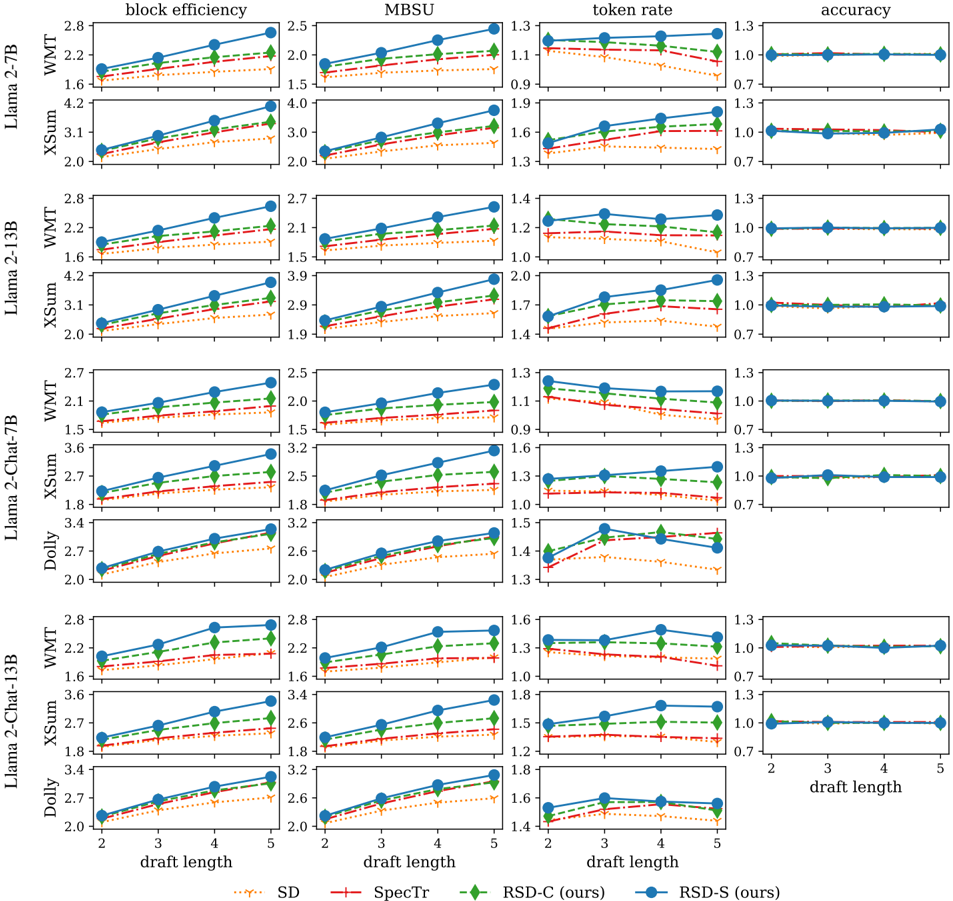
## Chart: Performance Metrics vs. Draft Length for Language Models
### Overview
This image presents a series of four charts, arranged in a 2x2 grid, comparing the performance of several language models (Llama 2-7B, Llama 2-13B, Llama 2-70B, Dolly, and Spectr) across four metrics: block efficiency, MBSU (Memory Bandwidth per Second Utilization), token rate, and accuracy. The performance is evaluated as a function of "draft length," ranging from 1 to 5. Each chart displays multiple lines representing different algorithms or configurations (SD, Spectr, RSDC-ours, RSDS-ours).
### Components/Axes
* **X-axis (all charts):** Draft Length (ranging from 1 to 5, with tick marks at each integer value).
* **Y-axis (varies by chart):**
* Block Efficiency: Scale ranges from approximately 1.5 to 2.8.
* MBSU: Scale ranges from approximately 1.4 to 4.2.
* Token Rate: Scale ranges from approximately 0.8 to 1.4.
* Accuracy: Scale ranges from approximately 0.6 to 1.3.
* **Legend (bottom-center):**
* SD (Solid Dark Red Line)
* Spectr (Dashed Dark Red Line)
* RSDC-(ours) (Solid Teal Line)
* RSDS-(ours) (Dashed Teal Line)
* **Rows (top to bottom):**
* Llama 2-7B
* Llama 2-13B
* Llama 2-70B
* Dolly
* Llama 2-Chat-13B
* **Columns (left to right):**
* Block Efficiency
* MBSU
* Token Rate
* Accuracy
### Detailed Analysis or Content Details
**Llama 2-7B:**
* **Block Efficiency:** RSDC-(ours) shows a slight upward trend, starting at approximately 1.8 and reaching around 2.2. RSDS-(ours) is relatively flat around 1.6. SD starts at ~1.7 and ends at ~2.0. Spectr is flat around 1.6.
* **MBSU:** RSDC-(ours) increases from ~1.3 to ~1.9. RSDS-(ours) is relatively flat around 1.5. SD starts at ~2.0 and ends at ~3.0. Spectr is flat around 1.5.
* **Token Rate:** RSDC-(ours) increases from ~0.9 to ~1.3. RSDS-(ours) is relatively flat around 1.1. SD starts at ~0.7 and ends at ~1.1. Spectr is flat around 0.9.
* **Accuracy:** RSDC-(ours) is relatively flat around 1.0. RSDS-(ours) is relatively flat around 0.7. SD starts at ~0.7 and ends at ~1.0. Spectr is flat around 0.7.
**Llama 2-13B:**
* **Block Efficiency:** RSDC-(ours) shows a slight upward trend, starting at approximately 2.0 and reaching around 2.4. RSDS-(ours) is relatively flat around 1.8. SD starts at ~1.8 and ends at ~2.2. Spectr is flat around 1.6.
* **MBSU:** RSDC-(ours) increases from ~1.4 to ~2.0. RSDS-(ours) is relatively flat around 1.6. SD starts at ~2.0 and ends at ~3.9. Spectr is flat around 1.9.
* **Token Rate:** RSDC-(ours) increases from ~1.1 to ~1.4. RSDS-(ours) is relatively flat around 1.2. SD starts at ~0.9 and ends at ~1.4. Spectr is flat around 1.1.
* **Accuracy:** RSDC-(ours) is relatively flat around 1.1. RSDS-(ours) is relatively flat around 0.8. SD starts at ~0.7 and ends at ~1.3. Spectr is flat around 0.7.
**Llama 2-70B:**
* **Block Efficiency:** RSDC-(ours) shows a slight upward trend, starting at approximately 2.1 and reaching around 2.5. RSDS-(ours) is relatively flat around 1.9. SD starts at ~1.8 and ends at ~2.3. Spectr is flat around 1.8.
* **MBSU:** RSDC-(ours) increases from ~1.1 to ~1.9. RSDS-(ours) is relatively flat around 1.4. SD starts at ~1.9 and ends at ~3.0. Spectr is flat around 1.5.
* **Token Rate:** RSDC-(ours) increases from ~0.9 to ~1.3. RSDS-(ours) is relatively flat around 1.1. SD starts at ~0.7 and ends at ~1.1. Spectr is flat around 0.9.
* **Accuracy:** RSDC-(ours) is relatively flat around 1.0. RSDS-(ours) is relatively flat around 0.7. SD starts at ~0.7 and ends at ~1.0. Spectr is flat around 0.7.
**Dolly:**
* **Block Efficiency:** RSDC-(ours) shows a slight upward trend, starting at approximately 2.2 and reaching around 2.6. RSDS-(ours) is relatively flat around 2.0. SD starts at ~2.0 and ends at ~2.4. Spectr is flat around 1.8.
* **MBSU:** RSDC-(ours) increases from ~1.3 to ~2.6. RSDS-(ours) is relatively flat around 1.8. SD starts at ~1.8 and ends at ~3.2. Spectr is flat around 1.8.
* **Token Rate:** RSDC-(ours) increases from ~1.0 to ~1.4. RSDS-(ours) is relatively flat around 1.2. SD starts at ~0.8 and ends at ~1.2. Spectr is flat around 1.0.
* **Accuracy:** RSDC-(ours) is relatively flat around 1.1. RSDS-(ours) is relatively flat around 0.8. SD starts at ~0.7 and ends at ~1.1. Spectr is flat around 0.7.
**Llama 2-Chat-13B:**
* **Block Efficiency:** RSDC-(ours) shows a slight upward trend, starting at approximately 2.0 and reaching around 2.4. RSDS-(ours) is relatively flat around 1.8. SD starts at ~1.8 and ends at ~2.2. Spectr is flat around 1.6.
* **MBSU:** RSDC-(ours) increases from ~1.2 to ~2.4. RSDS-(ours) is relatively flat around 1.6. SD starts at ~1.8 and ends at ~3.6. Spectr is flat around 1.9.
* **Token Rate:** RSDC-(ours) increases from ~0.9 to ~1.3. RSDS-(ours) is relatively flat around 1.1. SD starts at ~0.7 and ends at ~1.1. Spectr is flat around 0.9.
* **Accuracy:** RSDC-(ours) is relatively flat around 0.9. RSDS-(ours) is relatively flat around 0.7. SD starts at ~0.7 and ends at ~1.0. Spectr is flat around 0.7.
### Key Observations
* SD consistently exhibits higher MBSU values across all models and draft lengths.
* RSDC-(ours) generally shows an increasing trend for Block Efficiency, MBSU, and Token Rate as draft length increases.
* RSDS-(ours) tends to be relatively stable across different draft lengths for all metrics.
* Spectr consistently shows the lowest performance across all metrics.
* Accuracy is generally lower for RSDS-(ours) compared to other algorithms.
### Interpretation
The data suggests that the RSDC-(ours) algorithm demonstrates improved performance with increasing draft length, particularly in terms of block efficiency, memory bandwidth utilization, and token rate. The SD algorithm consistently provides the highest MBSU, indicating efficient memory usage. The RSDS-(ours) algorithm maintains stable performance but generally lags behind RSDC-(ours) and SD. Spectr consistently underperforms, suggesting it may not be well-suited for these tasks or requires further optimization.
The consistent upward trend of RSDC-(ours) suggests that it benefits from longer draft lengths, potentially due to increased opportunities for optimization or better utilization of available resources. The stability of RSDS-(ours) might indicate a different optimization strategy that prioritizes consistency over maximizing performance with increasing draft length. The differences in accuracy suggest that the algorithms employ different strategies for generating accurate outputs, with SD and RSDC-(ours) generally achieving higher accuracy than RSDS-(ours) and Spectr. The data highlights the trade-offs between different algorithms in terms of performance, efficiency, and accuracy, and suggests that the optimal choice of algorithm depends on the specific application and requirements.
DECODING INTELLIGENCE...