\n
## Diagram: BlocksWorld Task Decomposition
### Overview
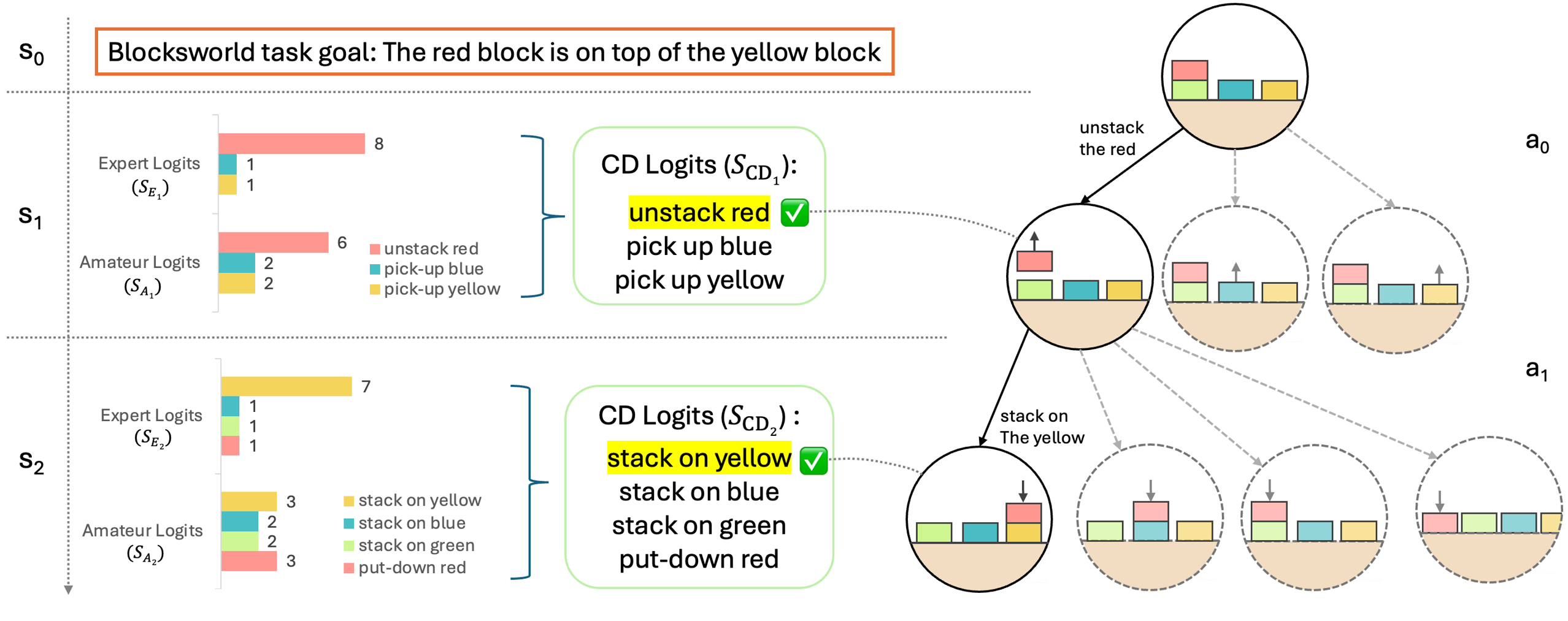
This diagram illustrates the decomposition of a BlocksWorld task – placing the red block on top of the yellow block – into a sequence of actions. It compares the action choices (logits) of "Expert" and "Amateur" agents at different stages (S0, S1, S2) of the task, and visualizes the resulting action sequences (a0, a1). The diagram shows how the agents' preferences for different actions evolve as they approach the goal.
### Components/Axes
The diagram is structured into three main vertical sections representing stages S0, S1, and S2. Each stage has two sub-sections: "Expert Logits (SE)" and "Amateur Logits (SA)". Each of these sub-sections contains a small table with numerical values. To the right of stages S1 and S2 are "CD Logits (SCD)" blocks, which show the selected action with a checkmark. The rightmost portion of the diagram shows the state transitions resulting from the selected actions, visualized as block arrangements.
* **Stages (S0, S1, S2):** Represent the progression of the task.
* **Expert Logits (SE):** Numerical values indicating the preference of an expert agent for different actions.
* **Amateur Logits (SA):** Numerical values indicating the preference of an amateur agent for different actions.
* **CD Logits (SCD):** Shows the selected action at each stage, with a checkmark indicating the chosen action.
* **Block Arrangements:** Visual representation of the state of the blocks at different stages.
* **Goal:** "The red block is on top of the yellow block" (stated at the top of the diagram).
### Detailed Analysis or Content Details
**S0 (Initial State):**
* No logits are shown for S0. The initial state is simply defined by the goal.
**S1:**
* **Expert Logits (SE):** The table shows a single value of 8. This is associated with the action "unstack red". A second value of 1 is also present.
* **Amateur Logits (SA):** The table shows values of 6, 2, and 2. These are associated with the actions "unstack red", "pick up blue", and "pick up yellow" respectively.
* **CD Logits (SCD1):** The selected action is "unstack red" (marked with a checkmark). Other options listed are "pick up blue" and "pick up yellow".
* **Action Sequence (a0):** The diagram shows the action "unstack the red" leading to a new block arrangement.
**S2:**
* **Expert Logits (SE):** The table shows a single value of 7. A second value of 1 is also present.
* **Amateur Logits (SA):** The table shows values of 3, 2, 2, and 3. These are associated with the actions "stack on yellow", "stack on blue", "stack on green", and "put-down red" respectively.
* **CD Logits (SCD2):** The selected action is "stack on yellow" (marked with a checkmark). Other options listed are "stack on blue", "stack on green", and "put-down red".
* **Action Sequence (a1):** The diagram shows the action "stack on the yellow" leading to a new block arrangement.
**Legend:**
* **unstack red:** Represented by a light purple color.
* **pick up blue:** Represented by a light blue color.
* **pick up yellow:** Represented by a light yellow color.
* **stack on yellow:** Represented by a dark blue color.
* **stack on blue:** Represented by a dark green color.
* **stack on green:** Represented by a dark red color.
* **put-down red:** Represented by a light red color.
### Key Observations
* The expert agent consistently shows a much stronger preference for the correct action ("unstack red" in S1, "stack on yellow" in S2) compared to the amateur agent.
* The amateur agent's logits are more distributed across multiple actions, indicating greater uncertainty.
* The selected actions at each stage (indicated by the checkmarks) align with the goal of placing the red block on top of the yellow block.
* The block arrangements visually demonstrate the state transitions resulting from the selected actions.
### Interpretation
This diagram demonstrates a hierarchical task decomposition approach to solving the BlocksWorld problem. The expert agent exhibits a more focused and decisive action selection process, as evidenced by the higher logits for the correct actions. The amateur agent, on the other hand, explores a wider range of actions, suggesting a less efficient or less informed strategy. The diagram highlights the importance of having a clear understanding of the task and a strong preference for the correct actions in achieving the goal. The visualization of the block arrangements provides a concrete understanding of how the actions contribute to the overall task solution. The difference in logits between the expert and amateur agents suggests that the expert has a better internal model of the task and its requirements. The diagram could be used to analyze and compare different planning algorithms or agent architectures.