## Line Chart: Paper Folding Accuracy vs. Training Samples
### Overview
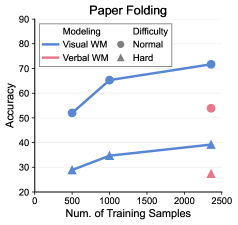
The chart illustrates the relationship between accuracy and the number of training samples for different modeling approaches and difficulty levels in a paper folding task. Accuracy is plotted on the y-axis (0–90), and training samples are on the x-axis (0–2500). Four data series are represented: Modeling (blue line), Verbal WM (red line), Normal (gray line), and Hard (triangle markers).
### Components/Axes
- **Y-axis**: Accuracy (0–90, increments of 10).
- **X-axis**: Number of Training Samples (0–2500, increments of 500).
- **Legend**: Located in the top-right corner. Colors and markers:
- Blue line: Modeling
- Red line: Verbal WM
- Gray line: Normal
- Triangle markers: Hard
### Detailed Analysis
1. **Modeling (Blue Line)**:
- Starts at ~50 accuracy with 500 samples.
- Increases steadily to ~70 accuracy at 2500 samples.
- Slope: Positive, linear trend.
2. **Verbal WM (Red Line)**:
- Starts at ~30 accuracy with 500 samples.
- Rises to ~40 accuracy at 2500 samples.
- Slope: Positive but less steep than Modeling.
3. **Normal (Gray Line)**:
- Flat line at ~30 accuracy across all sample counts.
- No variation observed.
4. **Hard (Triangle Markers)**:
- Flat line at ~25 accuracy across all sample counts.
- No variation observed.
### Key Observations
- **Modeling** shows the strongest improvement with increased training samples.
- **Verbal WM** demonstrates moderate improvement but lags behind Modeling.
- **Normal** and **Hard** difficulty levels remain static, suggesting no dependency on training data volume.
### Interpretation
The data indicates that **Modeling** benefits most from additional training samples, achieving a 20-point accuracy gain (50→70). **Verbal WM** also improves but at a slower rate (30→40), implying potential limitations in its learning mechanism. The **Normal** and **Hard** difficulty levels show no improvement, suggesting they may represent fixed constraints (e.g., inherent task difficulty) rather than variables influenced by training. This could imply that certain aspects of the paper folding task (e.g., physical constraints) are unresponsive to iterative learning, while others (e.g., pattern recognition) are highly trainable. The divergence between Modeling and Verbal WM highlights the importance of task-specific modeling strategies.