## Flowchart: Conventional Content Analysis
### Overview
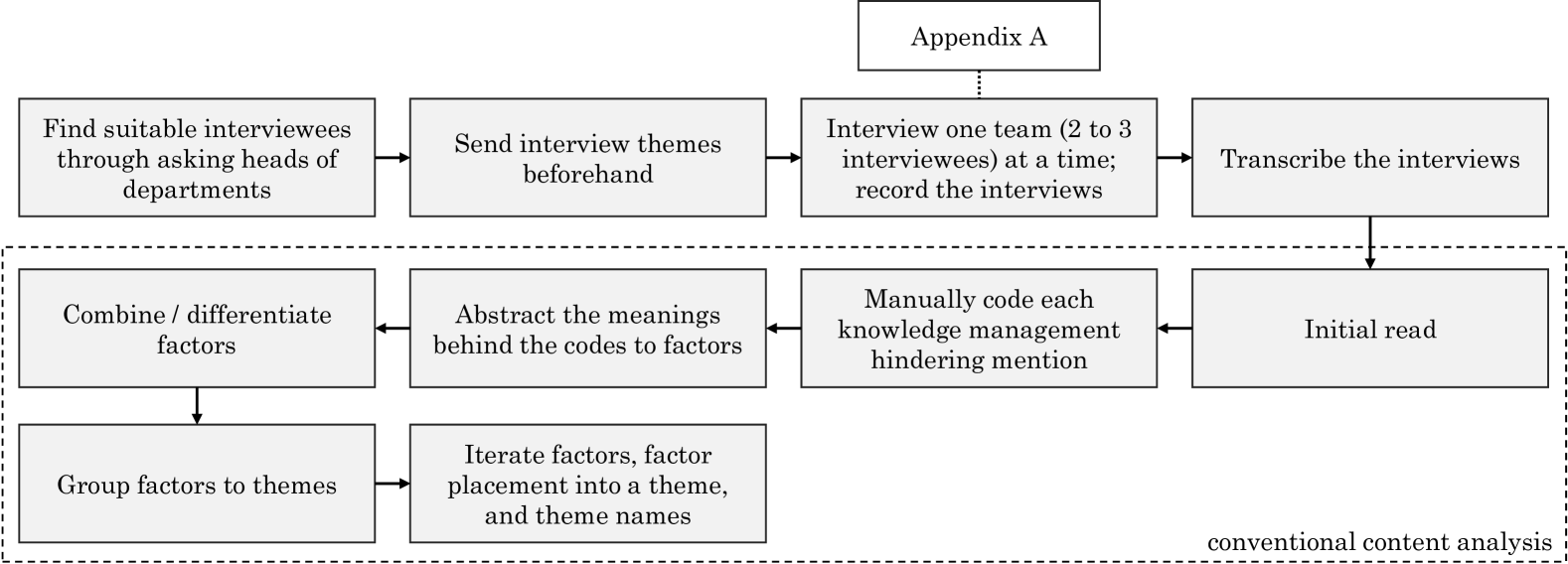
The image is a flowchart illustrating the steps involved in a conventional content analysis process. It outlines the process from identifying interviewees to grouping factors into themes.
### Components/Axes
The flowchart consists of rectangular boxes representing different stages of the analysis, connected by arrows indicating the flow of the process. The flowchart is divided into two sections, separated by a dashed line. The top section focuses on data collection, while the bottom section focuses on data analysis.
* **Boxes:** Each box contains a description of a specific step in the process.
* **Arrows:** Arrows indicate the direction of the workflow.
* **Appendix A:** A box at the top center labeled "Appendix A" is connected to the "Interview one team..." box with a dotted line.
* **Dashed Line:** A dashed line separates the data collection and data analysis phases.
* **"conventional content analysis"**: Text in the bottom right corner indicates the type of analysis.
### Detailed Analysis or ### Content Details
**Top Section (Data Collection):**
1. **Find suitable interviewees through asking heads of departments:** The process begins by identifying potential interviewees through departmental heads.
2. **Send interview themes beforehand:** Interview themes are sent to the interviewees in advance.
3. **Interview one team (2 to 3 interviewees) at a time; record the interviews:** Interviews are conducted with teams of 2-3 people, and the interviews are recorded.
4. **Transcribe the interviews:** The recorded interviews are transcribed.
**Bottom Section (Data Analysis):**
1. **Initial read:** The transcribed interviews are initially read.
2. **Manually code each knowledge management hindering mention:** Each mention of knowledge management hindering factors is manually coded.
3. **Abstract the meanings behind the codes to factors:** The meanings behind the codes are abstracted to identify factors.
4. **Combine / differentiate factors:** Factors are combined or differentiated.
5. **Group factors to themes:** Factors are grouped into themes.
6. **Iterate factors, factor placement into a theme, and theme names:** The factors, their placement into themes, and the theme names are iterated upon.
**Flow Direction:**
* The top section flows from left to right.
* The bottom section flows from right to left initially, then down, and then left to right.
### Key Observations
* The process is iterative, as indicated by the arrow looping back from "Iterate factors..." to "Abstract the meanings...".
* The dashed line separates the data collection and data analysis phases.
* The "Appendix A" box suggests that additional information or resources are available in the appendix.
### Interpretation
The flowchart provides a clear and concise overview of the conventional content analysis process. It highlights the key steps involved in collecting and analyzing data from interviews. The iterative nature of the analysis is emphasized, suggesting that the process is not always linear and may require revisiting earlier steps. The reference to "Appendix A" implies that the flowchart is part of a larger document or study, and that additional details can be found in the appendix. The process begins with identifying interviewees and ends with grouping factors into themes, demonstrating a systematic approach to qualitative data analysis.