\n
## Diagram: Research Interview and Conventional Content Analysis Process Flowchart
### Overview
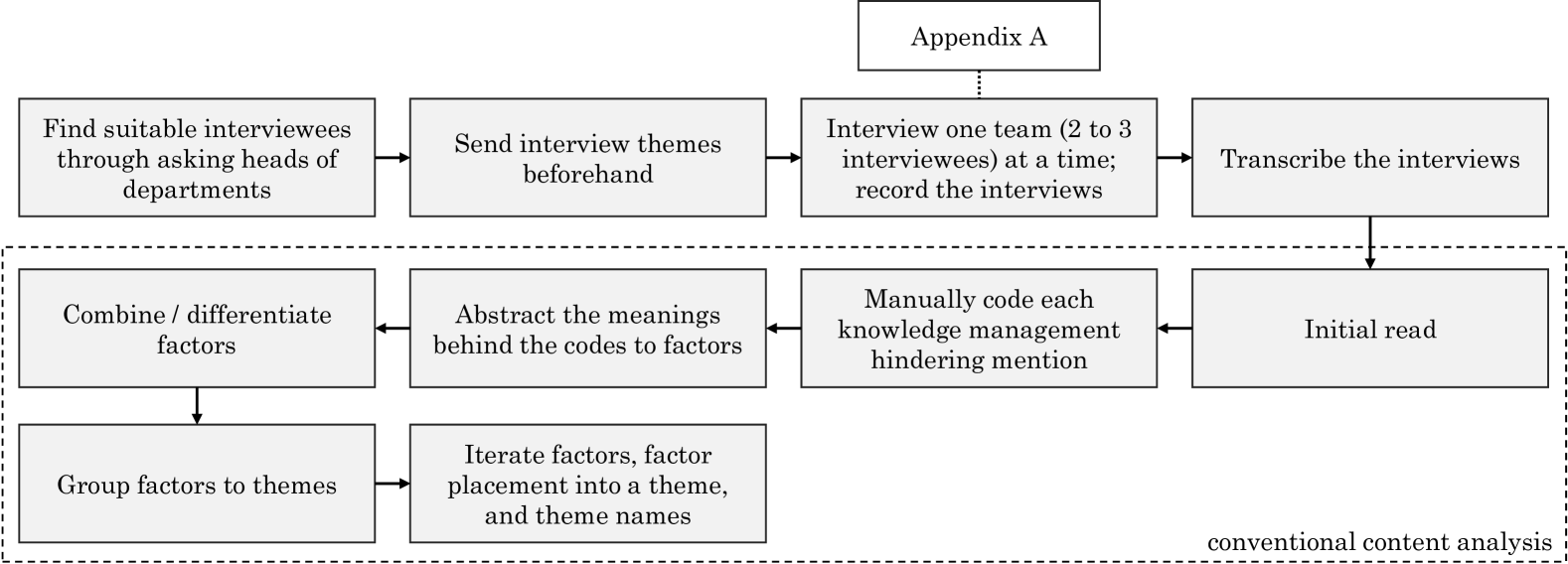
The image displays a two-part process flowchart illustrating a research methodology. The top section outlines a sequential interview process, while the bottom section, enclosed in a dashed box, details a "conventional content analysis" procedure that follows the interview transcription. The flow is indicated by directional arrows connecting rectangular process boxes.
### Components/Axes
The diagram consists of rectangular boxes containing process steps, connected by solid arrows indicating flow direction. A dashed box encloses the lower section. A separate box labeled "Appendix A" is connected via a dashed line to one of the interview steps.
**Top Row (Interview Process - Left to Right Flow):**
1. **Box 1 (Far Left):** "Find suitable interviewees through asking heads of departments"
2. **Box 2:** "Send interview themes beforehand"
3. **Box 3:** "Interview one team (2 to 3 interviewees) at a time; record the interviews"
* **Connected Element:** A box labeled "Appendix A" is positioned above this box, connected by a vertical dashed line.
4. **Box 4 (Far Right):** "Transcribe the interviews"
**Bottom Section (Conventional Content Analysis - Enclosed in Dashed Box):**
* **Label:** The text "conventional content analysis" is located in the bottom-right corner, inside the dashed box.
* **First Row (Right to Left Flow):**
1. **Box 5 (Right):** "Initial read"
2. **Box 6:** "Manually code each knowledge management hindering mention"
3. **Box 7:** "Abstract the meanings behind the codes to factors"
4. **Box 8 (Left):** "Combine / differentiate factors"
* **Second Row (Left to Right Flow):**
1. **Box 9 (Left, below Box 8):** "Group factors to themes"
2. **Box 10 (Right):** "Iterate factors, factor placement into a theme, and theme names"
### Detailed Analysis
The process is a linear sequence with a defined sub-process.
1. **Interview Phase (Top Row):**
* **Step 1:** Identification of participants via department heads.
* **Step 2:** Pre-interview preparation by sending themes.
* **Step 3:** Data collection via team interviews (2-3 people), with recording. The "Appendix A" reference suggests supplementary materials (e.g., interview guides, consent forms) are associated with this step.
* **Step 4:** Data preparation through transcription.
2. **Analysis Phase (Bottom Dashed Box - "conventional content analysis"):**
* The flow from "Transcribe the interviews" (Box 4) leads into "Initial read" (Box 5), marking the transition from data collection to analysis.
* **Step 5:** Familiarization with the data via an initial read.
* **Step 6:** Detailed coding, specifically targeting mentions of "knowledge management hindering" factors.
* **Step 7:** Abstraction from specific codes to more general "factors."
* **Step 8:** Refinement of factors through combination or differentiation.
* **Step 9:** Thematic development by grouping the refined factors.
* **Step 10:** Final iteration and naming of themes, which includes reviewing factor placement.
### Key Observations
* **Spatial Layout:** The interview process flows left-to-right across the top. The analysis process is contained within a distinct dashed box, with its internal flow moving right-to-left in the first row and then left-to-right in the second row, creating a "U-shaped" or recursive visual pattern.
* **Process Linkage:** A single arrow connects the final interview step ("Transcribe the interviews") to the first analysis step ("Initial read"), clearly showing the handoff between phases.
* **Specificity:** The coding step (Box 6) is highly specific, focusing on "knowledge management hindering mention," indicating the research has a defined thematic focus on barriers to knowledge management.
* **Iterative Nature:** The final step (Box 10) explicitly mentions iteration, highlighting that qualitative analysis is not strictly linear but involves revisiting and refining categories.
### Interpretation
This flowchart depicts a systematic, two-stage qualitative research methodology. The first stage is a structured interview protocol designed to gather data from teams within an organization. The second stage employs a **conventional content analysis** approach, which is inductive and grounded in the data itself.
The process suggests a rigorous approach to understanding barriers ("hindering mentions") to knowledge management. The flow from specific interview transcripts to initial codes, then to abstracted factors, and finally to grouped themes illustrates the core inductive logic of qualitative analysis: moving from concrete observations to conceptual understanding.
The inclusion of an "Appendix A" and the explicit mention of recording interviews point to a concern for methodological rigor and auditability. The iterative final step is crucial, as it acknowledges that theme development is an interpretive process requiring refinement. The dashed box around the analysis phase visually separates it as a distinct, self-contained analytical engine that transforms raw interview data into structured thematic findings.