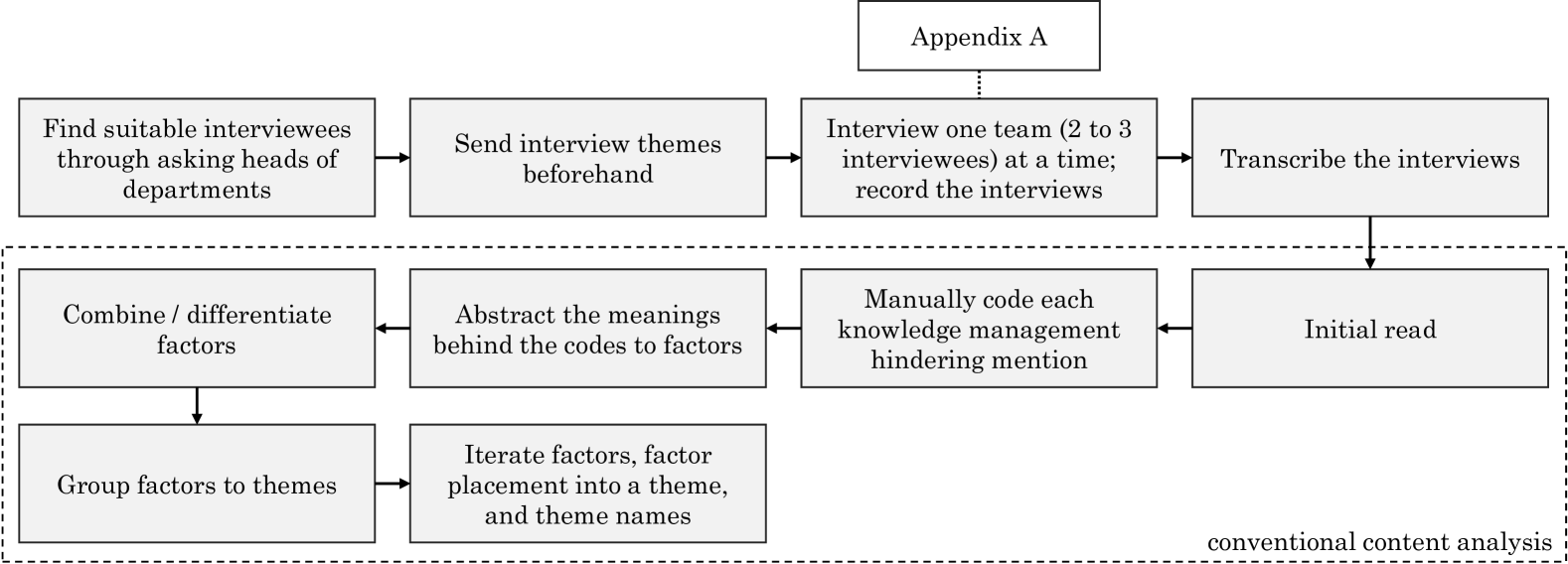
## Flowchart: Conventional Content Analysis Process
### Overview
The image depicts a two-phase flowchart for conducting conventional content analysis. The process is divided into two sections by a dotted line:
1. **Top Section**: Data collection and transcription (steps 1–4)
2. **Bottom Section**: Thematic analysis and coding (steps 5–10)
An appendix (Appendix A) is referenced but not detailed in the diagram.
---
### Components/Axes
- **Process Steps**:
- **Top Section**:
1. Find suitable interviewees through asking heads of departments
2. Send interview themes beforehand
3. Interview one team (2–3 interviewees) at a time; record the interviews
4. Transcribe the interviews
- **Bottom Section**:
5. Initial read
6. Manually code each knowledge management hindering mention
7. Combine/differentiate factors
8. Group factors to themes
9. Abstract the meanings behind the codes to factors
10. Iterate factors, factor placement into a theme, and theme names
- **Connectors**:
- Solid arrows indicate sequential flow (e.g., Step 4 → Step 5).
- Dashed arrows connect the top and bottom sections (e.g., Step 4 → Step 5).
- **Appendix**:
- Labeled "Appendix A" at the top, but no content is provided.
---
### Detailed Analysis
1. **Data Collection Phase (Top Section)**:
- Starts with identifying interviewees via department heads.
- Themes are shared with interviewees beforehand to standardize responses.
- Interviews are conducted in small groups (2–3 people) and recorded.
- Transcription follows immediately after interviews.
2. **Analysis Phase (Bottom Section)**:
- **Initial Read**: Review transcribed data to familiarize with content.
- **Manual Coding**: Identify mentions related to "knowledge management hindering."
- **Factor Grouping**: Aggregate codes into broader factors.
- **Theme Development**: Group factors into themes and refine theme names.
- **Iterative Refinement**: Abstract meanings from codes to factors and refine theme placements.
---
### Key Observations
- **Phase Separation**: The dotted line visually distinguishes data collection (top) from analysis (bottom).
- **Iterative Process**: Step 10 ("Iterate factors...") suggests a cyclical refinement process.
- **Manual Coding**: Emphasizes human interpretation over automated tools.
- **Appendix A**: Likely contains supplementary details (e.g., interview guides, coding frameworks).
---
### Interpretation
This flowchart outlines a **systematic qualitative research methodology** for content analysis. The two-phase structure ensures:
1. **Standardization**: Predefined themes (Step 2) reduce interviewer bias.
2. **Rigor**: Manual coding and iterative refinement (Steps 6–10) prioritize depth over speed.
3. **Thematic Focus**: The process culminates in abstracting meanings (Step 9), aligning with grounded theory principles.
The absence of numerical data or statistical tools reinforces its qualitative nature. The flowchart could represent a framework for studying organizational knowledge management challenges, as implied by the focus on "knowledge management hindering mentions."